
NGX Market Review & Outlook: Earnings Growth, Dividend Capacity, and Stronger Liquidity to Justify Further Repricing
By Market Formula Editorial Team / August 2026
Introduction
Transactions on the floor of the Nigerian Exchange (NGX) last week closed on a positive note with 0.12% growth, week on week. Year to date, the stock market has returned 57.81%, with the All-Share Index and Market Capitalisation at 245,573.60 points and N158.513 trillion respectively.
On the surface, a 0.12% weekly gain appears inconsequential. Beneath the headline, however, the market is sending a more important signal: the rally remains intact, but its character is changing. Liquidity is rotating, sector leadership is narrowing, and investor conviction is becoming increasingly selective. The central question is no longer whether Nigerian equities remain bullish—they do. The more consequential question is whether the rally has sufficient fundamental depth to sustain its extraordinary year-to-date advance.
The answer is cautiously affirmative, but with diminishing room for indiscriminate upside.
This NGX market review August 2026 breaks down what is driving the current market dynamics, the performance of key earnings releases, the outlook for the new week, and specific stocks to watch.
Let’s examine the NGX market review August 2026 with clarity and strategic discipline.
1. Market Structure: The 0.12% Weekly Gain and What It Really Means
The Nigerian equities market ended the week of August 7 on a positive note, with the All-Share Index rising a modest 0.12% to 245,573.60 points and extending its year-to-date gain to an impressive 57.81%. Market capitalisation also increased marginally to N158.51 trillion.
Banking Sector Leadership
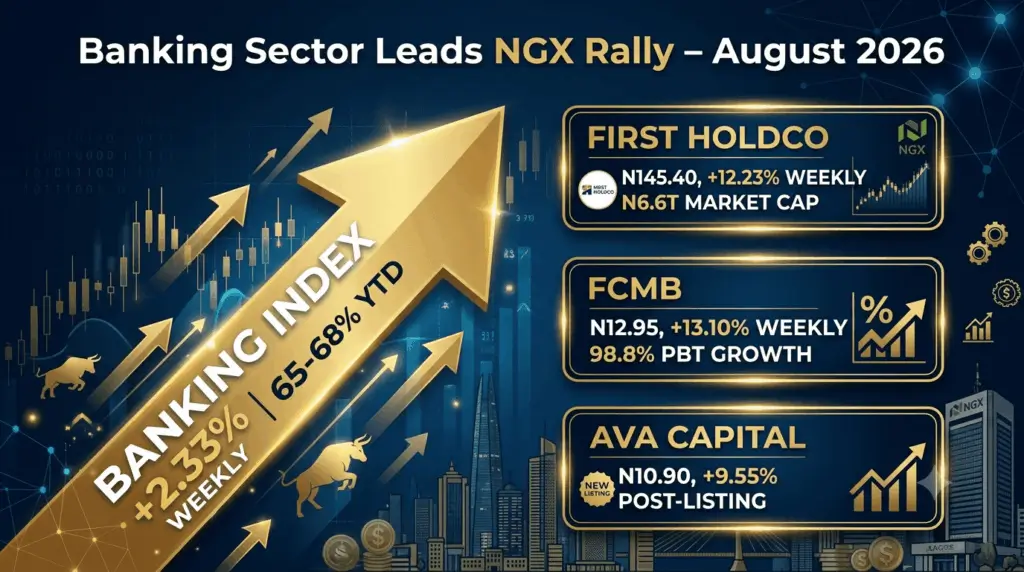
Banking stocks remain the principal engine of market momentum. The Banking Index gained 2.33% during the week, reflecting renewed demand for financial stocks amid expectations of stronger earnings, improved capital positions and balance-sheet expansion following the sector’s recapitalisation cycle.
First HoldCo rose 12.23% to close at N145.40 per share, while FCMB advanced 13.10% to N12.95, underscoring investor preference for institutions with compelling earnings and capital-restructuring narratives.
This rotation is significant. A rally led by companies with improving earnings capacity and stronger balance sheets is fundamentally more durable than one sustained primarily by speculative momentum. Nigeria’s banking recapitalisation programme, resilient profitability, and the prospect of expanded lending capacity provide a credible fundamental foundation for continued sector leadership.
Market Breadth Weakness
Yet the headline index conceals a growing weakness: market breadth.
Only 26 equities appreciated during the week, compared with 63 decliners, while 58 stocks remained unchanged. The implication is clear. The market is no longer rising as a broad-based tide; capital is becoming concentrated in selected large-cap and high-momentum names.
Trading statistics reinforce the caution. Although volume increased 4.69% to 5.36 billion shares, total value traded fell sharply by 65.64% to N139.05 billion, while the number of deals declined by 8.19%. The divergence between volume and value suggests that the market’s headline advance is not being accompanied by a commensurate expansion in broad-based conviction.
In other words, the rally has not disappeared. It is migrating.
Macroeconomic Environment
The macroeconomic environment, meanwhile, is becoming incrementally more supportive. Nigeria’s Composite PMI rose to 51.1 in July from 50.1 in June, marking a third consecutive month of expansion. At the same time, declining FGN bond yields across maturities indicate improving demand and liquidity conditions in the fixed-income market. If sustained, this could gradually improve the relative attractiveness of equities, particularly for companies positioned to convert economic recovery into stronger earnings.
The Foreign-Exchange Caveat
The foreign-exchange market remains the principal caveat. The naira strengthened in the official market to approximately N1,365.69/,whiletheparallel−marketrateweakenedtoaroundN1,420/. The resulting divergence indicates that, despite improvements in official-market conditions, underlying dollar demand and currency uncertainty have not been completely extinguished. For companies with substantial foreign-currency liabilities, imported inputs or translation exposure, exchange-rate volatility remains a meaningful threat to earnings quality and valuation.
The Sustainability Equation
Consequently, the sustainability equation is becoming more demanding. After a 57.81% year-to-date appreciation, valuation discipline can no longer be treated as a secondary consideration. The market requires a second leg of confirmation through earnings growth, dividend capacity, stronger liquidity and broader participation to justify further material repricing.
       ┌────────────────────────────────────────────────────────┐
       │         NGX MARKET REVIEW AUGUST 2026 – KEY SIGNALS    │
       └───────────────────────────┬────────────────────────────┘
                                   │
         ┌─────────────────────────┼─────────────────────────┐
         ▼                         ▼                         ▼
  [ BANKING LEADS ]          [ BREADTH WEAKENS ]        [ SUSTAINABILITY ]
  Banking Index +2.33%       26 gainers vs 63           Earnings growth and
  First HoldCo +12.23%       decliners – narrow         dividend capacity
  FCMB +13.10%               leadership                 now critical
2. What Is Driving the Growth in AVA Capital and FCMB?
The strong market reception experienced both by AVA Capital and FCMB is based on the companies’ impressive outlook and resilient performance alongside revenue growth.
AVA Capital: A New Listing with Scarcity Premium
Following its official admission to the Nigerian Exchange Group (NGX) Main Board on July 31, AVA Capital has offered a compelling investor demand amid scarcity, with improving fundamentals converging into accelerating price discovery. Listed at N7.50 per share, AVA Capital entered the quoted market at a time when investors are demonstrating renewed appetite for financial-services companies with scalable business models, expanding balance sheets and credible earnings trajectories.
The early interest in the stock cannot be explained by the listing alone. The more compelling story is the interaction between limited market free-float and accelerating investor demand. By August 5, AVA Capital had climbed 9.55% to N10.90, from N9.95.
The Scarcity Dynamic
Where the quantity of shares readily available for trading is relatively constrained, even moderate incremental demand can exert a disproportionate influence on price. This is a classic supply-demand dynamic: when prospective buyers materially exceed the volume of stock available from willing sellers, the market must search for a higher clearing price.
In AVA’s case, that scarcity effect appears to be intersecting with a fundamentally stronger earnings story.
Earnings Performance
AVA Capital’s first-half performance strengthens that proposition considerably. Revenue growth was accompanied by a substantial expansion in profitability, with profit-before-tax margin rising to 71.3% from 33.6% in the comparable period, while net profit margin increased to 52.7% from 24.9%.
Those numbers are more significant than the headline growth rate itself. They indicate that AVA is not merely expanding its revenue base; it is converting a greater proportion of each naira of revenue into profit. That points to improving operating leverage, stronger earnings conversion and disciplined cost absorption as the business scales.
Balance Sheet Expansion
The second major driver is the extraordinary expansion of the balance sheet. Total assets increased approximately 5.8 times to N110.96 billion, from N19.14 billion at FY2025. Such an expansion materially changes the scale at which the Group can operate. The growth was driven principally by higher client funds under management and increased financial assets held for investment, pointing to a substantial increase in the financial resources being intermediated through the platform.
FCMB Group: Earnings-Led Re-Rating
The recent strength in FCMB reflects more than the broader bullish sentiment sweeping across Nigeria’s banking stocks coupled with market respond to a fundamental change in the Group’s earnings trajectory with FCMB generating more income from a larger balance sheet, converting that income into substantially higher profits and strengthening shareholders’ equity at the same time.
H1 2026 Results
FCMB’s unaudited first-half 2026 results provide the clearest evidence. Gross earnings increased 27.8% year-on-year to N676.18 billion, from N529.20 billion in H1 2025. More importantly, the quality of revenue growth improved materially. Interest income rose 31% to N600.52 billion, while net interest income surged 71.8% to N356.35 billion. At the same time, net fee and commission income climbed 32.1% to N50.06 billion, reinforcing the contribution of non-interest income to the Group’s earnings architecture.
Operational Efficiency
This is an important distinction. FCMB is not simply growing its top line; it is widening the amount of income retained after funding costs. Interest expense actually declined 2.7% year-on-year despite the expansion in earning assets. That improvement reflects a more favourable funding structure, with low-cost deposits accounting for 74.9% of customer deposits, up from 65.4% at December 2025. Customer deposits themselves increased 11.4% to N4.92 trillion, while earning assets expanded 22% to N5.98 trillion.
Profitability Acceleration
The most compelling element of the H1 performance is the acceleration in profitability. Profit before tax almost doubled, rising 98.8% to N157.3 billion, compared with N79.1 billion a year earlier. Profit after tax increased approximately 90.5% to N139.9 billion. The magnitude of the increase demonstrates that the Group’s earnings growth is significantly outpacing its revenue expansion. A 27.8% increase in gross earnings producing almost 100% growth in PBT suggests that the incremental naira of revenue is generating disproportionately more profit. The Group’s cost-to-income ratio improved to 41.4%, indicating that operating efficiency is becoming an increasingly important contributor to earnings quality.
Asset Quality Improvement
Even more telling is that this performance was achieved despite a substantial increase in impairment charges, which rose to N85.93 billion from N36.22 billion. Rather than disguising credit costs, FCMB has been accelerating the clean-up of legacy loans, with the banking subsidiary’s non-performing-loan ratio falling to 5.2%. This introduces an important layer to the investment thesis: the Group is simultaneously growing earnings and strengthening asset quality.
Earnings Per Share
Perhaps the most direct indicator of improving shareholder economics is earnings per share. FCMB’s H1 2026 EPS increased to N4.23 from N3.70 in H1 2025. That represents an increase of approximately 14.3%, and it is particularly noteworthy because the Group’s post-recapitalisation share base is larger. In other words, FCMB has not merely generated more absolute profit; it has increased the earnings attributable to each share despite a larger equity base. That is a more meaningful measure of value creation for existing and prospective shareholders.
Against this fundamental backdrop, FCMB’s movement towards its recent market high of N12.95, compared with its 52-week low of N9.50, becomes more understandable. The price action represents a market attempting to incorporate the company’s improved earnings power into its valuation.
3. Is First HoldCo a Good Buy at N145.40?
At N145.40 per share, FirstHoldCo sits just 3.1% below its N150.00 market high, placing the stock firmly in price-discovery territory. Yet the proximity to its peak does not, by itself, make the shares expensive. The more important consideration is whether the company’s exceptional earnings trajectory and improving investor confidence are strong enough to support a valuation beyond the current high.
The Fundamental Evidence
FirstHoldCo reported N1.93 trillion in H1 2026 gross earnings, up 16.7% year-on-year, while profit before tax surged 83.5% to N653.5 billion and operating income rose 25.8% to N1.38 trillion. Non-interest income also increased to N497.1 billion, demonstrating that earnings growth is becoming increasingly diversified.
This is important for valuation because the market is increasingly rewarding earnings quality rather than headline revenue growth alone.
Market Capitalisation Milestone
FirstHoldCo first crossed the N6 trillion threshold on August 3, 2026, when it traded at N134 per share. By August 7, its market capitalisation had reached approximately N6.61 trillion to N6.71 trillion after its shares closed at N148.35. The stock has surged approximately 180% since the beginning of the year.
Sustainability of the Rally
The move towards N150 suggests that investors are increasingly willing to pay a premium for FirstHoldCo’s improved earnings power and strategic positioning. The market is effectively asking whether today’s profits represent a temporary earnings peak or the beginning of a structurally stronger profitability cycle.
Key Structural Drivers Supporting Medium-to-Long-Term Sustainability:
- Earnings Breakthrough: FirstHoldCo reported a record N653.5 billion pre-tax profit for H1 2026, with Profit After Tax surging 81.6% to N526.1 billion
- Balance Sheet & Asset Quality Transformation: Impairment charges dropped significantly, while the group recovered substantial amounts from legacy non-performing loans
- Recapitalisation Progress: The group’s Capital Adequacy Ratio (CAR) has rebounded, significantly de-risking the group relative to CBN deadlines
- Non-Funded Income Resilience: Non-interest income soared to N497.1 billion, driven by electronic banking services, trade finance, and proprietary investment gains
Key Risks to Sustainability:
- Overbought Technical Indicators: Rallies exceeding 100% in a single month frequently encounter sharp profit-taking waves
- Contrasting Dividend Yield: High-net-worth liquidity could periodically rotate toward higher-yielding Tier-1 peers
Investment Verdict
At N145.40, FirstHoldCo remains fundamentally attractive, but it is no longer a low-risk entry point. For a medium to long-term investor, the stock can still be considered a “BUY/ACCUMULATE”, particularly on evidence of continued earnings strength and institutional demand. However, investors entering purely because the stock is approaching N150 should exercise caution: proximity to an all-time 52-week high can increase the probability of short-term profit-taking.
The more sophisticated strategy is therefore to buy the fundamentals, not chase the price. If FirstHoldCo sustains its earnings momentum, the N150 level could ultimately become a stepping stone rather than a ceiling.
4. Why Is the Share Price of Zichis Trending Down?
The recent decline in Zichis appears less a reflection of weakening fundamentals than a valuation and momentum correction following an extraordinary price rally.
The Fundamental Story
Zichis delivered a remarkable H1 2026 performance, with revenue rising to approximately N910.5 million and profit after tax reaching about N457 million, representing several-fold year-on-year growth. The results highlight the growing contribution of the company’s integrated agro-processing investments and reinforce the strength of its underlying business.
The Valuation Correction
However, the stock’s exceptional earnings growth was accompanied by an even more aggressive expansion in its market valuation. From its January listing price, Zichis embarked on an extraordinary rally, eventually reaching a reported 52-week high of N40.35. At such elevated levels, the stock became increasingly vulnerable to profit-taking and valuation compression.
Its subsequent retreat toward the N20–N26 region—trading at N20.76 as of August 5, 2026—signals a significant technical reset. The stock lost 9.74% in a single session, slipping from N23.00 to N20.76.
Broader Market Pressure
The broader NGX market correction has also intensified the pressure. After months of exceptional gains, investors have increasingly moved to lock in profits, particularly across small and mid-cap momentum stocks. Consequently, even companies delivering strong earnings can experience substantial price declines as investors reassess valuations, risk and future growth expectations.
Corporate Action Consideration
The 1-for-1 bonus issue and 20-kobo dividend should also be considered when interpreting Zichis’ historical price movements. The bonus increased shareholders’ number of shares, while the market adjusted the share price to reflect the corporate action. As a result, comparisons based solely on unadjusted historical prices can distort the true magnitude of the stock’s performance.
Zichis therefore presents a compelling market paradox: fundamentally stronger, yet technically weaker and undergoing valuation compression. The current downward trend is best interpreted as a price-discovery and profit-taking phase rather than definitive evidence of fundamental deterioration.
5. Is Cadbury a Good Buy at N58.10?
At N58.10 per share, Cadbury presents a more compelling risk-reward proposition for medium to long-term investors, following its retreat from a 52-week high of N75.25. The decline of roughly 23% from its peak has created a significantly lower entry point, as investors reassess the company’s earnings trajectory, margins and valuation.
The Earnings Picture
Cadbury’s first-half 2026 results provide a mixed picture. Revenue rose to approximately N83.35 billion, from N77.25 billion in the corresponding period, indicating continued top-line growth. However, profit after tax declined to N8.11 billion, compared with N10.17 billion previously.
That deterioration filtered through to earnings per share, which fell from N4.46 to N3.56, representing a decline of approximately 20.2%. For investors, this is the central weakness in the current investment case. Revenue growth is encouraging, but it becomes less meaningful when rising input, distribution and operating costs prevent that growth from translating into stronger profitability.
The Risk-Reward Equation
Despite the earnings decline, the recent share-price correction has changed the risk-reward equation. Cadbury retains a portfolio of established consumer brands and significant revenue-generating capacity. If management succeeds in improving operating efficiency, restoring margins and returning EPS to a sustainable growth trajectory, the current share price could provide attractive upside for investors willing to look beyond near-term earnings weakness.
Investment Verdict
At N58.10, Cadbury is arguably approaching a strategic accumulation zone for medium- to long-term investors, particularly those comfortable with near-term earnings volatility. However, calling it an unequivocal “buy” would be premature. The company must still prove that revenue growth can translate into stronger margins, earnings and cash generation.
For investors willing to take a measured position, the current weakness offers an opportunity to accumulate gradually rather than chase the stock after a recovery. Confirmation would come from margin improvement, renewed EPS growth and a sustained recovery above the stock’s moving-average zone.
6. Stocks to Watch
Considering the week ahead, possible stocks to place on the investment radar includes:
Tier-1 Banking & Dividend Catalysts
| Stock | Catalyst |
|---|---|
| First HoldCo (FIRSTHOLD) | Trading at N145.40, up 12.23% for the week. Strong earnings trajectory and institutional demand continue to drive momentum |
| Zenith Bank | Trading around N126.50. Board meeting scheduled to consider H1 results and interim dividend |
| Access Holdings | Priced at ~N29.20 (~2.1x P/E, 0.4x P/B). Deep discount to underlying net asset value |
| FCMB Group | Closed at N12.95, up 13.10% for the week. Strong H1 results with PBT up 98.8% |
| GTCO | Consistent dividend history and strong fintech expansion |
| Wema Bank | Mid-tier banking play with growing digital presence |
New Listing & Growth Plays
| Stock | Catalyst |
|---|---|
| AVA Capital | Recent Main Board listing at N7.50; traded at N10.90 on August 5 (+9.55%). Scarcity premium + strong earnings conversion |
| NGX Group | Record H1 performance with revenue up 118% and PBT up 170%. Declared N1.30 per share interim dividend |
Telecom & Industrial Heavyweights
| Stock | Catalyst |
|---|---|
| MTN Nigeria | Telecom recovery play; strong H1 earnings with revenue up 25.9% to N2.99 trillion |
| Dangote Cement | H1 2026 revenue of N2.514 trillion (+21.4%) and PAT of N638.5 billion (+22.7%) |
Healthcare & Insurance
| Stock | Catalyst |
|---|---|
| Neimeth | Healthcare sector player with defensive characteristics |
| May & Baker | Pharmaceutical company with growth potential |
Technology & Other Plays
| Stock | Catalyst |
|---|---|
| CWG Plc | Trading ~18% below its 52-week high, offering exposure to rising technology adoption |
| ETI (Ecobank Transnational) | Pan-African banking exposure |
| Meyer | Consumer goods player |
7. Action Plan for Investors (Week of August 10–14, 2026)
Step 1: Focus on earnings catalysts.
Prioritise Tier-1 banking counters (Zenith, Access) that have board meetings scheduled to approve H1 numbers and interim dividends.
Step 2: Be selective in banking.
With the Banking Index up 65–68% year-to-date, some profit-taking is expected, but fundamentally sound banks remain accumulation targets.
Step 3: Monitor new listings.
AVA Capital’s price discovery phase presents both opportunity and risk. Watch for volume and institutional participation.
Step 4: Look for quality at a discount.
Cadbury at N58.10 and Zichis post-correction may offer strategic accumulation opportunities for patient investors.
Step 5: Stay disciplined.
The market is shifting from broad speculative buying to disciplined, stock-specific positioning. Quality of gains matters more than size.
8. Final Summary & The Bottom Line
The NGX market review August 2026 reveals a market in transition. The 0.12% weekly gain and 57.81% year-to-date return demonstrate the resilience of the Nigerian equities market. However, the rally is becoming increasingly selective, with banking stocks leading the charge while market breadth weakens.
  ┌──────────────────────────────────────────────────────────┐
  │        NGX MARKET REVIEW AUGUST 2026 – KEY TAKEAWAYS     │
  ├─────────────────────┬────────────────────────────────────┤
  │ Weekly Performance  │ ASI +0.12% to 245,573.60          │
  │                     │ Market Cap: N158.513 trillion     │
  ├─────────────────────┼────────────────────────────────────┤
  │ Year-to-Date        │ +57.81% return                    │
  ├─────────────────────┼────────────────────────────────────┤
  │ Banking Sector      │ +2.33% weekly | +65-68% YTD      │
  ├─────────────────────┼────────────────────────────────────┤
  │ Top Performers      │ First HoldCo +12.23% | FCMB       │
  │                     │ +13.10% | AVA Capital +9.55%     │
  ├─────────────────────┼────────────────────────────────────┤
  │ Market Breadth      │ 26 gainers vs 63 decliners –      │
  │                     │ narrow leadership                 │
  ├─────────────────────┼────────────────────────────────────┤
  │ Key Themes          │ Earnings growth, dividend         │
  │                     │ capacity, sector rotation         │
  └─────────────────────┴────────────────────────────────────┘
The Bottom Line:
The Nigerian equities market appears to be entering a maturity phase of the rally—a stage in which sector rotation and company-specific fundamentals will increasingly determine returns. Banking stocks remain the strongest leadership group, while weakness in insurance, consumer goods and other lagging segments could eventually create selective opportunities where valuations are supported by credible earnings prospects.
The investment message is therefore becoming more nuanced: the next phase of Nigeria’s bull market may be won less by simply remaining invested and more by being correctly positioned. The bull remains alive, but the burden of proof has changed. For the rally to become genuinely sustainable, corporate earnings must catch up with elevated expectations, market breadth must improve, liquidity must deepen and investor optimism must increasingly give way to fundamental conviction.
The Nigerian market can still move higher. But from these levels, the quality of the gains will matter more than the size of the gains.
For more weekly NGX updates and strategy guides, explore our market trends and analysis archive.
Disclaimer: This article is for informational purposes only and does not constitute investment advice. Always conduct your own research or consult a qualified financial advisor before investing. Past performance does not guarantee future results.
Wonderful analysis. Many attractive stocks to pick from.