
The Dangote Refinery IPO: A Strategic Guide to Deciding if N525 is a Bargain or a Trap
By Market Formula Editorial Team / September 2026
Introduction
The arrival of the Dangote Refinery on the Nigerian stock market is arguably the most anticipated financial event for domestic investors in recent history. With an Initial Public Offering (IPO) price set at 525 Naira per share, the excitement is palpable across the country. However, as a mentor in this space, I must remind you that while excitement is a wonderful emotion at a wedding, it can be a dangerous guide when you are putting your hard-earned money into the stock market.
Investing is about more than just owning a piece of a famous African business; it is about the hard numbers and ensuring the price you pay today justifies the profits you will receive tomorrow. Before you commit a single Naira to this offer, you need to look beyond the headlines and understand the underlying value of what is being sold. This Dangote Refinery IPO valuation analysis will provide you with a mental framework to evaluate the refinery not just as a magnificent industrial asset, but as a financial investment.
Let’s examine the Dangote Refinery IPO valuation analysis with clarity and strategic discipline.
1. Understanding the “Price Tag” vs. the “Value”
One of the most common mistakes beginners make is looking at the price of a single share—in this case, 525 Naira—and asking if it is “cheap.” This is a misleading approach. To understand the true cost, you must look at the market capitalization, which is the value the market places on the entire company.
Think of it like owning a house. If I divide the ownership of a house worth 1 million Naira into 1,000 pieces, each piece costs 1,000 Naira. If I instead divide that same house into 1 million pieces, each piece costs only 1 Naira. The 1 Naira piece looks “cheaper,” but the house’s total value hasn’t changed.
Based on current reports, there are roughly 124.23 billion total shares in the refinery. At 525 Naira per share, the entire company is being valued at approximately 65.22 trillion Naira, or nearly $49.35 billion. This is the real price tag you are considering. A 50 Naira share can be expensive if the company is tiny and failing, while a 5,000 Naira share can be a bargain if the company is a global giant producing massive profits. Your first task is to ask: Is this refinery worth 65 trillion Naira today?
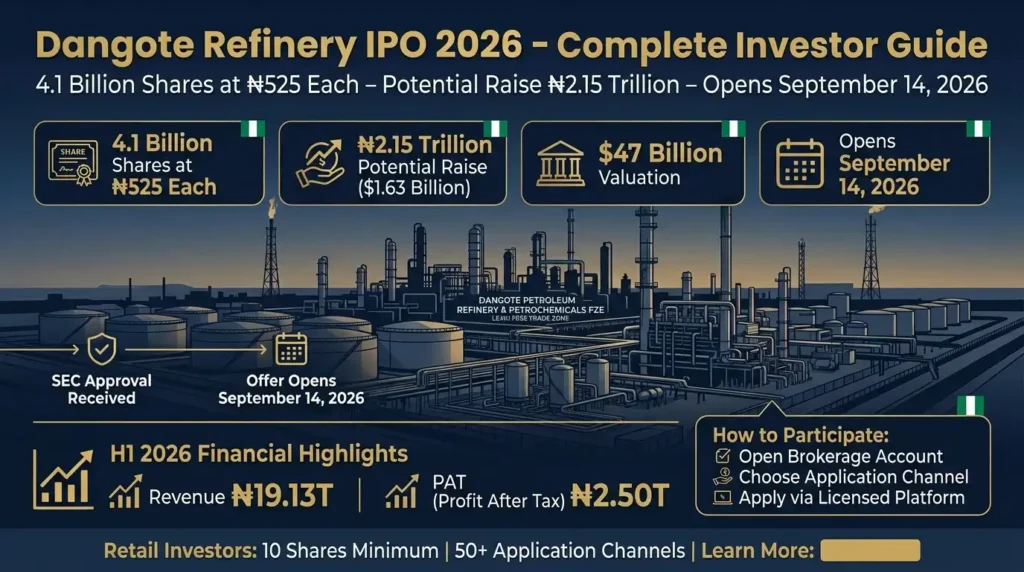
The refinery’s pre-listing market capitalisation is stated at N63.07 trillion, while its indicative market capitalisation at listing is N65.22 trillion. That means the IPO itself adds approximately N2.15 trillion to the company’s valuation through the issuance of new shares.
       ┌────────────────────────────────────────────────────────┐
       │     DANGOTE REFINERY IPO VALUATION ANALYSIS – KEY FACTS│
       └───────────────────────────┬────────────────────────────┘
                                   │
         ┌─────────────────────────┼─────────────────────────┐
         ▼                         ▼                         ▼
  [ OFFER SIZE ]            [ VALUATION ]              [ TIMELINE ]
  4.1 billion shares        ~$49.35 billion           Opens: Sept 14
  at ₦525 per share         (N65.22 trillion)         Closes: Oct 13
  Minimum: 10 shares        Pre-listing:              Listing: Nov 2026
  (₦5,250)                  N63.07 trillion
2. The Private Deal Mystery: Why Context Matters
Before the public was invited to buy, a private placement took place in July 2026, where large institutional investors bought into the refinery. These major African and international players reportedly valued the company at around $40 billion.
The private placement was completed in stages, with the initial tranche in June setting a valuation floor near $39 billion** and the final close drawing total demand of close to **$4 billion—well ahead of what was on offer. The pricing implied a valuation of roughly **$40 billion** for the company. Femi Otedola, the FirstHoldCo chairman, committed $100 million and told reporters he liquidated his entire holding in Geregu Power Plc to fund it. Nigeria’s pension regulator also cleared retirement funds to participate for the first time, opening a pool of savings worth more than $17 billion.
This raises a vital question for you: If professional investors entered at a $40 billion valuation just weeks ago, why is the general public being asked to pay closer to **$49.35 billion**?
There may be perfectly logical reasons for this jump. Garba Kurfi, Managing Director of APT Securities and Funds Limited, noted that the pricing also compared favourably with the company’s earlier private placement and changes in the naira-dollar exchange rate. According to him, Dangote Refinery had carried out its private placement at 35 kobo when the exchange rate was about N140 to the dollar, while the exchange rate had subsequently risen significantly.
However, as an intelligent investor, you should wait for the official prospectus to confirm the details. You need to know if the “big money” players are allowed to sell their shares immediately after listing and what specific price they paid per share. Institutional interest is a good sign, but it is not a guarantee that the public price is a bargain for you.
3. The Seven Gates: Testing the Investment
To determine if this IPO passes the test, I use a system I call the “Seven Gates.” Until we have clear, audited answers for each, your decision should remain cautious.
Gate 1: What is “Inside the Box”?
You must verify exactly which assets you will own. Does your share include the petrochemical operations, the pipelines, and the storage facilities, or just the petroleum refinery itself? The prospectus states that the offer is intended to “broaden public ownership of the Issuer” while strengthening its refining and petrochemicals capacity. The refinery currently operates approximately 700,000 barrels per day of refining capacity and plans to add a further approximately 700,000 barrels per day, potentially taking capacity to about 1.4 million barrels per day.
Gate 2: Profit vs. Revenue
Sales are not the same as profits. A refinery can sell billions of dollars of fuel, but it must first pay for the crude oil, the workers, maintenance, taxes, and interest on loans. Management has projected remarkable future earnings, but you should look for the audited current profit available to shareholders today.
The refinery’s H1 2026 results provide a strong foundation. It recorded $13.91 billion in revenue** and **$1.82 billion in profit after tax in the first half of 2026. This represents a major turnaround from the $475.8 million loss** recorded for the full year in 2025. CardinalStone Research projects FY2026 revenue of about **$29.6 billion and profit after tax of $3.8 billion.
Gate 3: The Weight of Debt
The refinery cost roughly $20 billion to build, and plans are already in place to double its capacity. This requires significant capital. Debt isn’t always bad if it helps grow profits, but lenders always eat at the dining table before shareholders. You need to know the total debt, the interest rates, and when that money must be paid back.
Gate 4: The Crude Oil Supply Chain
A refinery is like a bakery; if the bakery cannot find affordable flour, it cannot make a profit. The refinery began operating in 2024 and reached its full 650,000-barrel-a-day nameplate capacity in February. It has since demonstrated throughput of about 700,000 barrels a day. However, you need evidence that the refinery can secure enough crude at a price that leaves a healthy profit for you.
Gate 5: International Comparisons
Size alone does not justify a high share price. When we compare the proposed $49.35 billion valuation to international refining giants, a gap appears. While the Dangote Refinery is newer and serves a massive, growing African market, you must be sure the premium you are paying is supported by stronger growth and higher profits than these global peers.
Two Nigerian investment firms, CardinalStone Research and Chapel Hill Denham, have independently valued the refinery at between N77.7 trillion and N82.62 trillion—above the N65.22 trillion indicative market capitalisation. CardinalStone places a 12-month equity valuation of N77.7 trillion on the refinery, translating to a target price of N688.09. Chapel Hill Denham estimates a current fair equity value of $62.53 billion, equivalent to N82.62 trillion.
Gate 6: The Dollar Dividend Reality
There is a lot of buzz about “dollar dividends,” but you must read the fine print. The offer has been structured to accommodate the company’s dollar-denominated operations, including the payment of dividends in dollars. The strategy is designed to leverage foreign-exchange earnings from refined petroleum products and petrochemical exports while providing investors with some protection against naira volatility.
However, these shares are expected to trade on the Nigerian Exchange in Naira. If the Naira loses value, your total investment value in Dollar terms can still drop, even if your dividend is calculated in Dollars. You need to confirm if these dividends are guaranteed, how they will be paid, and whether you will receive actual Dollars or the Naira equivalent.
Gate 7: Governance and Control
Who will actually run the company? The IPO shares represent only about 3.3% of the total company. This means a very small supply of shares will be available for ordinary people to trade. While high demand for a small supply can push the price up quickly, it can also make the price very unstable.
The refinery is targeting as many as 10 million investors across Africa, including lower-income earners and its own drivers, cooks, managers, and other workers. You need to know who sits on the board and how minority shareholders like you will be protected from the decisions of the majority owners.
4. Managing Your Risk: How Much is Too Much?
If the prospectus answers these questions satisfactorily, the next step is deciding how much to invest. This is where emotional discipline becomes your most valuable asset.
First, you must remove all “protected money” from your calculations. Your emergency savings, your rent, your children’s school fees, and your business capital are not IPO money. Furthermore, never borrow money to invest in a volatile IPO, regardless of the excitement.
For a cautious beginner, I suggest limiting your initial position to between 1% and 3% of your long-term investment portfolio. For example, if you have 10 million Naira in long-term investments, 1% is 100,000 Naira, which buys you about 190 shares at the offer price. If you have a higher risk tolerance, you might go up to 5%, but you should set a firm ceiling. Your conviction in a company should grow with evidence, not hype. You can always buy more later as the company publishes its results as a listed business.
5. IPO vs. Waiting: The Power of Patience
You do not have to rush. Buying during the IPO gives you early access at a fixed price, but it also carries the risk that the price could fall below 525 Naira once it starts trading on the open market.
Waiting until the shares are listed has distinct advantages. You can observe real market demand and study the company’s first few sets of published results as a public entity. Missing an IPO is not dangerous; the opportunity to own a great company will last for many years. What is dangerous is overpaying with important money because you felt pressured by the crowd.
The offer opens on September 14, 2026 and closes on October 13, 2026. Trading on the NGX is expected to begin in late November. That gives you time to observe the market’s reaction and make a more informed decision.
6. Analyst Valuations and the Fair Price Debate
The question of whether N525 is a fair price has drawn significant attention from market analysts. Garba Kurfi described the proposed IPO price as fair, noting that the absence of another refinery of comparable scale in the market gives investors limited alternatives. He based his assessment on the company’s projected earnings, noting that estimated earnings of about N14 per share would imply a price-to-earnings (P/E) ratio of roughly 30 at a share price of N525. He compared the valuation with those of other companies in the Nigerian market, noting that the P/E ratio of Aradel was above 20, while that of Seplat was more than 15.
CardinalStone Research’s 12-month valuation of N77.7 trillion translates to a target share price of N688.09. Chapel Hill Denham’s estimate of a current fair equity value of $62.53 billion, equivalent to N82.62 trillion, suggests even more upside. Both valuations are supported by expectations of a sharp improvement in the refinery’s earnings as production increases.
However, analysts warn that the higher valuations do not guarantee that the refinery’s shares will rise after listing. The company will need to maintain strong refining margins, operate at high capacity and successfully complete its expansion plans to justify the higher valuations.
7. Action Plan for Investors
Step 1: Prepare your accounts. Ensure your CSCS details and brokerage account are active through a licensed broker. Retail investors can apply through over 50 Electronic Application Channels, with a minimum subscription of 10 shares costing ₦5,250.
Step 2: Avoid scams. Never transfer money through personal accounts or unofficial links. Use only official application instructions.
Step 3: Read the Prospectus. Do not rely on rumours. When the official document is released, look for the hard numbers on debt, cash flow, and ownership. The prospectus is available through receiving banks, brokers, and the company’s investor relations portal.
Step 4: Decide your limit. Set your maximum investment amount now, before the public excitement starts to cloud your judgment.
8. Final Summary & The Bottom Line
The Dangote Refinery is a world-class industrial operation that has passed the “reality test.” It is a real asset serving a real market. However, becoming a wise shareholder means distinguishing between admiring a business and analyzing its shares.
  ┌──────────────────────────────────────────────────────────┐
  │     DANGOTE REFINERY IPO VALUATION ANALYSIS – SUMMARY    │
  ├─────────────────────┬────────────────────────────────────┤
  │ Offer Price         │ ₦525 per share                    │
  ├─────────────────────┼────────────────────────────────────┤
  │ Minimum Investment  │ 10 shares (₦5,250)                │
  ├─────────────────────┼────────────────────────────────────┤
  │ Implied Valuation   │ $49.35 billion (N65.22 trillion)  │
  ├─────────────────────┼────────────────────────────────────┤
  │ Pre-Listing Cap     │ N63.07 trillion                   │
  ├─────────────────────┼────────────────────────────────────┤
  │ H1 2026 Revenue     │ $13.91 billion                    │
  ├─────────────────────┼────────────────────────────────────┤
  │ H1 2026 PAT         │ $1.82 billion                     │
  ├─────────────────────┼────────────────────────────────────┤
  │ Analyst Targets     │ N688.09 (CardinalStone)           │
  │                     │ $62.53bn (Chapel Hill Denham)     │
  ├─────────────────────┼────────────────────────────────────┤
  │ Offer Period        │ Sept 14 – Oct 13, 2026            │
  └─────────────────────┴────────────────────────────────────┘
The Bottom Line:
The Dangote Refinery IPO is a landmark event for Nigeria’s capital market. The refinery’s transformation from a $475.8 million loss in FY2025 to a $1.82 billion profit in H1 2026 demonstrates the underlying strength of the business. The expansion plans to double capacity to 1.4 million barrels per day—with an estimated capital expenditure of $14.3 billion—underscore the long-term growth potential.
However, the excitement surrounding the IPO should not eliminate investment discipline. The $49.35 billion valuation represents a significant premium over the $40 billion private placement valuation just weeks earlier. While analysts like CardinalStone and Chapel Hill Denham see further upside, the company will need to maintain strong refining margins, operate at high capacity, and successfully complete its expansion plans to justify the premium.
If the numbers justify the 525 Naira price, it could be a cornerstone of your portfolio for years to come. If the data is incomplete or weak, your best move is to wait for more evidence. Remember, in the world of investing, patience is often more profitable than speed.
For more weekly NGX updates and strategy guides, explore our market trends and analysis archive.
Disclaimer: This article is for informational purposes only and does not constitute investment advice. Always conduct your own research or consult a qualified financial advisor before investing. Past performance does not guarantee future results. The information in this article is based on publicly available information as of September 2026 and is subject to change.
What I learned from this article is Remember, in the world of investing, patience is often more profitable than speed.