
The Dangote Refinery IPO: A Strategic Guide to Deciding Your Next Move
By Market Formula Editorial Team / September 2026
Introduction
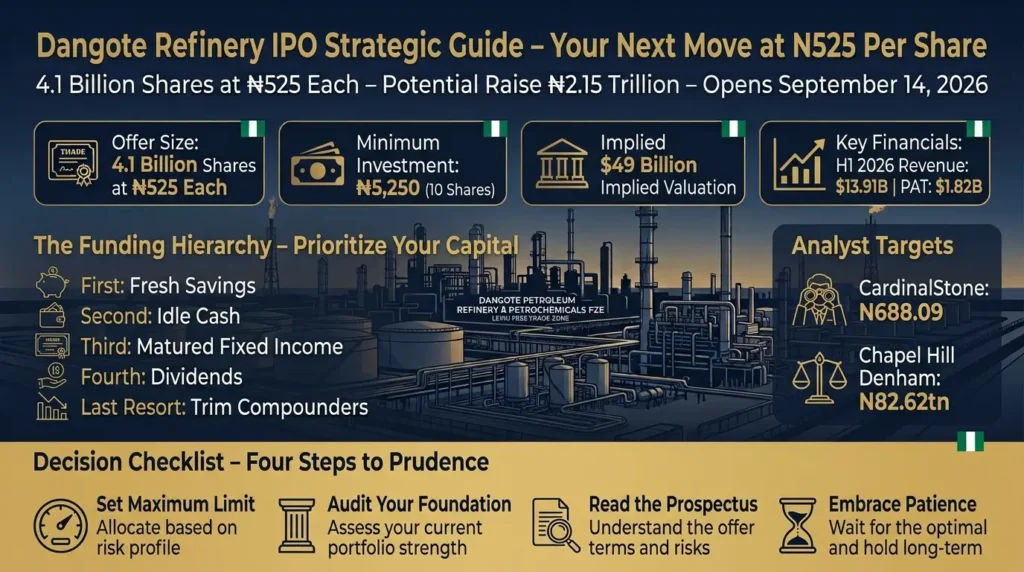
The buzz surrounding the Dangote Refinery IPO is unlike anything the Nigerian stock market has witnessed in recent years. With the official offer price set at ₦525 per share, it seems as though every conversation in the financial space revolves around this single asset. The offer comprises 4.1 billion ordinary shares at N525 per share, targeting gross proceeds of about N2.1525 trillion if fully subscribed. The minimum subscription is just 10 shares valued at N5,250, making the offer accessible to millions of Nigerians.
However, as an investor, you must learn to separate the majesty of a physical business from the cold reality of a financial investment. A refinery that processes 700,000 barrels of oil a day and saves the country billions of dollars in imports is undoubtedly a national triumph. But a share price that values a company at nearly $49 billion is a “price on a story”. To succeed, you must decide if that story matches your personal financial goals.
This Dangote Refinery IPO strategic guide will walk you through the logic of this offer, the risks currently hidden behind the headlines, and—most importantly—how to fund your purchase without destroying the wealth you’ve already built.
Let’s examine the Dangote Refinery IPO strategic guide with clarity and strategic discipline.
1. Separating the Business from the Investment
It is easy to be mesmerized by the scale of the project. This refinery is one of the most technologically advanced in the world, capable of turning “dirty” crude into premium fuel that meets international standards. It has its own power plant, its own port, and enough storage for 5 billion litres of fuel. In its first six months of 2026, it generated $1.82 billion in profit after tax** on revenue of **$13.91 billion—a massive turnaround from losses of $476 million** in the same period of 2025. The refinery also recorded **$2.60 billion in EBITDA, supported by a rise in refining margins from $13.70 per barrel in 2025 to $24.50 per barrel in H1 2026.
However, as a mentor, I must tell you that a great business can still be a challenging investment if the entry price is too high. At ₦525, you aren’t just buying the refinery as it exists today; you are paying upfront for a future where everything goes perfectly.
Just a few months ago, private institutional investors valued this business at roughly $40 billion**. The public is now being asked to buy in at a valuation between **$47 billion and $50 billion**. You must ask yourself: what has changed in the last few months to justify a **$10 billion jump in the “price tag”? When you buy an IPO, you are buying a claim on future profits, and the price you pay for those profits determines your eventual return.
       ┌────────────────────────────────────────────────────────┐
       │     DANGOTE REFINERY IPO STRATEGIC GUIDE – KEY FACTS   │
       └───────────────────────────┬────────────────────────────┘
                                   │
         ┌─────────────────────────┼─────────────────────────┐
         ▼                         ▼                         ▼
  [ OFFER SIZE ]            [ VALUATION ]              [ FINANCIALS ]
  4.1 billion shares        ~$49 billion              H1 2026 Revenue:
  at ₦525 per share         implied valuation         $13.91 billion
  Minimum: 10 shares        (public offer)            H1 2026 PAT:
  (₦5,250)                                            $1.82 billion
2. The “Dangerous Question”: What Are You Selling?
The excitement for this IPO is so intense that we are already seeing selling pressure across the NGX. Many investors are liquidating their existing positions just to raise the cash for the refinery. This is where the “Fear of Missing Out” (FOMO) becomes dangerous.
Before you touch your current portfolio, you must ask: What am I surrendering to buy this? If you sell a high-performing “blue-chip” stock that has been paying you consistent dividends for years just to chase a “fashionable” new listing, you might be exchanging proven compounding for expensive excitement.
The Three-Pile Portfolio Audit
To decide where your IPO money should come from, categorise your current holdings into three piles:
1. The Keep Pile: These are your “strong compounders.” They have growing earnings, robust cash flow, and a “moat” or competitive advantage that is hard to break. Stocks like the NGX Group itself—which makes money whether the market goes up or down—should be protected. If a company’s investment thesis is still intact, do not punish it just because a famous IPO has arrived.
2. The Trim Pile: Consider reducing your position in stocks that have become too large for your portfolio. If you are over-exposed to one industry—for example, if you own eight different banking stocks—this is a perfect time to rebalance. Trimming allows you to fund the IPO without damaging the foundation of your wealth.
3. The Sell Pile: This is the most logical source of funds. If you own stocks based on old rumours, or if a company’s management has become questionable, or if it has reported losses for several consecutive quarters, sell it. Use this IPO as an excuse to clean out the “dead wood” in your portfolio.
3. Testing the “Future Story” of the Refinery
For the ₦525 price to deliver a significant return, several operational “gears” must turn in perfect synchronisation. As a beginner, you should be aware of the friction points that could slow these gears down.
The “Flour for the Bakery” Problem
A refinery is like a world-class bakery. No matter how modern the ovens are, the bakery fails if it cannot get flour. Currently, the refinery is reportedly receiving less than half of the crude oil supply promised by domestic arrangements. This forces the company to buy crude from international markets in US dollars.
This creates a “currency squeeze.” If the refinery buys its “raw materials” in dollars but sells a large portion of its fuel in Naira, any significant shift in the exchange rate can eat into the profit margins meant for you, the shareholder. The refinery began pricing petrol, diesel and aviation fuel in US dollars, saying it was struggling to secure enough crude through the Federal Government’s naira-for-crude arrangement.
The Cash Flow Gap
The refinery plans to spend upwards of $12 billion on expansion to double its capacity. While expansion is good for the long term, it is very expensive. In the coming years, even if the refinery reports billions in profit, that cash might be diverted into construction and debt repayment rather than being sent to you as dividends.
The refinery has already reduced its debt by N798 billion to N7.9 trillion in the first half of 2026. While this is positive, the debt burden remains substantial. The prospectus highlights substantial debt obligations and foreign-exchange risks, and the IPO’s premium valuation demands scrutiny of the refinery’s debt burden, foreign-exchange volatility, and refining margin fluctuations.
The Dollar Dividend Reality
Investors are often excited by the prospect of “dollar dividends,” but it is important to know that these are not yet guaranteed or approved. Foreign-currency revenues do not automatically translate into foreign-currency dividends. For now, your investment case should be built on the business’s ability to grow, not a promise of foreign currency payments that may or may not materialise.
4. Analyst Valuations and the Fair Price Debate
The question of whether N525 is a fair price has drawn significant attention from market analysts.
CardinalStone Research has assigned a 12-month equity valuation of N77.7 trillion, translating to a target price of N688.09, implying an upside of 39.6 per cent from the offer price. Chapel Hill Denham estimates the refinery’s current fair equity value at $62.53 billion, equivalent to N82.62 trillion, suggesting potential upside of approximately 27 per cent.
Renaissance Capital places its valuation in a range of $57.1 billion to $65.4 billion. These independent estimates suggest that the refinery could be worth significantly more than the valuation implied by its planned NGX listing.
However, analysts warn that the higher valuations do not guarantee that the refinery’s shares will rise after listing. The company will need to maintain strong refining margins, operate at high capacity, and successfully complete its expansion plans to justify the higher valuations.
5. Your Funding Hierarchy: A Safety-First Approach
If you have done your research and decided that the refinery fits your long-term plan, the next step is finding the money. There is a specific order of safety you should follow:
| Priority | Source of Funds | Risk Level |
|---|---|---|
| First Choice | Fresh savings or new income | Lowest risk |
| Second Choice | Idle cash in brokerage or bank | Low risk |
| Third Choice | Matured fixed-income investments (T-Bills, bonds) | Low risk |
| Fourth Choice | Dividends from other stocks | Moderate risk |
| Last Resort | Trimming strongest compounders | Highest opportunity cost |
The Golden Rules of IPO Funding
Never borrow money to buy an IPO. Never use your “essential” money—this means house rent, school fees, or emergency savings. IPO allotments are not instant; your money could be “tied up” for six to nine months before you even see the shares in your account. If you need that cash for a medical emergency in three months, you will be in a very difficult position.
6. The Retail Investor Incentive Programme
The Issuer has introduced a Retail Investor Incentive Programme to reward long-term retail investors. Subject to regulatory approvals, a Retail Investor who subscribes for and is allotted Offer Shares equal to or greater than the Minimum Subscription and maintains Continuous Shareholding for 12 months from the Allotment Date will become eligible to receive one Incentive Share at no additional cost. A further 12 months of Continuous Shareholding earns one additional Incentive Share.
The maximum entitlement is two Incentive Shares per eligible Retail Investor. This programme is designed to foster an investment culture in Nigeria, similar to the British Gas privatisation under Margaret Thatcher in 1986.
Aliko Dangote has stated that “anyone with a Bank Verification Number (BVN) will be able to invest and become a co-owner of this world-class refinery”. The refinery is targeting up to 10 million retail investors across Africa.
7. The Mental Preparedness Test
Before you submit your application, you must perform a psychological “stress test” on yourself. The stock market is unpredictable. Once the refinery lists on the secondary market, the price could shoot to ₦800, or it could drop to ₦350.
Ask yourself: Can I tolerate a 30% drop in value immediately after listing? If seeing your ₦525 investment turn into ₦370 would cause you to panic and sell at a loss, your intended investment is likely too large.
Furthermore, understand that oversubscription is not a guarantee of profit. Just because everyone is trying to buy doesn’t mean the price will stay high forever. Real wealth is built through “boring” patience and years of compounding, not by chasing every exciting headline that hits the news.
8. Action Plan for Investors
Step 1: Set a Maximum Limit. Determine the exact amount you can afford to have “locked away” for at least a year. Name this number before the excitement of the offer period takes over.
Step 2: Audit Your Foundation. Protect your proven “dividend machines.” Do not sacrifice your reliable, dividend-paying stocks for a fashionable new listing.
Step 3: Read the Document. Look at the debt levels and the free cash flow projections. Ensure you are buying into a financial reality, not just an industrial dream.
Step 4: Check the FTSE Russell Connection. The Dangote Refinery is not yet on the FTSE Frontier Index list, but the refinery’s listing could further enhance the NGX’s institutional appeal. The 10 large-cap stocks identified by FTSE Russell include Guaranty Trust Holding Company, Zenith Bank, MTN Nigeria Communications, Dangote Cement, Stanbic IBTC Holdings, First HoldCo, Nestlé Nigeria, Nigerian Breweries, Presco, and Aradel Holdings.
Step 5: Embrace Patience. If you miss this IPO, your financial future is not over. There will always be another opportunity. It is better to miss a good deal than to rush into a bad one with money you cannot afford to lose.
9. Final Summary & The Bottom Line
The Dangote Refinery IPO is a monumental event for Africa, but for you, it is simply one of many choices in a long investing career. To approach this offer like a professional, you must separate the business from the investment, protect your existing portfolio, and ensure your funding sources do not compromise your financial stability.
  ┌──────────────────────────────────────────────────────────┐
  │     DANGOTE REFINERY IPO STRATEGIC GUIDE – KEY TAKEAWAYS│
  ├─────────────────────┬────────────────────────────────────┤
  │ Offer Price         │ ₦525 per share                    │
  ├─────────────────────┼────────────────────────────────────┤
  │ Minimum Investment  │ 10 shares (₦5,250)                │
  ├─────────────────────┼────────────────────────────────────┤
  │ Implied Valuation   │ ~$49 billion                      │
  ├─────────────────────┼────────────────────────────────────┤
  │ H1 2026 Revenue     │ $13.91 billion                    │
  ├─────────────────────┼────────────────────────────────────┤
  │ H1 2026 PAT         │ $1.82 billion                     │
  ├─────────────────────┼────────────────────────────────────┤
  │ Analyst Targets     │ N688.09 (CardinalStone)           │
  │                     │ N82.62tn (Chapel Hill Denham)     │
  ├─────────────────────┼────────────────────────────────────┤
  │ Retail Incentive    │ 2 free shares for 24-month        │
  │                     │ continuous holding                │
  ├─────────────────────┼────────────────────────────────────┤
  │ Key Risks           │ Crude supply, FX exposure,        │
  │                     │ debt burden, cash flow diversion  │
  ├─────────────────────┼────────────────────────────────────┤
  │ Offer Period        │ Sept 14 – Oct 13, 2026            │
  └─────────────────────┴────────────────────────────────────┘
The Bottom Line:
Invest in the refinery because it fits your specific 10-to-20-year wealth plan, not because “everyone else is doing it.” True success in the NGX comes from knowing what you own and exactly why you own it.
The Dangote Refinery is a world-class industrial operation that has passed the “reality test.” It is a real asset serving a real market. However, becoming a wise shareholder means distinguishing between admiring a business and analysing its shares. If the numbers justify the 525 Naira price, it could be a cornerstone of your portfolio for years to come. If the data is incomplete or weak, your best move is to wait for more evidence.
Remember, in the world of investing, patience is often more profitable than speed.
For more weekly NGX updates and strategy guides, explore our market trends and analysis archive.
Disclaimer: This article is for informational purposes only and does not constitute investment advice. Always conduct your own research or consult a qualified financial advisor before investing. Past performance does not guarantee future results. The information in this article is based on publicly available information as of September 2026 and is subject to change.