
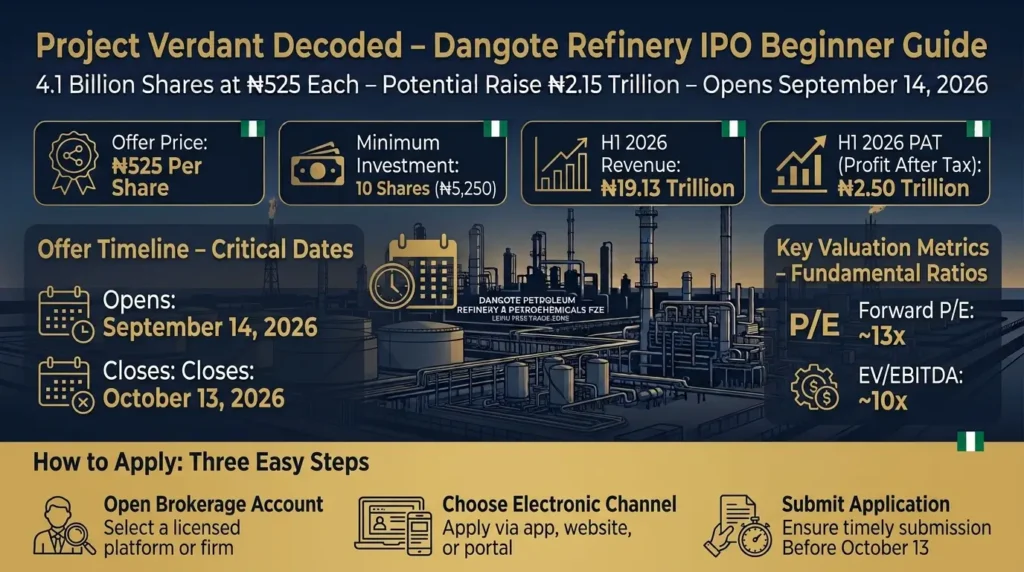
Project Verdant Decoded: The Beginner’s Complete Guide to the Dangote Refinery IPO
By Market Formula Editorial Team / September 2026
Introduction
The initial public offering (IPO) of Dangote Petroleum Refinery and Petrochemicals Free Zone Enterprise—codenamed Project Verdant—marks a historic milestone for the Nigerian Exchange (NGX) and the broader West African energy market. For retail investors, the opportunity to purchase an equity stake in one of the world’s most ambitious industrial assets is unprecedented.
However, evaluating a complex 194-page IPO prospectus audited by Deloitte & Touche and independently reviewed by KPMG requires looking beyond brand prestige to analyze hard operational and financial data. This Dangote Refinery IPO beginner guide translates the official disclosures into clear, practical insights.
This guide breaks down the offer terms, asset valuation, profit trajectory, debt structure, and key risk factors so you can make a well-informed decision about Project Verdant.
Let’s examine the Dangote Refinery IPO beginner guide with clarity and strategic discipline.
1. Offer Framework: Key Terms and Participation Mechanics
Project Verdant allows individual and institutional investors to subscribe directly to newly issued shares in the company. The structural parameters of the offering establish the baseline rules of entry for the public.
Key Offer Details
| Element | Detail |
|---|---|
| Offer Price | ₦525.00 per share |
| Offer Size | 4,100,000,000 ordinary shares |
| Application Opens | September 14, 2026 |
| Application Closes | October 13, 2026 |
| Minimum Subscription | 10 shares (₦5,250.00) |
| Gross Proceeds | ₦2.152 trillion (approximately $1.63 billion) |
| Net Proceeds | ₦2.111 trillion (after ₦41.5 billion offer costs) |
| Underwriting | Not underwritten |
| Institutional Commitment | Pan-African Refinery Investment SPV ($400 million, ~25.34% of offer) |
| Green Shoe Option | 30% over-allotment provision |
Public Float and Share Ownership
Before the IPO, Aliko Dangote held an effective direct and indirect controlling stake of approximately 87.27%. Following the issuance of 4.1 billion new shares alongside 120.13 billion existing shares, the post-IPO public float will sit at approximately 3.3% of total outstanding shares, which could influence secondary market liquidity after listing.
       ┌────────────────────────────────────────────────────────┐
       │      PROJECT VERDANT – OFFER FRAMEWORK AT A GLANCE     │
       └───────────────────────────┬────────────────────────────┘
                                   │
         ┌─────────────────────────┼─────────────────────────┐
         ▼                         ▼                         ▼
  [ OFFER PRICE ]            [ TIMELINE ]               [ PUBLIC FLOAT ]
  ₦525 per share            Opens: Sept 14             ~3.3% of total
  Minimum: 10 shares        Closes: Oct 13             shares available
  (₦5,250)                  Listing: Q4 2026           for public trading
2. Understanding the Asset: Inside the Industrial Complex
Subscribing to Project Verdant means acquiring an equity stake in an integrated refining and petrochemical megastructure situated on 2,635 hectares in the Dangote Industries Free Zone in Ibeju-Lekki, Lagos. Representing a $19 billion total asset base, it is the world’s largest single-train crude oil refinery.
Key Operational Metrics
| Metric | Detail |
|---|---|
| Nameplate Capacity | 700,000 bpd (rerated from 650,000 bpd) |
| Nelson Complexity Index | 11.5 (vs. 8.9 emerging markets average) |
| Captive Power Plant | 570 MW natural gas-fueled |
| Storage Capacity | 4.7 billion litres |
| Pipeline Network | 1,100 km subsea and onshore |
| SPM Buoys | 5 (2 crude oil, 3 product) |
| Gantry System | 96 loading bays |
| Distribution Fleet | 10,000 CNG-powered trucks |
| Employees | 4,778 |
| Crude Grades Processed | 36 (as at June 2026) |
The facility operates a fully integrated infrastructure ecosystem designed to ensure operational self-sufficiency. High processing complexity enables the plant to refine heavy, lower-cost crude grades into premium Euro V-compliant light fuels like Premium Motor Spirit (PMS/gasoline), Automotive Gas Oil (AGO/diesel), and Aviation Turbine Kerosene (ATK/jet fuel).
3. Financial Transformation: From Ramping Losses to Multi-Trillion Profits
Evaluating the enterprise requires separating its construction and ramp-up phases from its current operational output. During 2024 and 2025, the company posted net losses due to heavy financing costs incurred on its $19 billion construction debt while processing units were still scaling up.
Financial Performance Summary
| Metric | FY 2024 | FY 2025 | H1 2026 |
|---|---|---|---|
| Revenue | ₦9.38 Trillion | ₦18.74 Trillion | ₦19.13 Trillion |
| Gross Profit/(Loss) | (₦888 Billion) | ₦343 Billion | ₦3.43 Trillion |
| Net Profit/(Loss) | (₦2.23 Trillion) | (₦723 Billion) | ₦2.50 Trillion |
| Gross Refining Margin | Negative | Positive | ~$24.2/bbl |
In the first half of 2026 alone, gross profit rose to ₦3.43 trillion ($2.50 billion)**, driven by an estimated **Gross Refining Margin (GRM) of $24.2 per barrel. Net profit after tax reached **₦2.50 trillion ($1.82 billion)**. This operational swing reflects strong fixed-cost absorption as overhead expenses were spread over massive fuel production volumes, generating an annualized **Return on Equity (ROE) of 34.24%** against a $10.63 billion equity base.
4. Valuation Deep Dive: Analyzing the ₦525 Offer Price
Determining whether ₦525 per share represents a fair entry price involves examining key market multiples against international energy benchmarks and recent private transactions.
Valuation Metrics
| Metric | Calculation | Result |
|---|---|---|
| Implied Market Cap | 124.23 billion shares × ₦525 | ~₦65.22 trillion ($47–50 billion) |
| Forward P/E Ratio | $47.4bn market value ÷ $3.64bn annualized profit | ~13x |
| Enterprise Value | $47.4bn market cap + $5.67bn net debt | ~$53.1 billion |
| EV/EBITDA | $53.1bn ÷ ~$5.2bn annualized EBITDA | ~10x |
| Price-to-Book | $47.4bn market cap ÷ $10.63bn equity | ~4.64x |
| Private Placement Premium | $47–50bn vs. $39–40bn private valuation | 20–25% premium |
Key Observations:
- Forward P/E of 13x represents a reasonable baseline valuation for a newly profitable infrastructure asset with strong revenue momentum.
- EV/EBITDA of 10x is slightly above global refining peers (8–9x), indicating a modest valuation premium over mature international refiners.
- P/B ratio of 4.64x reflects the significant value creation embedded in the refinery’s operational turnaround.
- Private placement premium of 20–25% reflects improved market sentiment and operational de-risking since the institutional round.
5. Debt Obligations and the $14.3 Billion Expansion Plan
Understanding debt management and the planned allocation of IPO funds is essential for evaluating long-term shareholder returns.
Debt Profile
As of June 30, 2026, total debt stood at **$5.67 billion** (all secured bank debt carrying interest rates tied to SOFR plus 6% to 7%), down from $6.24 billion at year-end 2025. Annualized earnings growth has brought the Net Debt to EBITDA leverage ratio down to 0.27 times. However, absolute debt servicing costs remain high, taking ₦424 billion in finance costs during H1 2026 alone.
Allocation of IPO Net Proceeds (₦2.111 Trillion)
| Expense Category | Allocation | % of Proceeds |
|---|---|---|
| Core Refining Process Units & Equipment | ₦686.5 Billion | 32.5% |
| Utilities, Offsites & Supporting Infrastructure | ₦841.0 Billion | 39.8% |
| Civil, Mechanical & Construction Works | ₦583.5 Billion | 27.6% |
Purpose of Proceeds: Doubling Capacity to 1.4 Million BPD
None of the ₦2.111 trillion net proceeds will be used to pay off bank loans or enrich existing owners; 100% of the capital is dedicated to growth CAPEX for doubling refining capacity.
The company has initiated an expansion programme to increase crude processing capacity from 700,000 bpd to 1,400,000 bpd by 2029/2030, alongside expanding polypropylene production to 2.4 million metric tons annually. The total expansion budget is estimated at $14.3 billion**, with the IPO covering roughly **$1.5 billion (10%) and the remaining $12.8 billion funded through internally generated cash flow and additional project debt.
6. Essential Risk Factors Disclosed in the Prospectus
Pages 134 to 155 of the prospectus outline operational, regulatory, and market risks that every prospective shareholder must consider.
Key Risks
1. Single-Site Concentration
All refining, storage, power, and marine assets are located on a single 2,635-hectare site in Lagos, exposing operations to localized disruptions from industrial accidents, extreme coastal weather, or security events.
2. Crude Feedstock Dependency
Approximately 60% of crude feedstock is sourced domestically through NNPC term contracts under the Domestic Crude Supply Obligation (DCSO) and crude-for-Naira programmes. Remaining volumes are imported internationally, exposing feedstock costs to global maritime security risks and chokepoint disruptions such as the Strait of Hormuz.
3. Refining Margin Volatility
Exceptionally high H1 2026 refining margins ($24.2/bbl) were supported by regional geopolitical supply imbalances. Global crack spreads are inherently cyclical, and narrowing margins would impact net profitability.
4. Government Policy Interventions
Future shifts in domestic fuel pricing, subsidy reintroductions, or foreign exchange controls could compress domestic profit margins.
5. Expansion Execution Risk
The initial refinery required seven years from commencement to commercial production. Managing a $14.3 billion expansion while servicing $5.67 billion in existing debt introduces potential cost overruns or schedule delays.
6. Secondary Market Float
With only 3.3% of shares in public hands post-IPO, trading liquidity on the open market may initially be limited, making large buy or sell orders more volatile.
7. Legal Proceedings
As of August 2026, the enterprise faced 14 pending legal cases, including 9 material litigation cases involving claims exceeding $200 million.
7. Special Considerations: Sharia Certification and Retail Incentives
The prospectus contains two notable structural features for retail and ethical investors.
Sharia Compliance
Buraq Capital Limited conducted a formal Sharia assessment, confirming that the enterprise satisfies standard business activity and financial screening criteria. The offer holds an official FRACE certificate from the Central Bank of Nigeria, making it accessible to Islamic investment funds across Africa.
Retail Investor Incentive Programme
To incentivize long-term ownership, the Issuer has introduced a Retail Investor Incentive Programme (subject to final regulatory approvals).
| Qualification Period | Requirement | Entitlement |
|---|---|---|
| First 12 Months | Continuous Shareholding of ≥ Minimum Subscription | 1 Incentive Share |
| Second 12 Months | Continued Continuous Shareholding | 1 Additional Incentive Share |
| Maximum | — | 2 Incentive Shares |
The programme is designed to foster a long-term investment culture among Nigerian retail investors.
8. Action Plan: Portfolio Execution Checklist
Project Verdant provides an opportunity to own a direct equity stake in a world-class, multi-trillion Naira cash-generating energy asset. However, sustainable wealth creation requires aligning your investment strategy with operational reality.
Step 1: Align Your Investment Horizon
The core growth narrative relies on executing the $14.3 billion expansion programme to 1.4 million bpd by 2030. Investors seeking short-term flips may experience market volatility, whereas long-term investors are better positioned to compound value over a 3-to-5-year period.
Step 2: Prudent Position Sizing
Never invest funds needed for near-term living expenses, emergency reserves, or borrowed capital. Allocate a portfolio percentage that reflects your individual risk tolerance.
Step 3: Determine Your Allocation
Decide on your total capital commitment based on the ₦525 per share price (minimum 10 shares / ₦5,250.00).
Step 4: Submit via Approved Channels
Submit your subscription digitally through an approved electronic bank or brokerage channel before the October 13, 2026 closing deadline.
Step 5: Plan for Long-Term Holding
Hold your allotted shares for at least 12 to 24 months to qualify for the proposed retail loyalty bonus shares and participate in the company’s long-term operational growth.
Step 6: Verify Primary Documentation
Review the official financial summaries and risk factor disclosures at refinery.dangote.com before finalizing your purchase.
9. Final Summary & The Bottom Line
The Dangote Refinery IPO beginner guide reveals a world-class asset with strong financial momentum, significant growth plans, and a clear path to listing on the NGX Main Board.
  ┌──────────────────────────────────────────────────────────┐
  │   PROJECT VERDANT – KEY TAKEAWAYS FOR BEGINNERS          │
  ├─────────────────────┬────────────────────────────────────┤
  │ Offer Price         │ ₦525 per share                    │
  ├─────────────────────┼────────────────────────────────────┤
  │ Minimum Investment  │ 10 shares (₦5,250)                │
  ├─────────────────────┼────────────────────────────────────┤
  │ Gross Proceeds      │ ₦2.152 trillion                   │
  ├─────────────────────┼────────────────────────────────────┤
  │ H1 2026 Revenue     │ ₦19.13 trillion                   │
  ├─────────────────────┼────────────────────────────────────┤
  │ H1 2026 PAT         │ ₦2.50 trillion                    │
  ├─────────────────────┼────────────────────────────────────┤
  │ Forward P/E         │ ~13x                              │
  ├─────────────────────┼────────────────────────────────────┤
  │ EV/EBITDA           │ ~10x                              │
  ├─────────────────────┼────────────────────────────────────┤
  │ Public Float        │ ~3.3% of total shares             │
  ├─────────────────────┼────────────────────────────────────┤
  │ Application Closes  │ October 13, 2026                  │
  └─────────────────────┴────────────────────────────────────┘
The Bottom Line:
Project Verdant is more than an IPO—it is a landmark transaction that transforms a major privately controlled industrial asset into a widely held public investment. The refinery’s transformation from a ₦2.23 trillion loss in FY2024 to a ₦2.50 trillion profit in H1 2026 demonstrates the underlying strength of the business. The expansion plans to double capacity to 1.4 million barrels per day—with an estimated capital expenditure of $14.3 billion—underscore the long-term growth potential.
However, the excitement surrounding Project Verdant should not eliminate investment discipline. The single-site concentration risk, feedstock dependency, and margin volatility are real. Prospective investors must carefully consider the valuation, the risks, and their own investment objectives before participating.
If the numbers justify the ₦525 price, it could be a cornerstone of your portfolio for years to come. If the data is incomplete or weak, your best move is to wait for more evidence. Remember, in the world of investing, patience is often more profitable than speed.
For more weekly NGX updates and strategy guides, explore our market trends and analysis archive.
Disclaimer: This article is for informational purposes only and does not constitute investment advice. Always conduct your own research or consult a qualified financial advisor before investing. Past performance does not guarantee future results. The information in this article is based on the Prospectus dated September 7, 2026, and is subject to change.