
Dangote Refinery IPO 2026: Offer Price, NGX Impact & Investor Guide
By Market Formula Editorial Team / September 2026
Introduction
The approval by Nigeria’s Securities and Exchange Commission (SEC) for the Initial Public Offering (IPO) of Dangote Petroleum Refinery & Petrochemicals FZE represents far more than another corporate fund-raising exercise. It could become a defining moment in the evolution of Nigeria’s capital market.
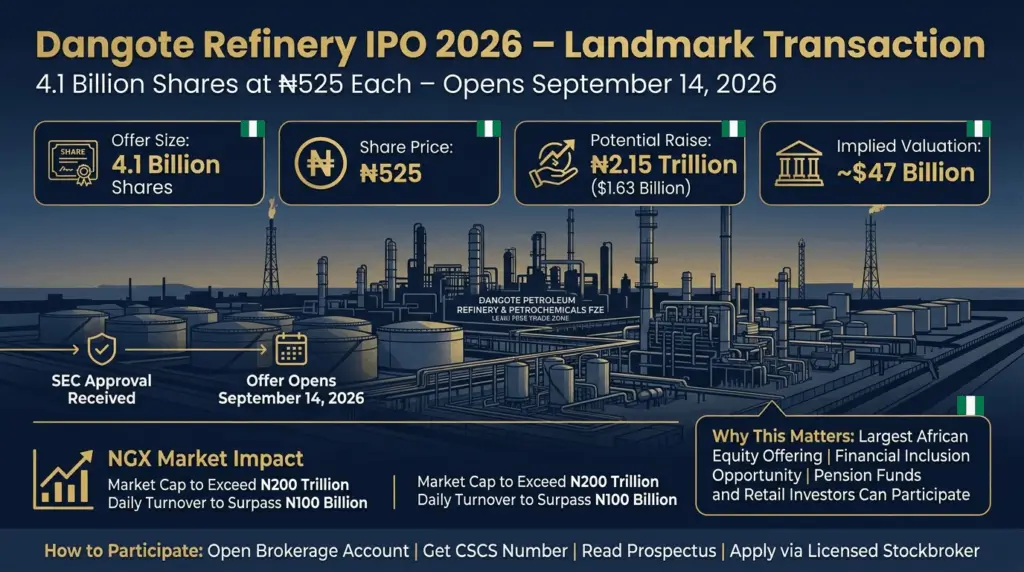
After months of anticipation and regulatory scrutiny, the SEC has approved an offer of 4.1 billion ordinary shares at ₦525 per share, potentially raising approximately ₦2.15 trillion ($1.63 billion) **if fully subscribed. The refinery has approximately **120.13 billion existing shares registered**, implying a valuation of about **$47 billion. The offer is expected to open around September 14, 2026.
This development comes after months of regulatory and market attention surrounding the proposed offering. In June 2026, the SEC had ordered a halt to unauthorised marketing of an alleged Dangote Refinery securities offering, emphasising that investors should rely on properly approved information. The subsequent approval represents an important demonstration of the regulatory gatekeeping role of the SEC.
This Dangote Refinery IPO 2026 guide examines the significance of the transaction, its implications for the Nigerian capital market, and what investors need to know.
Let’s explore the Dangote Refinery IPO 2026 with clarity and strategic insight.
1. Why the Dangote Refinery IPO Is Significant
The Dangote Refinery is not an ordinary company coming to the market. Built at a cost of about $20 billion, the refinery has a stated capacity of 700,000 barrels per day, making it the largest single-train refinery in the world. It has become an important participant in Nigeria’s petroleum-product supply and export markets.
In February 2026, the refinery made history by becoming the first refinery in the world to run its Crude Distillation Unit (CDU) and Motor Spirit (MS) Block at full capacity of 650,000 barrels per day. Following performance tests, the facility’s operating capacity has been further optimised to approximately 700,000 barrels per day. Its output has contributed to a substantial increase in Nigeria’s petroleum-product exports, reducing the country’s reliance on imported refined products.
The IPO therefore creates an opportunity for the Nigerian capital market to transform a major privately controlled industrial asset into a widely held public investment.
It potentially changes the relationship between:
Industrialisation → Corporate ownership → Capital formation → Wealth creation → Public participation
That is the real significance.
text
       ┌────────────────────────────────────────────────────────┐
       │         DANGOTE REFINERY IPO 2026 – KEY FACTS          │
       └───────────────────────────┬────────────────────────────┘
                                   │
         ┌─────────────────────────┼─────────────────────────┐
         ▼                         ▼                         ▼
  [ OFFER SIZE ]            [ VALUATION ]              [ TIMELINE ]
  4.1 billion shares        ~$47 billion              Offer opens
  at ₦525 per share         implied valuation         September 14, 2026
  Potential ₦2.15tn         (120.13bn existing        Listing expected
  capital raise             shares registered)        Q3/Q4 2026
2. A Landmark Transaction for the NGX
If successfully executed, the transaction will be one of the largest equity offerings ever undertaken in Africa.
For the Nigerian Exchange (NGX), the transaction could:
- Significantly increase market capitalisation
- Deepen the equities market
- Increase trading liquidity
- Attract institutional investors
- Increase retail investor participation
- Strengthen the investment-banking ecosystem
- Create new research coverage
- Increase brokerage activity
- Enhance Nigeria’s visibility among international investors
The size of the transaction is particularly important because Nigerian equities have historically struggled with limited depth and liquidity compared with larger emerging markets.
Market Capitalisation Impact
The scale of the IPO is expected to be transformative for the NGX. Analysts project that the listing of the Dangote Refinery could add 30 per cent to 40 per cent to the Exchange’s N160 trillion market capitalisation. Industry projections suggest total market capitalisation could surpass N200 trillion following the listing.
Bismarck Rewane, Managing Director of Financial Derivatives Company, has projected that the listing could lift NGX market capitalisation by +30 to 40 per cent from N161 trillion to N236 trillion. The refinery is expected to account for nearly one-third of the entire market value, with the listing potentially raising NGX capitalisation to about ₦222.6 trillion.
Trading Activity
Market operators expect daily turnover to jump from the current N30 billion–N50 billion range to over N100 billion. The chief operating officer of InvestData Consulting Limited, Ambrose Omordion, noted that “this one company alone will represent between 30 per cent to 40 per cent of the market capitalization”.
The Dangote Refinery could become an important anchor asset around which greater institutional participation develops.
3. From Private Wealth to Public Wealth
Perhaps the most profound implication is the possibility of converting part of the value created by a privately owned industrial asset into publicly accessible investment wealth.
The IPO allows pension funds, asset managers, institutional investors and individual Nigerians to participate in the ownership of a strategically important Nigerian enterprise. The planned offering is specifically expected to include retail investors, meaning individual Nigerians should be able to participate rather than the offer being restricted exclusively to banks, pension funds and other institutional investors.
This is the essence of a functioning capital market:
The capital market should not merely provide a place to trade shares; it should provide citizens with an opportunity to participate in the ownership of productive assets.
If millions of Nigerians become shareholders, the refinery becomes more than an industrial project. It becomes an investment institution within the Nigerian economy.
4. A Potential Catalyst for Financial Inclusion
The IPO could provide a major opportunity to introduce new investors to the Nigerian capital market. The managing director of Globalview Capital Limited, Aruna Kebira, recalled the impact of previous Dangote offers, saying “even now, people are selling their stocks and keeping money to buy Dangote. Those who are not yet investors are coming to the market because of Dangote”.
Many Nigerians participate in the financial system primarily through:
- Bank accounts
- Savings products
- Pension schemes
- Insurance
- Informal investment arrangements
A major IPO can introduce these individuals to equity ownership. This presents an opportunity for stockbrokers and other capital-market operators to move from simply executing transactions to becoming financial educators and investment advisers.
The industry should therefore see the Dangote IPO as an opportunity to build a new generation of long-term investors—not simply as an opportunity to sell shares.
5. The Impact on Stockbroking Firms
The transaction could significantly increase business opportunities for Trading Licence Holders (TLHs). Potential opportunities include:
| Opportunity Area | Description |
|---|---|
| Primary-market business | Stockbrokers can participate in distribution and mobilisation of subscriptions |
| Secondary-market activity | Once listed, the shares could generate significant trading volumes |
| Wealth management | New shareholders will require portfolio-management and investment-advisory services |
| Institutional business | Pension funds, insurance companies and asset managers could become significant participants |
| Research | The refinery will require continuous financial, industry and valuation analysis |
| Corporate finance | Its success could encourage other large Nigerian private companies to consider public-market financing |
For stockbrokers, therefore, the Dangote IPO should be viewed as the beginning of a long-term client relationship, not merely a one-off transaction.
6. The IPO Could Stimulate More Nigerian Companies to List
One of the most important possible consequences is the demonstration effect. Large private companies may begin asking: “If Dangote can access the Nigerian capital market at this scale, why shouldn’t we?”
This could encourage IPOs from:
- Large family-owned businesses
- Technology companies
- Telecommunications companies
- Energy companies
- Logistics firms
- Infrastructure companies
- Manufacturing businesses
- Healthcare companies
- Consumer businesses
Nigeria needs more companies to move from private ownership to public ownership. A vibrant capital market requires a continuous pipeline of quality issuers.
7. The IPO Can Strengthen Domestic Capital Formation
One of Nigeria’s structural challenges is the shortage of long-term domestic capital for infrastructure and productive investment. The capital market provides a mechanism for transforming:
Household savings + Institutional savings → Investment capital → Productive assets → Economic growth
The Dangote transaction demonstrates how an industrial project can eventually return to the capital market to raise additional capital for expansion. The refinery is seeking the capital to support its planned expansion from its current operating capacity of about 700,000 barrels per day to 1.4 million barrels per day.
This creates an important model:
Build → Operate → Demonstrate value → List → Raise capital → Expand → Create more value
Once completed, the expansion would surpass India’s Jamnagar refinery to become the world’s largest refinery.
8. The Refinery Could Strengthen Nigeria’s Position as an Energy and Capital-Market Hub
The significance goes beyond Nigeria. The refinery is increasingly connected to regional petroleum-product markets. Its growing exports have already changed trade flows across Africa and beyond.
At the same time, West African regulators are considering the development of a regional fuel-pricing benchmark and trading hub, partly driven by increased refining capacity in Nigeria.
Consequently, a successful Dangote Refinery listing could reinforce Nigeria’s ambition to become both:
A regional energy hub and a regional financial-market hub.
9. But the IPO Also Presents Risks
The excitement surrounding the IPO should not eliminate investment discipline. Investors must consider:
Valuation risk
A great company can still be a poor investment if its shares are purchased at an excessive valuation. The refinery’s $47 billion valuation is significant, and analysts have questioned how that valuation compares with established international refining companies.
Crude supply risk
The refinery needs reliable and competitively priced crude feedstock.
Commodity-price risk
Refining margins can change significantly with global crude and petroleum-product prices.
Concentration risk
The refinery is expected to account for nearly one-third of NGX market capitalisation, introducing structural concentration risk. Investors should not confuse the importance of the refinery to Nigeria with a guarantee of investment returns.
Governance risk
As ownership becomes more widely distributed, investors will expect strong corporate governance, transparency and minority-shareholder protection.
Execution risk
Expansion to 1.4 million barrels per day will require substantial capital, operational excellence and dependable feedstock.
10. A Major Test for the SEC
The Dangote IPO is also an important test of Nigeria’s regulatory framework. The SEC must ensure that:
- Disclosure is comprehensive
- Valuation information is transparent
- Investors understand the risks
- Marketing is properly controlled
- Allocation is fair
- Related-party issues are appropriately disclosed
- Corporate governance is robust
- Post-listing compliance is maintained
The regulator’s earlier intervention against unauthorised marketing in June 2026demonstrates why regulatory discipline matters. A successful transaction will strengthen confidence in the SEC as a credible capital-market regulator.
11. A Major Test for the NGX
The transaction also provides an opportunity for the NGX to demonstrate its ability to handle a mega-cap listing. The exchange must ensure:
Efficient trading + Adequate liquidity + Market surveillance + Investor education + Technology resilience + Transparent price discovery
The post-listing period may be even more important than the IPO itself. A successful IPO followed by an illiquid secondary market would limit the transaction’s long-term impact. The objective should therefore be to create a liquid market in the shares, not merely to complete the listing.
12. The Pension Industry Becomes Strategically Important
Nigeria’s pension industry represents one of the country’s largest pools of long-term domestic capital. A large IPO such as this creates an opportunity for pension funds and other institutional investors to participate in productive Nigerian assets, subject of course to their regulatory mandates, investment limits and fiduciary responsibilities.
This illustrates an important principle:
Nigeria does not only need more savings; it needs mechanisms for converting savings into productive long-term investment.
The capital market is central to that process.
13. The IPO Could Improve the Culture of Equity Ownership
Nigeria needs to move from a culture of:
“Where can I keep my money?”
to:
“What productive assets can I own?”
The difference is fundamental. Owning shares means participating in the economic growth of companies. If properly structured and supported by investor education, the Dangote IPO could encourage Nigerians to think more seriously about:
- Long-term investing
- Dividends
- Capital appreciation
- Portfolio diversification
- Corporate ownership
- Wealth transfer across generations
14. The Bigger Opportunity: Creating an IPO Pipeline
The real measure of success should not be whether Dangote Refinery becomes a successful IPO. The bigger question is:
Will Dangote become the beginning of a new generation of Nigerian IPOs?
Nigeria should use the momentum to develop a national IPO Pipeline Strategy. This could involve identifying large private companies capable of listing and providing them with listing-readiness assessments, corporate-governance support, financial reporting improvement, investor-relations preparation, valuation guidance, restructuring advice, regulatory guidance, and access to institutional investors.
The objective should be to make IPOs a normal pathway for successful Nigerian businesses.
15. Implications for the Development of the Nigerian Capital Market
The Dangote Refinery IPO potentially advances the Nigerian capital market in eight major dimensions:
| Area | Potential Impact |
|---|---|
| Market Capitalisation | Significant increase from N160tn to N200tn–N236tn |
| Liquidity | Potential increase in trading activity to over N100bn daily |
| Investor Base | Greater retail and institutional participation |
| Productivity | Capital directed toward a major productive asset |
| Financial Inclusion | More Nigerians exposed to equity ownership |
| Corporate Governance | Greater public disclosure and accountability |
| International Visibility | Increased global attention to NGX |
| IPO Culture | Potential catalyst for more private companies to list |
16. Action Plan for Investors
Now that you understand the Dangote Refinery IPO 2026, here is your practical action plan.
Step 1: Prepare your brokerage account.
Ensure your brokerage account is active and registered with the NGX. You will need a CSCS account to hold shares electronically.
Step 2: Read the prospectus carefully.
The final SEC-approved offer documents will contain the exact opening date, closing date, minimum subscription and allotment arrangements. Treat the official prospectus, rather than social-media flyers, as authoritative.
Step 3: Decide on your allocation.
Do not bet your entire portfolio on one IPO. Diversify: treat Dangote Refinery as one pillar of a broader portfolio.
Step 4: Consider the risks.
Valuation, crude supply, commodity prices, concentration, governance and execution risks all warrant careful assessment.
Step 5: Be prepared for partial allocation.
If demand exceeds supply, you may receive a partial allocation. A 15 per cent greenshoe option is expected if demand exceeds the base offer.
Step 6: Think long-term.
The refinery is a long-term infrastructure asset with expansion plans from 700,000 bpd to 1.4 million bpd.
17. Final Summary & The Bottom Line
The Dangote Refinery IPO could represent a watershed moment for Nigeria. It is potentially:
- The largest African equity offering
- A major industrial financing transaction
- A financial-inclusion opportunity
- A test of Nigeria’s capital-market infrastructure
All at the same time.
  ┌──────────────────────────────────────────────────────────┐
  │       DANGOTE REFINERY IPO 2026 – KEY TAKEAWAYS          │
  ├─────────────────────┬────────────────────────────────────┤
  │ Offer Size          │ 4.1 billion shares at ₦525 each   │
  ├─────────────────────┼────────────────────────────────────┤
  │ Potential Raise     │ ~₦2.15 trillion ($1.63 billion)   │
  ├─────────────────────┼────────────────────────────────────┤
  │ Valuation           │ ~$47 billion implied valuation    │
  ├─────────────────────┼────────────────────────────────────┤
  │ Offer Opens         │ September 14, 2026                │
  ├─────────────────────┼────────────────────────────────────┤
  │ Refinery Capacity   │ 700,000 bpd (expanding to 1.4m)   │
  ├─────────────────────┼────────────────────────────────────┤
  │ NGX Impact          │ Market cap to exceed N200tn–N236tn│
  ├─────────────────────┼────────────────────────────────────┤
  │ Investor Access     │ Retail and institutional          │
  ├─────────────────────┼────────────────────────────────────┤
  │ Key Risks           │ Valuation, crude supply,          │
  │                     │ concentration, governance         │
  └─────────────────────┴────────────────────────────────────┘
The Bottom Line:
But its ultimate significance will not be measured merely by the amount of money raised. It should be measured by what comes after the IPO.
If the transaction produces deeper liquidity, stronger investor participation, better corporate governance, more IPOs, greater institutional investment and increased public ownership of productive Nigerian enterprises, then the Dangote Refinery IPO will have achieved something much greater than raising capital. It will have helped Nigeria move from a capital market dominated by trading existing securities toward a market increasingly focused on mobilising capital for productive investment and broadening ownership of national wealth.
The Dangote Refinery IPO is therefore not just a transaction. It is a test of whether Nigeria can turn one historic listing into a new era of capital formation.
If successfully executed, the most important legacy of the Dangote Refinery IPO may not be the refinery’s valuation—it may be the new companies, new investors and new capital-market culture that emerge because of it.
For more weekly NGX updates and strategy guides, explore our market trends and analysis archive.
Disclaimer: This article is for informational purposes only and does not constitute investment advice. Always conduct your own research or consult a qualified financial advisor before investing. Past performance does not guarantee future results.
I’m interested in the shares. Thank you.