
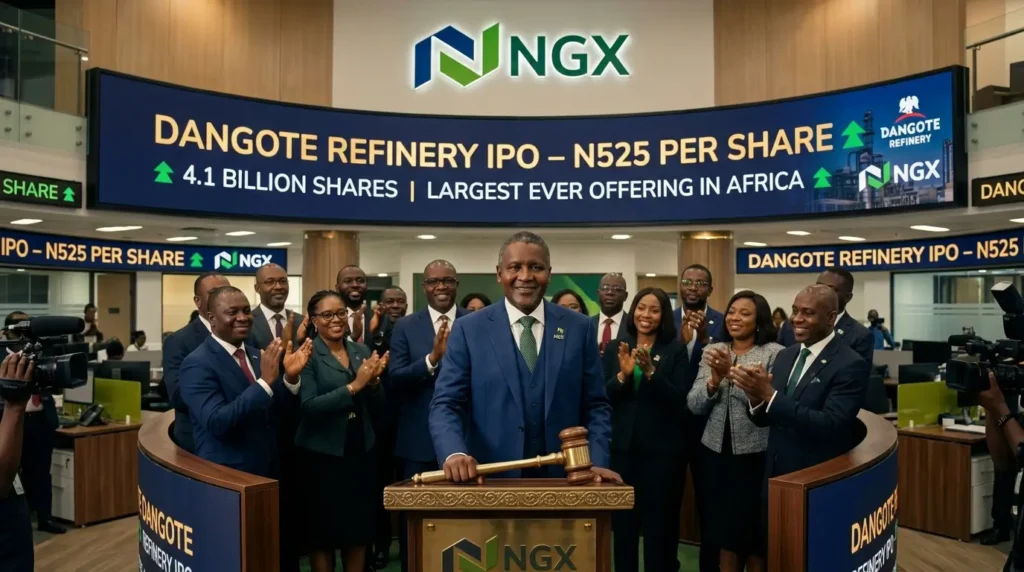
Dangote Refinery IPO Opens: Inside the “People’s IPO” and Nigeria’s Capital Market Transformation
By Market Formula Editorial Team / September 2026
Introduction
On September 14, 2026, the Nigerian Exchange (NGX) witnessed a moment that transcended finance. Aliko Dangote, alongside his executive team, market regulators, and government officials, formally opened the market to launch the Initial Public Offering of Dangote Petroleum Refinery and Petrochemicals FZE. But as the Chairman made clear, this was never simply about raising capital.
“We are going to fully share all our prosperity with the people,” Dangote told the assembled crowd. “That’s why we call this the people’s IPO.”
The event marked the official opening of a subscription window offering 4.1 billion ordinary shares at N525 per share, with a minimum investment of just 10 shares (N5,250) — deliberately structured so that teachers, civil servants, and first-time investors could participate.
This Dangote Refinery people’s IPO article captures the strategic vision behind the listing, the operational milestones that de-risk the investment case, and what this moment means for Nigeria’s capital market.
Let’s examine the Dangote Refinery people’s IPO with clarity and strategic discipline.
1. A Historic Market Opening: The Moment Itself
In a departure from tradition, the event was framed as a market opening rather than a closing ceremony — a deliberate symbolic choice. Dangote explained that he had to travel to Canada for a 6:00 p.m. meeting, so the organisers “graciously agreed” that the market should be opened, not closed.
By the count of three, the Chairman, accompanied by former NGX President Ike Chioke, Group Vice President Devakumar Edwin, and other executives, opened the exchange for trading.
“These are moments in the life of a nation when an occasion becomes greater than the event itself,” Dangote said. “When a transaction becomes a statement. When an investment becomes a possibility. When what initially belongs to a company begins, in a different sense, to belong to the people.”
The occasion drew the Governor of Lagos State, Babajide Sanwo-Olu, the Chairman of the NGX Group, the Chief Executive Officer Temi Popoola, and representatives from the Securities and Exchange Commission, alongside capital market operators, stockbrokers, institutional investors, and Dangote’s own daughters and executive leadership.
text
       ┌────────────────────────────────────────────────────────┐
       │   DANGOTE REFINERY PEOPLE'S IPO – KEY ANNOUNCEMENTS    │
       └───────────────────────────┬────────────────────────────┘
                                   │
         ┌─────────────────────────┼─────────────────────────┐
         ▼                         ▼                         ▼
  [ OFFER TERMS ]            [ VISION 2030 ]            [ EXPANSION ]
  N525 per share             $350bn group market       1.4m bpd refining
  Minimum: 10 shares         cap target                2.5m tons
  (N5,250)                   Every Dangote company      polypropylene
  USD dividends              listed on NGX              400,000t LAB plant
2. Why the Private Placement Precedes the IPO
One of the most revealing disclosures concerned the sequencing of the capital raise. Dangote explained that the company had already completed a **$2.5 billion private placement** — comprising $1.5 billion for the IPO tranche and $1 billion for the private placement — before opening the public offer.
Crucially, demand exceeded expectations so substantially that the company returned $1.2 billion to applicants who could not be accommodated.
“We refused to collect one single currency other than dollar,” Dangote said. “We went in for $1 billion and it was very encouraging what came back to us. We ended up returning a lot of applications — their money — which is $1.2 billion, and we took only $2.5 billion.”
This detail matters for investors evaluating the offer. The private placement has already met the group’s near-term funding requirements, which means the public IPO is not a distress capital raise — it is, in the Chairman’s framing, an invitation.
“So coming back now to do IPO is actually about making sure that we invite the public so that they can get part of this benefit.”
3. The Democratisation of Wealth Creation
The central thesis of Dangote’s address was that an asset of this magnitude should not concentrate value among a small elite.
“However, we believe that an asset of this magnitude should not create value for only very few people. No — it should create value for millions of people. Not only Nigerians, all over the world.”
He highlighted specific beneficiaries: teachers, civil servants, and parents paying school fees abroad. The logic is straightforward. Because the refinery earns revenue in dollars, it intends to declare dividends in dollars, providing a natural hedge against naira depreciation.
“Even if there is devaluation, they’ll continue to pay their school fees. Why? Because you will be getting your dividend in dollars.”
The Chairman likened the opportunity to owning shares in companies like Amazon or Microsoft “where people bought the shares for next to nothing and now those shares have become something big.”
“This is a share you must buy, you must hold, and we’ll continue to grow the company.”
4. The 2030 Vision: $350 Billion and Full Group Listing
Dangote made two forward-looking commitments that investors should note carefully.
First, the Dangote Group intends to list every company it operates on the NGX.
“We as a group will list every single company that we operate.”
Second, he projected that the group’s combined market capitalisation — even at a conservative 10x price-to-earnings multiple — should reach no less than $350 billion by 2030.
“I don’t know about the others, but I know our own market cap, even at 10 times PE ratio, by 2030 should not be less than $350 billion.”
He also signalled an eventual international listing. “In the next three years, by the grace of God, three to four years, we’ll try and also list outside the African continent — most likely in the US.”
This ambition reframes the Dangote Refinery IPO not as a standalone transaction but as the opening act of a multi-year capital markets programme.
5. Operational Reality: What the Refinery Is Actually Doing
Dangote was emphatic that the investment case rests on operational substance rather than narrative.
“This is not a projection. We are already piling. Our site is very very busy.”
Current Operational Highlights
| Metric | Detail |
|---|---|
| Refinery Capacity | 700,000 bpd (expanding to 1.4 million bpd) |
| Jet Fuel Exports | Largest supplier of jet fuel to Europe |
| Polypropylene Target | 2.5 million tons |
| LAB Plant | 400,000 metric tons — first train ever built in the world |
| September Jet Fuel Allocation | Fully sold out; only Nigerian allocation reserved |
On jet fuel, Dangote noted that the refinery’s entire August and September output had been sold out, with only Nigeria’s allocation reserved. “Europe must really thank Nigeria under the leadership of President Bola Ahmed Tinubu for keeping their planes flying.”
He also addressed the energy transition scepticism directly. “Some people will come and say, ‘Ah, but we are doing transition — why are you building a refinery?’ Well, people who deceive themselves and believe you are in transition, let them remain in transition. We are going ahead.”
His argument: oil produces approximately 6,800 different items, and 30% of any modern car is plastic. Global aircraft order books — Air India (580 aircraft), Emirates (~500), Riyadh Air (~300) — will require jet fuel for decades, yet few new refineries are being built.
“So we’ve taken that opportunity — not only expanding this refinery, we are very bullish.”
6. Continental Expansion: Pipelines, Ports, and Kenya
Beyond Nigeria, the Chairman outlined a series of African infrastructure projects already underway.
Regional Pipeline Network
| Corridor | Details |
|---|---|
| Southern Africa | 2,620–2,650 km pipeline from Namibia → Botswana → South Africa |
| Second Line | Extending to Zimbabwe → Zambia → DRC |
| East Africa | Port infrastructure, tank farms, and long pipeline from Somalia into Ethiopia |
| Kenya | Refinery launch in Lamu, targeted for completion in three years |
The Kenya project will be launched on September 30, with a three-year build timeline.
“Africa must own this share,” Dangote said. “People out there, they want to invest, but they don’t want to invest in little companies. They are looking for big ticket items.”
7. Governance, Support, and Acknowledgements
Dangote credited a broad coalition for making the IPO possible.
Government Support: He thanked President Bola Ahmed Tinubu for “liberalising the economy” through subsidy removal and exchange rate democratisation, and Lagos State Governor Babajide Sanwo-Olu for community support — including personally intervening when landowners resisted vacating refinery land.
Regulatory Collaboration: He singled out Dr. Emomotimi Agama, Director-General of the SEC, for “a very collaborative working relationship ensuring that we did the right thing.”
NGX Leadership: He acknowledged NGX Chairman Umaru Kwairanga and CEO Temi Popoola for driving the exchange’s transformation, recalling that as a former NGX President he “never ever thought this exchange would be at this level in 2026.”
Advisers: Vetiva, FirstCap, Stanbic IBTC Capital, and other issuing houses, brokers, solicitors, reporting accountants, registrars, and receiving banks were all recognised.
Executive Team: He specifically praised Group CFO Murat Lawal, CEO David Bird, Chuka Bajie, Aliyu Suleiman, and the Dangote Group executives for delivering the transaction on schedule.
8. Investor Engagement: The January Refinery Visit
In a notable commitment to transparency, Dangote announced that the investing public will be invited to visit the refinery in January 2027 to see the assets firsthand.
“We will have an event in January to take the investing public to the refinery to see where their money is going to go.”
He framed the invitation as evidence that investors are “not investing in a story” or “a dream.”
“We are past that dream. We are now nearing what you call reality. You will invest in reality.”
9. Action Plan for Investors
Step 1: Understand the offer terms. N525 per share, minimum 10 shares (N5,250), subscription closes October 13, 2026.
Step 2: Note the USD dividend proposition. The refinery earns dollar-linked revenue and intends to declare dividends in USD, subject to regulatory approval.
Step 3: Evaluate the private placement context. The $2.5 billion private placement is fully subscribed, meaning the IPO is not a distress raise.
Step 4: Consider the multi-year thesis. The group targets $350 billion market capitalisation by 2030 and full listing of all Dangote companies on the NGX.
Step 5: Apply through approved channels. Use electronic application platforms, SEC-registered stockbrokers, or international compliant partner platforms.
Step 6: Plan for long-term holding. Hold for 12–24 months to qualify for the Retail Investor Incentive Programme.
10. Final Summary & The Bottom Line
The Dangote Refinery people’s IPO opened on September 14, 2026, with a clear message: this is not simply a capital raise but a deliberate effort to democratise wealth ownership in Africa’s largest industrial asset.
  ┌──────────────────────────────────────────────────────────┐
  │   DANGOTE REFINERY PEOPLE'S IPO – KEY TAKEAWAYS          │
  ├─────────────────────┬────────────────────────────────────┤
  │ Offer Price         │ N525 per share                    │
  ├─────────────────────┼────────────────────────────────────┤
  │ Minimum Investment  │ 10 shares (N5,250)                │
  ├─────────────────────┼────────────────────────────────────┤
  │ Dividends           │ Intended in USD (dollarized       │
  │                     │ business model)                   │
  ├─────────────────────┼────────────────────────────────────┤
  │ Private Placement   │ $2.5bn fully raised; $1.2bn       │
  │                     │ returned to applicants            │
  ├─────────────────────┼────────────────────────────────────┤
  │ 2030 Group Target   │ $350 billion market cap           │
  ├─────────────────────┼────────────────────────────────────┤
  │ Expansion Plan      │ 1.4m bpd refining, 2.5m tons      │
  │                     │ polypropylene, 400,000t LAB       │
  ├─────────────────────┼────────────────────────────────────┤
  │ Subscription Closes │ October 13, 2026                  │
  └─────────────────────┴────────────────────────────────────┘
The Bottom Line:
The opening ceremony delivered more than a market ritual. It articulated a thesis: that Nigeria’s largest industrial asset should be owned by millions of Nigerians and Africans, not a handful of institutions.
Dangote closed with a line that captured the ambition precisely:
“I don’t want anybody again to call me the richest man in Africa. I want to be called the wealthiest man in Africa so that I can create wealth for others.”
For investors, the question is no longer whether the refinery is a serious asset. The operational data — full-capacity production, sold-out jet fuel exports, $1.82 billion in H1 2026 profit — answers that. The question is whether the N525 entry price and the multi-year expansion thesis align with your personal investment horizon.
For more weekly NGX updates and strategy guides, explore our market trends and analysis archive.
Disclaimer: This article is for informational purposes only and does not constitute investment advice. Always conduct your own research or consult a qualified financial advisor before investing. Past performance does not guarantee future results. Statements attributed to speakers reflect remarks made at the NGX market opening event on September 14, 2026.