
How to Save Money in Nigeria: A Beginner’s Guide
By Market Formula Editorial Team / October 2026
Introduction
Saving money sounds simple until you have to do it consistently. You receive your salary, pay your rent, buy food, settle bills, handle family responsibilities and take care of other expenses. Before you know it, the money you intended to save has disappeared.
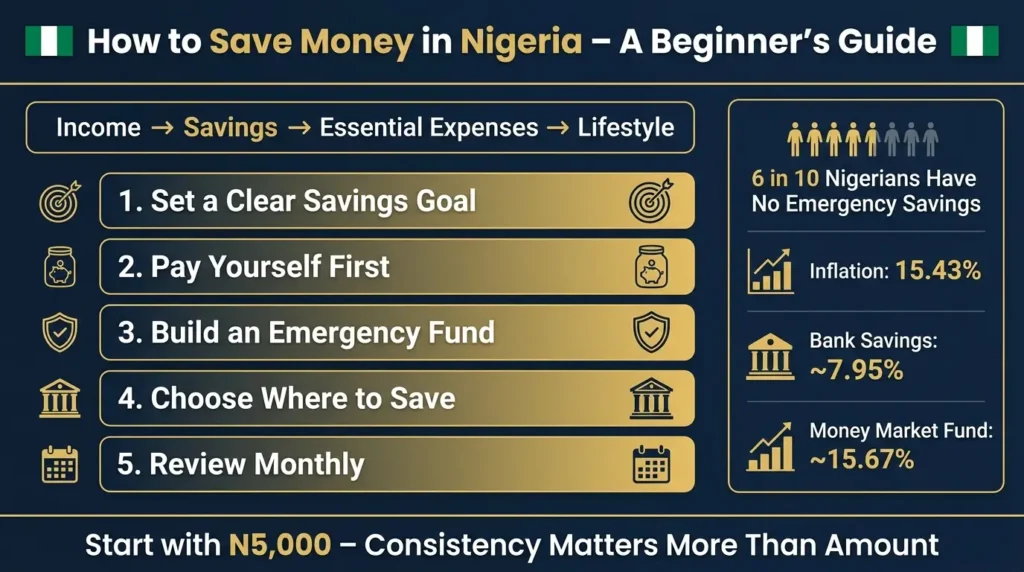
If this sounds familiar, you are not alone. Rising living costs, irregular income and competing financial responsibilities can make saving difficult, even when you earn a reasonable income. According to the PiggyVest Savings Report 2025, the proportion of Nigerians saving monthly dropped to 40% in 2025 from 64% in 2023, while six in ten respondents have no emergency savings. Only 6% of Nigerians feel financially secure .
This how to save money in Nigeria guide provides a practical system for building a savings habit, setting realistic goals, and choosing where to keep your money.
Let’s examine how to save money in Nigeria with clarity and strategic discipline.
1. What Does It Mean to Save Money?
Saving money means setting aside part of your income for future use instead of spending all of it immediately. You might save towards rent, school fees, an emergency, a business, a planned purchase or a future investment.
For example, if you earn N250,000 monthly and set aside N25,000, you are saving 10% of your income. The money does not have to be large before the habit becomes useful. What matters is that you establish a pattern of setting money aside and gradually increase the amount as your circumstances improve.
However, saving money is not simply about accumulating a balance in your bank account. You also need to consider what the money is for, when you will need it and whether the place where you keep it is appropriate for that purpose.
       ┌────────────────────────────────────────────────────────┐
       │   HOW TO SAVE MONEY IN NIGERIA – THE SAVINGS SYSTEM    │
       └───────────────────────────┬────────────────────────────┘
                                   │
         ┌─────────────────────────┼─────────────────────────┐
         ▼                         ▼                         ▼
  [ SET A GOAL ]             [ PAY YOURSELF FIRST ]     [ CHOOSE WHERE ]
  Specific target            Income → Savings →         Bank account,
  and timeframe              Expenses                   money market fund,
  (e.g., N600k rent          Not Income → Expenses      fixed deposit,
  in 12 months)              → Whatever remains         Treasury bills
2. Why Is Saving Money Difficult for Many Nigerians?
Before choosing a savings app or deciding how much to save, it helps to understand what makes saving difficult.
Your expenses consume most of your income. Housing, food, transportation, electricity, education and family responsibilities can take up a substantial part of a household’s income. According to the PiggyVest Savings Report 2025, 30% of Nigerians earn below N100,000 monthly, making it the largest income band in the country. If your essential expenses already consume most of what you earn, saving may require a combination of expense adjustments, income growth and realistic planning.
You wait until the end of the month. Many people intend to save whatever remains after paying their bills. Unfortunately, there is often little left. A better approach is to decide how much you can save when your income arrives, rather than waiting until the month ends.
You do not have a specific savings goal. Saving without a target can make it easy to withdraw money for every attractive purchase or unexpected expense. A clear goal gives your savings a purpose.
You mix savings with spending money. If your savings and everyday spending money are kept together, it can be difficult to know how much you can safely spend. Separating the two can make it easier to track your progress and avoid unnecessary withdrawals.
Your income is irregular. Business owners, freelancers, commission-based workers and self-employed people may not receive the same amount every month. A more practical strategy is to establish a minimum target based on your normal income and save additional amounts when business performs well.
3. Set a Clear Savings Goal
Before you start saving, decide what you are saving for. Different goals require different amounts, timeframes and levels of access to your money.
| Savings Goal | Example Target | Timeframe |
|---|---|---|
| Emergency fund | N300,000 | Gradual |
| Rent | N600,000 | 12 months |
| School fees | N240,000 | 6 months |
| Business equipment | N500,000 | 10 months |
| Holiday or planned purchase | N120,000 | 12 months |
These are illustrative targets, not estimates of what every Nigerian household needs. Once you have identified a goal, calculate the monthly contribution required:
Monthly savings required = Savings target ÷ Number of months available
Suppose you need N600,000 for rent in 12 months: N600,000 ÷ 12 = N50,000 per month.
This gives you a clear target to work towards. If N50,000 is beyond your current capacity, consider whether you can start earlier, reduce the target where appropriate, increase your income or make other adjustments. The purpose of calculating your target is to replace guesswork with a plan.
4. How Much of Your Income Should You Save?
There is no single savings percentage that works for everyone. You may have heard of the 50/30/20 budgeting rule, which allocates 50% of income to needs, 30% to wants and 20% to savings and debt repayment. It can serve as a starting point, but your actual situation may be different.
Someone earning N200,000 and paying rent, school fees and supporting relatives may have less room to save than someone earning the same amount with fewer responsibilities. Instead of abandoning saving because you cannot meet a particular percentage, begin with an amount you can sustain.
| Monthly Income | Saving 5% | Saving 10% | Saving 20% |
|---|---|---|---|
| N100,000 | N5,000 | N10,000 | N20,000 |
| N200,000 | N10,000 | N20,000 | N40,000 |
| N300,000 | N15,000 | N30,000 | N60,000 |
| N500,000 | N25,000 | N50,000 | N100,000 |
The lesson is simple: start with what your circumstances allow, then work towards increasing your savings rate. If you can only save N5,000 monthly today, that is a starting point. You can increase the amount when your income improves or when you identify expenses you can reasonably reduce.
5. Pay Yourself First
One of the most practical ways to build a savings habit is to save before discretionary spending begins. Instead of following this pattern:
Income → Spending → Bills → Whatever remains
Try this:
Income → Planned savings → Essential expenses → Discretionary spending
For example, imagine you earn N300,000 every month and decide to save N20,000. As soon as your income arrives, transfer the N20,000 into your designated savings account or savings product. You now have N280,000 available for other expenses.
This does not mean you should neglect rent, food, debt repayments or other essential obligations. Your savings target must fit a realistic budget. The principle is to make saving a planned expense rather than an afterthought.
If your income is irregular, you can apply the same principle whenever you receive money, using a percentage or minimum contribution that suits your circumstances.
6. Build an Emergency Fund Before Taking Unnecessary Investment Risks
An emergency fund is money reserved for unexpected expenses or a temporary interruption to your income. It can help you handle an urgent bill without borrowing money or selling investments at an unfavourable time.
Examples of emergencies include unexpected medical expenses, urgent home or vehicle repairs, temporary loss of income, emergency travel, and other necessary expenses that cannot reasonably be postponed.
An emergency fund should be accessible when you need it. That is why money reserved for emergencies should not automatically be placed in a long-term investment or an asset whose value can fluctuate substantially.
How Much Should Your Emergency Fund Contain?
A common starting framework is to build towards three to six months of essential living expenses. The appropriate target depends on your income stability, household responsibilities and access to other reliable sources of support.
Suppose your essential monthly expenses are N250,000:
| Coverage | Target |
|---|---|
| 1 month | N250,000 |
| 3 months | N750,000 |
| 6 months | N1,500,000 |
You do not have to accumulate the entire amount immediately. You could start with a smaller initial buffer, then gradually build towards your full target. For someone with an irregular business income or several dependants, a larger reserve may be appropriate.
Important: Your emergency fund is different from money you are saving for a known future expense. Rent due in six months is a planned obligation, not an unexpected emergency. Both need planning, but they should be accounted for separately.
7. Where Should You Keep Your Savings in Nigeria?
Once you have decided how much to save, the next question is where to keep the money. There is no single best option for every savings goal. Your decision should depend on when you need the money, how easily you must access it, the risks involved and whether you expect to earn a return.
Option 1: A Bank Savings Account
A savings account can be suitable for everyday reserves and money you may need at short notice. As of 2026, the benchmark savings deposit rate is approximately 7.95% per annum, though this has been falling following the CBN’s recent rate cuts. Access Bank, Stanbic IBTC Bank, Fidelity Bank, Wema Bank and Premium Trust Bank were among lenders offering savings deposit rates around the 8% range.
Advantages: Convenient access to your money; familiar banking services; useful for separating savings from everyday spending.
Things to consider: Interest rates and account conditions vary; fees and transaction limits may apply; the return may not keep pace with inflation.
Option 2: Digital Savings Apps
Some financial technology platforms offer automated savings, goal-based savings and products with advertised returns. These features may help you build discipline, especially if you struggle to save money manually. However, do not choose a platform based on the advertised rate alone.
Before committing money, check: Which legal entity holds or manages the money? The regulatory status of the provider and the underlying product? Whether the advertised rate is fixed, variable or conditional? Withdrawal restrictions and penalties? Applicable fees and taxes? Whether your money is held as a bank deposit or invested in a financial product?
A product described as a savings plan is not necessarily the same as a bank deposit. The underlying legal and financial arrangement matters.
Option 3: Fixed Deposits
A fixed deposit generally involves placing money with a financial institution for an agreed period in exchange for interest under specified terms. It may be appropriate for money you do not expect to need immediately. Before choosing one, confirm the rate, tenure, minimum amount, early-withdrawal conditions, fees and tax treatment. Do not place your entire emergency fund into a product that may restrict access to your money.
Option 4: Money-Market Mutual Funds
Money-market funds pool investors’ money and invest in short-term money-market instruments, subject to the fund’s investment mandate. They are regulated by the Securities and Exchange Commission (SEC) . They can be worth researching if you want to explore alternatives to ordinary savings accounts.
Stanbic IBTC’s February 2026 factsheet reported a fund return of about 15.67%, while United Capital’s Money Market Fund reported a net effective yield of 15.37% as of April 2026. However, a money-market fund is an investment, not simply a savings account with a higher interest rate. Its return is not necessarily fixed or guaranteed, and its liquidity, charges and risks depend on the particular fund and its terms.
Before investing, review the fund’s current factsheet and offer documents. Check the fund manager, regulatory status, historical performance, fees, redemption arrangements and risks. Do not assume that past returns will continue at the same level in the future.
Option 5: Treasury Bills
Treasury bills are short-term government securities issued by the Federal Government through the relevant debt-management and monetary authorities. They can be suitable for some savings goals when the investment period matches the date you need the money.
As of late 2026, the 364-day Treasury bill stop rate was approximately 15.85%, while the 182-day rate was around 15.80%. However, you should understand the maturity date, minimum investment, purchase process, applicable charges and what happens if you need to exit before maturity. Treasury bills are not interchangeable with instant-access savings accounts. Access to your money before maturity depends on the available arrangements and market conditions.
Which Option Should You Choose?
| Option | Main Consideration | Potentially Suitable Purpose |
|---|---|---|
| Bank savings account | Accessibility and account terms | Everyday reserves |
| Digital savings product | Provider, terms and withdrawal rules | Goal-based saving |
| Fixed deposit | Tenure and early withdrawal | Planned future expenses |
| Money-market fund | Variable returns, fees and redemption | Short-term investment goals |
| Treasury bills | Maturity and access before maturity | Planned expenses aligned with maturity |
This is not a ranking of returns or safety. Actual terms vary between providers and products. The right place for your money depends on its purpose, not simply on which provider advertises the highest rate.
8. Does a Higher Savings Rate Always Mean a Better Deal?
Not necessarily. Suppose two products advertise annual returns of 10% and 15%. At first glance, the second appears more attractive. But you need to ask several questions:
- Is the quoted rate guaranteed?
- Is it an annual rate or a promotional rate?
- Does it apply to the full balance?
- Are there withdrawal restrictions?
- What fees or taxes apply?
- Is the return fixed or variable?
- What risks are you accepting?
A bank deposit, fixed deposit and money-market fund may calculate and distribute returns differently. You must understand the actual product terms before comparing them.
An Illustrative Comparison
Suppose you set aside N100,000 for one year. For illustration, assume each product delivers a constant annual return, the returns are reinvested, and there are no fees or taxes.
| Assumed Annual Return | Value After One Year |
|---|---|
| 10% | N110,000 |
| 11% | N111,000 |
| 15% | N115,000 |
These figures are mathematical examples, not current quotations from any provider. They show why a higher return can make a difference, but they do not tell you whether the product is suitable. For that, you must consider risk, liquidity and the terms of the investment.
9. Understand Inflation Before Choosing Where to Save
Another factor to consider is inflation. Inflation means that the general price level of goods and services increases over time. When prices rise, the same amount of money may buy fewer goods and services.
Nigeria’s headline inflation rate stood at 15.43% in July 2026, according to the CBN. Food inflation remained higher at 17.52%. This means that the purchasing power of your savings is being eroded if your returns are below the inflation rate.
Imagine you have N100,000 today. If a basket of goods that costs N100,000 today costs N110,000 next year, you would need an additional N10,000 to buy the same basket. Now imagine your savings earn 5% over that period. Your balance would rise to N105,000, but it would still fall short of the N110,000 needed to purchase the same basket. Your money has increased in nominal terms, but its purchasing power has declined.
This is why the advertised return alone does not tell the full story. When evaluating a savings or investment product, consider both the monetary return and the effect of inflation on what your money can buy.
10. How to Save Money When Your Income Is Low
You do not have to wait until you earn a large salary before building a savings habit. But you should be realistic about what is possible.
Start with a small, consistent amount. If N5,000 is what you can currently afford, start there. The purpose is to develop a repeatable habit without neglecting essential expenses.
Save windfalls deliberately. If you receive a bonus, gift, commission or unexpected business income, decide in advance how much will go towards your savings goals. You can use part of the money for immediate needs while reserving another part for the future.
Review recurring expenses. Check subscriptions, service charges and other recurring payments. Cancel services you no longer use and compare alternatives where practical. Small adjustments may help, although substantial savings often require looking at larger expenses as well.
Avoid unrealistic targets. A target that repeatedly forces you to borrow before the next payday may be too aggressive. Adjust your contribution until you can sustain it without creating another financial problem.
Look for ways to improve income. There is a limit to how much you can cut from an already tight budget. If essential expenses consume almost everything you earn, additional income may be necessary to make meaningful progress. The goal is not to blame yourself for financial constraints. It is to identify which parts of your financial situation you can realistically improve.
11. Common Savings Mistakes to Avoid
Saving without a purpose. Give each savings goal a clear target and timeframe.
Using emergency savings for non-emergencies. Separate essential reserves from money intended for planned purchases and lifestyle spending.
Locking away money you may need soon. Match the product’s terms to the date you need the money.
Chasing unusually high returns. Verify the provider, product structure and risks. High promised returns with little or no explanation deserve particular scrutiny.
Assuming every digital savings product is a bank deposit. Check what happens to your money legally and financially. Do not assume the same protections apply to every product.
Ignoring fees and withdrawal rules. Charges and restrictions can affect the amount you ultimately receive and when you can access it.
Stopping whenever you miss a target. If an unexpected expense interrupts your plan, reassess your budget and resume saving when you can. A savings habit should be resilient enough to accommodate changes in real life.
12. Action Plan: A Practical Savings System You Can Start This Month
Step 1: Calculate your reliable monthly income. Use a conservative estimate if your income fluctuates.
Step 2: Identify your essential expenses. Calculate what you need for housing, food, transport, utilities, debt obligations and other necessary costs.
Step 3: Choose one savings goal. Start with a priority such as an emergency fund or a known upcoming expense.
Step 4: Set a realistic monthly target. Choose an amount that fits your budget.
Step 5: Decide where to keep the money. Consider access, risk, terms, charges and the purpose of the savings.
Step 6: Transfer the money consistently. Automate the transfer if the service is available and suitable, or make it part of your payday routine.
Step 7: Review your progress monthly. Check how much you saved, whether you met your target and whether your circumstances have changed.
Step 8: Increase the target when you can. As income improves or expenses fall, consider increasing your contributions.
The key is to build a system that can continue working beyond the first month.
13. Frequently Asked Questions
How much should I save monthly in Nigeria?
There is no universal amount. Start with what your income and essential expenses allow, then work towards increasing your savings rate. A percentage-based target can help you adjust as your income changes.
Where is the safest place to save money in Nigeria?
Safety depends on the type of product, the institution providing it, the applicable regulatory framework and how much access you need. Verify the provider and the product’s terms rather than assuming every savings app, bank account or investment has identical protections.
Is it better to save money in a bank or a savings app?
It depends on the specific products. Compare the rate, fees, withdrawal rules, provider, regulatory status and the legal arrangement under which your money is held. Convenience and advertised returns should not be the only considerations.
Should I save or invest first?
If you have no financial buffer, building accessible emergency savings is generally an important early priority. You should also consider expensive debt, upcoming obligations and your investment timeframe. You may be able to save and invest simultaneously when your circumstances permit.
Can I start saving with N5,000?
Yes. If N5,000 fits your budget, it can be a useful starting contribution. The amount you can save will depend on your income, essential expenses and financial responsibilities.
Is a money-market fund the same as a savings account?
No. A money-market fund is an investment fund that invests in short-term instruments. Its returns and risks differ from those of a bank savings account. Review the fund’s documents, charges, redemption rules and risk disclosures before investing.
How can I save money when my salary is not enough?
Start by identifying your essential expenses and reviewing costs you can realistically reduce. Set a modest target if possible, address expensive debt where appropriate and consider ways to increase income. If your income is consistently below essential expenses, budgeting alone may not solve the problem.
14. Final Summary & The Bottom Line
Saving money is not simply about choosing an account with an attractive interest rate. It is about deciding what your money is for, setting realistic targets, building financial discipline and choosing a place to keep your money that suits your needs.
  ┌──────────────────────────────────────────────────────────┐
  │   HOW TO SAVE MONEY IN NIGERIA – KEY TAKEAWAYS           │
  ├─────────────────────┬────────────────────────────────────┤
  │ Set a Goal          │ Specific target and timeframe      │
  │                     │ (e.g., N600k rent in 12 months)    │
  ├─────────────────────┼────────────────────────────────────┤
  │ Pay Yourself First  │ Income → Savings → Expenses        │
  │                     │ Not Income → Expenses → Savings    │
  ├─────────────────────┼────────────────────────────────────┤
  │ Emergency Fund      │ 3–6 months of essential expenses   │
  │                     │ 6 in 10 Nigerians have none        │
  ├─────────────────────┼────────────────────────────────────┤
  │ Savings Rates       │ Bank: ~7.95% | Money Market:       │
  │                     │ ~15.67% | T-Bills: ~15.85%         │
  ├─────────────────────┼────────────────────────────────────┤
  │ Inflation           │ 15.43% (July 2026) — your savings  │
  │                     │ must beat this to preserve wealth  │
  └─────────────────────┴────────────────────────────────────┘
The Bottom Line:
Start with the amount you can afford. Build an emergency fund gradually. Keep planned expenses separate from long-term investments. Compare products carefully and understand the risks before committing your money. As your income grows, you can increase your savings contributions and explore suitable investment opportunities.
The first goal is to develop a savings system you can maintain. The next is to understand how to protect the purchasing power of what you save.
Your Next Steps:
- Track your spending for 30 days – Know exactly where your money goes
- Set a savings goal – Even N5,000 per month is a start
- Build an emergency fund – Aim for at least 3–6 months of essential expenses
- Choose where to keep your savings – Match the product to your goal’s timeframe
- Review your progress monthly – Adjust as your circumstances change
For more weekly NGX updates and strategy guides, explore our market trends and analysis archive.
Disclaimer: This article is for educational purposes only and does not constitute personalised financial or investment advice. Rates, fees, product conditions and regulations can change. Verify current information with the relevant institution or regulator before making financial decisions.