
NGX Investor Toolkit: How to Open a Brokerage Account in Nigeria (Module 2)
By Market Formula Editorial Team / July 2026
Introduction
Knowing about the stock market is one thing. Actually getting your money into it is another. This NGX investor toolkit module 2 walks you through the exact account structure, the platforms available to you, and how to place your very first trade — step by step.
Too many beginners understand the theory of investing but stall at the practical hurdle: opening an account and buying their first share. The process is simpler than you think, but there are critical details — like where your shares are actually stored and how to spot a scam — that can make the difference between a smooth start and a costly mistake.
Let’s build your practical investor toolkit from the ground up.
1. The Account Structure You Need to Understand First – NGX Investor Toolkit Module 2
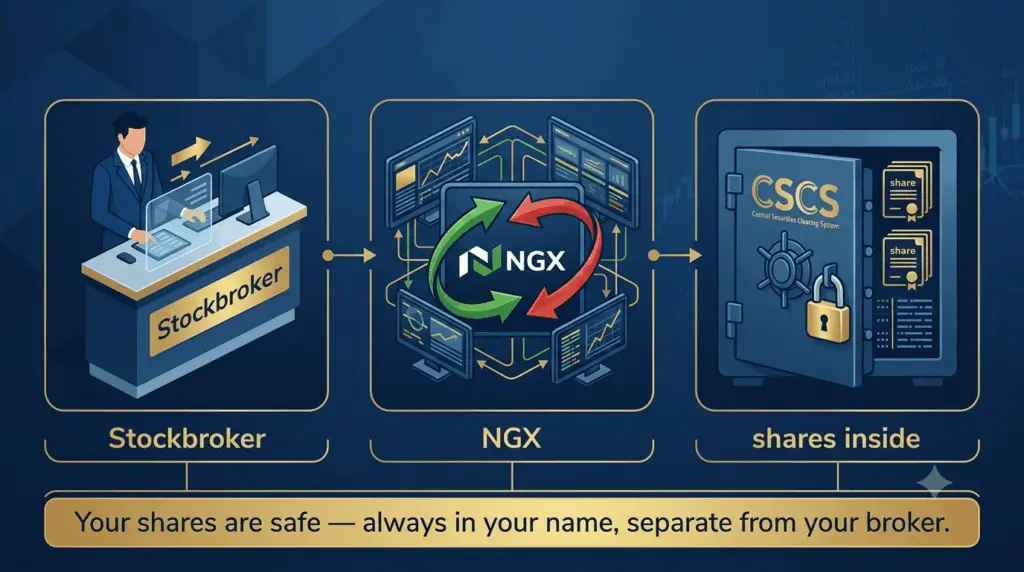
Before you open anything, you need to understand something that confuses almost every Nigerian beginner: your shares are not held by your stockbroker.
This surprises many people. When you buy shares on the NGX, the broker executes the trade on your behalf — but the actual shares are stored somewhere else entirely. This NGX investor toolkit module 2 explains the two entities involved.
Your Stockbroker
The stockbroker is your access point to the NGX. They are the licensed intermediary who places buy and sell orders on your behalf. Think of them like an agent. You tell them what you want, they go to the market and get it for you.
Some brokers are traditional — you call them, send an email, or walk into their office. Others are modern digital platforms where you do everything yourself through an app. Either way, the broker’s job is execution and customer service. They do not hold your shares permanently.
All stockbroking firms operating in Nigeria must be licensed by the Securities and Exchange Commission (SEC) , which conducts rigorous due diligence and continuous monitoring to ensure adherence to professional standards and financial solvency. The list of licensed stockbrokers is published on the websites of the SEC and NGX Group.
CSCS — Central Securities Clearing System
This is where your shares actually live.
The Central Securities Clearing System (CSCS) is the central depository for all NGX-listed shares in Nigeria. Incorporated on July 29, 1992, and commencing operations on April 14, 1997, CSCS is the Clearing and Settlement House of the Nigerian Capital Market. Every investor who buys shares on the NGX has a unique CSCS account number — think of it like a share wallet that belongs only to you. No matter which broker you use, your shares always sit in your personal CSCS account.
Why does this matter? It means your shares are safe even if your stockbroker closes down, goes bankrupt, or you decide to switch platforms. Your shares do not disappear with the broker — they remain in your CSCS account and you can transfer them to a new broker whenever you choose.
When you open a brokerage account, the broker automatically creates or links a CSCS account to your profile. You will receive a CSCS number — keep it safe. CSCS offers an Online Portfolio Management View service that provides investors with access to view their respective stock portfolio in addition to services provided by intermediary stockbrokerage firms. You can monitor your stock position, know the “Buy” and “Sell” prices of your stocks, and view your transaction history independently of your broker at any time.
CSCS has also launched innovative services to improve accessibility. In partnership with MTN Nigeria, CSCS introduced the *7270# USSD Code Service, designed to democratize access to investment services by enabling investors to check balances, stock positions, and Direct Cash Settlement (DCS) status directly from their mobile phones, without the need for internet access.
The simple way to picture the relationship:
| Entity | Role |
|---|---|
| Your Broker | The shop where you place your order |
| The NGX | The market where the transaction happens |
| The CSCS | The safe where your purchases are stored |
All three work together every time you buy or sell a share.
2. Your Brokerage Options in Nigeria (2026)
You have two main routes to choose from — traditional stockbrokers and digital investment platforms. Each has its strengths depending on your situation.
Route 1 — Traditional SEC-Licensed Stockbrokers
These are established brokerage firms that have been operating in Nigeria for years. They are licensed by the SEC and are members of the NGX. Examples include Meristem Securities, Stanbic IBTC Stockbrokers, Chapel Hill Denham, CardinalStone, and FBNQuest.
Traditional brokers are a good choice if you are investing larger amounts, want a dedicated account officer, or prefer to speak with a human being before making decisions. Some offer research reports, portfolio management services, and investment advisory — useful if you want professional guidance alongside your own analysis.
The process is typically more formal — you fill in physical or scanned forms, provide your KYC documents, and an account officer walks you through setup. Minimum investments vary but are generally higher than digital platforms.
Regulatory Note: In January 2026, the SEC revised minimum capital requirements for market operators. Brokers executing client trades are now required to maintain a minimum capital of ₦600 million (up from ₦200 million), while dealers engaged in proprietary trading must hold ₦1 billion. Broker-dealers providing combined services must maintain ₦2 billion. All affected entities are required to comply by June 30, 2027. This regulatory strengthening means the brokers you invest through are better capitalized and more resilient than ever before.
Route 2 — Digital Investment Platforms
These are app-based platforms designed to make investing accessible to everyday Nigerians, particularly younger investors. The most commonly used ones include:
- Chaka — One of the earliest Nigerian digital brokers. Gives you access to both NGX-listed stocks and US stocks (NYSE/NASDAQ) from the same app. Particularly useful if you want to invest locally and internationally from one platform.
- Trove Finance — Similar dual-market access. Known for its clean interface and beginner-friendly experience. Allows you to start with small amounts and buy fractional shares of US stocks.
- Bamboo — Primarily focused on US stocks but also offers NGX access. Strong community and educational content within the app.
- Meristem’s Trade / Stanbic IBTC’s Online Trading — Digital arms of traditional brokers. Combines the credibility of an established institution with the convenience of an app.
In July 2026, First Securities Brokers launched the FirstInvest App, offering investors a seamless digital experience to open and manage their investment accounts, monitor portfolios, and trade equities listed on the NGX directly from their mobile devices.
Starting capital: Some brokers let you begin with around ₦10,000, and several digital apps allow entry points as low as ₦1,000. If you live abroad, you can still invest — most brokers will accept an international passport and a foreign utility bill alongside your BVN to satisfy KYC checks.
What to Look for When Choosing
There are five things that should guide your decision before you commit to any platform:
| Factor | What to Check |
|---|---|
| SEC Regulation | Only use platforms licensed by the SEC. Check the public register at sec.gov.ng |
| Fees and Commissions | Compare brokerage commissions, SEC fees, NGX fees, and CSCS fees |
| Ease of Funding/Withdrawal | How easily can you move money in and out? How long do withdrawals take? |
| Customer Support | Can you reach a real person when something goes wrong? |
| Account Minimum | Match the platform’s requirements to your starting capital |
The One Red Flag You Must Never Ignore
If anyone — whether on Instagram, TikTok, WhatsApp, or in person — tells you to send your money to them so they can buy stocks on your behalf, and they cannot show you a verifiable CSCS account in your own name, walk away. This is one of the most common financial scams operating in Nigeria right now. Legitimate investing always puts the shares in your name, in your own CSCS account. No exceptions.
3. Step-by-Step: How to Open Your NGX Account
The process is largely the same whether you use a traditional broker or a digital platform. This NGX investor toolkit module 2 walks you through exactly what to expect.
Step 1 — Gather Your Documents
You will need the following to complete your KYC (Know Your Customer) verification:
- Valid government-issued ID — National ID card, driver’s licence, international passport, or voter’s card
- BVN (Bank Verification Number) — this is mandatory
- Proof of address — a utility bill or bank statement showing your address, ideally not older than 3 months
- Passport photograph
- Your bank account details for funding and withdrawals
Have digital copies of all these ready in JPEG before you begin. It speeds up the process significantly.
Step 2 — Complete the Account Opening Form
For digital platforms, this is done entirely on the app or website — fill in your personal details, upload your documents, and submit. Verification typically takes between 24 hours and 3 business days depending on the platform.
For traditional brokers, you may be required to submit physical forms or visit a branch. Some now accept scanned copies via email.
During this process, your CSCS account will be created automatically and linked to your brokerage profile. In April 2026, CSCS announced enhancements to its investor onboarding processes aimed at improving efficiency, supporting faster account creation, and enabling more seamless interaction across market participants.
Step 3 — Fund Your Account
Once your account is verified and active, you fund it via bank transfer to the broker’s designated account. Most platforms now support instant transfers via USSD or internet banking. Keep your funding receipt until you confirm the money reflects in your brokerage account.
Step 4 — Search for the Stock You Want to Buy
Use the platform’s search function to find the company by its name or ticker symbol. Every NGX-listed company has a unique ticker. For example:
| Company | Ticker Symbol |
|---|---|
| Zenith Bank | ZENITHBANK |
| MTN Nigeria | MTNN |
| Dangote Cement | DANGCEM |
| GTCO | GTCO |
Step 5 — Place Your Order
This is where most beginners get confused, so let me explain the two order types you will encounter.
| Order Type | What It Means | When to Use |
|---|---|---|
| Market Order | Buy immediately at whatever the current available price is | When you want to execute quickly and are not concerned about the exact price |
| Limit Order | Set the exact price you are willing to pay; order only executes if a seller matches that price | When you want to control the exact price you pay |
For beginners, limit orders are generally better practice — they protect you from accidentally paying more than you intended, especially for less liquid stocks where prices can move between the time you click and the time the order is processed.
Step 6 — Confirm Your Trade and Check Your CSCS
Once your trade is executed, you will receive a contract note from your broker — either by email or within the app. This is your official proof of purchase. It shows the stock you bought, the quantity, the price, and the fees charged. Save every contract note.
From 1 June 2026, the market moved to a T+1 settlement cycle, which means trades now settle one business day after the trade date rather than two. This means your shares will appear in your CSCS account within one business day of your trade. This is a significant improvement from the previous T+2 and T+3 cycles, providing faster access to your shares and quicker capital turnaround.
4. Understanding the Real Cost of Trading on the NGX
Every trade comes with costs. Understanding them helps you avoid surprises and make smarter decisions. This NGX investor toolkit module 2 breaks down exactly what you pay.
Breakdown of Trading Costs
Example: If you buy ₦100,000 worth of stock, you might pay:
- SEC Fee: ₦300
- CSCS Fee: ₦300
- Brokerage Commission (~1%): ₦1,000
- Trade Alert Fee: ₦4
- Stamp Duty: ₦80
- VAT on fees: ~₦120
- Total cost: ~₦1,800 (1.8%)
When combined, trading costs typically range between 1.5% and 2.5% of your transaction value. This is why frequent trading can be expensive — each trade eats into your returns.
5. Understanding the ±10% Daily Price Limit
This is something unique to the NGX that every investor needs to know — especially if you are coming from a forex background where prices move freely.
The NGX operates a daily price movement limit of ±10%. This means that no matter what is happening, a stock’s price cannot rise or fall by more than 10% from its previous closing price in a single trading day.
Example: If Zenith Bank closed yesterday at ₦30.00, today it can trade anywhere between ₦27.00 and ₦33.00 — but not outside that range.
This rule exists to prevent extreme volatility, panic selling, and market manipulation. It is a protection mechanism.
What does this mean for you practically?
It means that if terrible news breaks about a company — a scandal, a profit warning, a regulatory fine — the stock cannot crash by 40% in one day the way stocks on international exchanges sometimes do. It will fall 10% today, 10% tomorrow if selling continues, and so on. This gives you time to react and manage your position rather than waking up to a catastrophic overnight loss.
On the upside, it also means momentum can build gradually. A stock in strong demand may hit the +10% limit for several consecutive days — called going on bid — which is a signal of aggressive buying pressure.
6. Action Plan: Your First Steps as an NGX Investor
Now that you have completed this NGX investor toolkit module 2, here is your practical action plan.
Step 1: Choose your broker.
Decide between a traditional broker and a digital platform. Check SEC registration. For a deeper dive into traditional brokers, see Module 1 – NGX Basics.
Step 2: Gather your documents.
Get your BVN, valid ID, proof of address, and passport photograph ready.
Step 3: Open your account and get your CSCS number.
Complete the KYC process. Your broker will generate your CSCS number.
Step 4: Fund your account.
Start with a small amount — ₦10,000 to ₦50,000 is a sensible beginning.
Step 5: Place your first trade.
Use a limit order to control your price. Start with a liquid stock from the NGX 30.
Step 6: Save your contract note and check your CSCS.
Verify your shares appear in your CSCS account within T+1 settlement.
7. Module 2 — Quick Summary
| Concept | What You Now Know |
|---|---|
| CSCS | Your personal share safe — separate from your broker, always in your name |
| Broker options | Traditional firms vs. digital apps — each suits different investor types |
| SEC regulation | Only invest through SEC-licensed platforms — verify at sec.gov.ng |
| Account opening | 6 clear steps from documents to your first executed trade |
| Order types | Market order = buy now at current price. Limit order = buy only at your chosen price |
| T+1 settlement | Shares officially settle 1 business day after your trade |
| Trading costs | ~1.5–2.5% per trade including SEC, NGX, CSCS fees, brokerage, and VAT |
| ±10% daily limit | NGX price movement is capped daily — protection against sudden crashes |
8. Final Summary & The Bottom Line
The NGX investor toolkit module 2 has covered everything you need to open your brokerage account and place your first trade. The process is straightforward: choose a licensed broker, complete your KYC, fund your account, and place your order.
  ┌──────────────────────────────────────────────────────────┐
  │       NGX INVESTOR TOOLKIT – KEY TAKEAWAYS               │
  ├─────────────────────┬────────────────────────────────────┤
  │ CSCS Account        │ Your shares are safe – always in   │
  │                     │ your name, separate from your      │
  │                     │ broker[reference:41]                   │
  ├─────────────────────┼────────────────────────────────────┤
  │ Broker Options      │ Traditional firms or digital apps │
  │                     │ – both must be SEC-licensed[reference:42]│
  ├─────────────────────┼────────────────────────────────────┤
  │ Account Opening     │ 6 steps: documents → KYC → fund   │
  │                     │ → search → order → confirm        │
  ├─────────────────────┼────────────────────────────────────┤
  │ Trading Costs       │ ~1.5–2.5% per trade – trade       │
  │                     │ less frequently to minimize fees  │
  ├─────────────────────┼────────────────────────────────────┤
  │ T+1 Settlement      │ Shares settle 1 business day      │
  │                     │ after your trade[reference:43]     │
  ├─────────────────────┼────────────────────────────────────┤
  │ ±10% Daily Limit    │ Price movement capped daily –     │
  │                     │ protection against extreme swings │
  └─────────────────────┴────────────────────────────────────┘
The Bottom Line:
Opening a brokerage account and getting your CSCS number are the two most important practical steps you will take as a new NGX investor. With modern digital platforms, the process takes minutes. Start small. Learn the mechanics. Understand the costs. And remember: the most important thing is to start. Your future self will thank you.
Coming up in Module 3: The heart of this entire kit — Fundamental Analysis for NGX Stocks. You will learn how to read a company’s financial statements, calculate the key ratios that reveal whether a stock is worth buying, and apply the exact same framework professional analysts use to separate strong companies from weak ones.
For more weekly NGX updates and strategy guides, explore our market trends and analysis archive.
Disclaimer: This article is for informational purposes only and does not constitute investment advice. Always conduct your own research or consult a qualified financial advisor before investing. Past performance does not guarantee future results.