
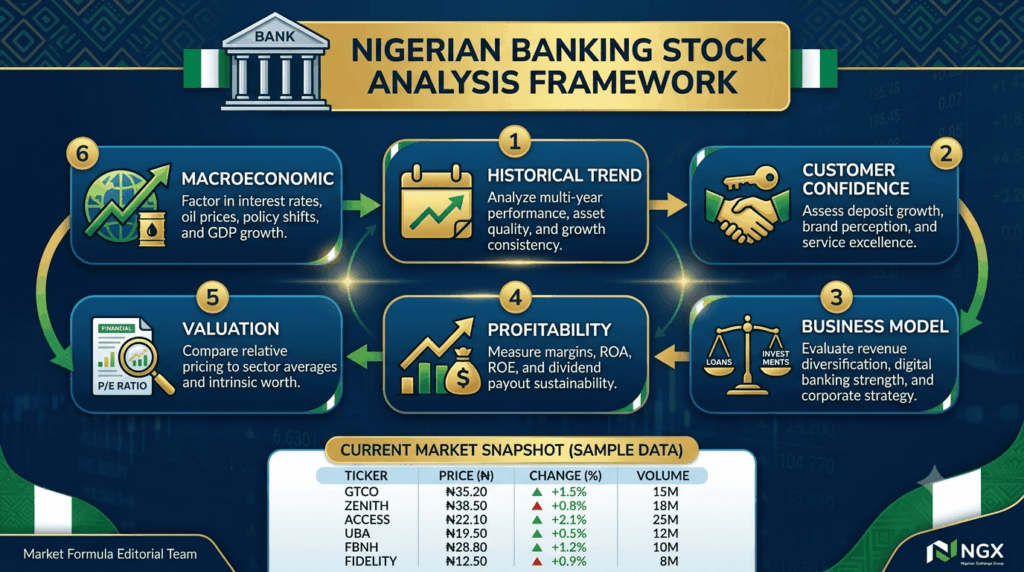
The Complete Framework for Investing in Nigerian Banking Stocks: A Strategic Guide for 2026
By Market Formula Editorial Team / July 2026
Introduction
Investing in Nigerian banking stocks requires a fundamentally different approach than investing in oil and gas, consumer goods, or industrial companies. Banks are unique—they are leveraged to the economy, sensitive to interest rates, and heavily regulated. A framework that works for Dangote Cement or MTNN will not necessarily work for Zenith Bank or GTCO.
This guide presents a specialized, six-step analysis framework for evaluating Nigerian banking stocks. Whether you are a beginner building your first portfolio or an experienced investor looking to refine your approach, this framework will help you separate fundamentally strong banks from those that merely look attractive on the surface.
The Nigerian banking sector has been through a transformative period. Following the CBN’s recapitalisation programme, 12 deposit money banks listed on the NGX saw their combined market capitalisation surge to N25.6 trillion as of July 17, 2026—a 58.6% increase from N16.12 trillion in December 2025. By the recapitalisation deadline, banks collectively raised over N4.65 trillion in fresh capital, fundamentally reshaping the sector’s risk profile and growth potential.
Let’s examine the Nigerian banking stock analysis framework with clarity and strategic discipline.
1. Historical Trend Analysis (4–5 Year Window)
Successful banking investment requires looking beyond a single year’s report to understand the “big picture.” You should analyze historical records from at least a four to five-year period to identify consistent growth patterns and build the confidence necessary to hold a stock through market dips.
Why Long-Term History Matters
A single year of strong performance can be misleading. A bank might post impressive profits due to one-off gains—such as foreign exchange revaluation or a large asset sale—that are unlikely to repeat. Conversely, a bank might have a weak year due to exceptional provisions that clean up its balance sheet for future growth.
By examining a 4–5 year window, you can identify:
- Consistent earnings growth – Is the bank growing profits steadily, or are they volatile?
- Resilience through cycles – How did the bank perform during economic downturns?
- Management effectiveness – Has the bank consistently improved its key metrics over time?
Sector Performance Context
The Nigerian banking sector has demonstrated remarkable resilience. The NGX Banking Index closed July 10, 2026 at 41.78% year-to-date growth, making it the third-best performing index after Oil & Gas (96.80%) and Industrial Goods (88.73%). However, the sector has also experienced significant volatility, with the Banking Index declining to 2,118.28 points in mid-July from 2,149.14 points amid profit-taking.
This volatility underscores why a long-term historical perspective is essential—short-term fluctuations should not distract from a bank’s underlying trajectory.
2. Assessing Customer Confidence
Customer confidence is the top priority because it provides the bank with its cheapest source of capital. A bank with strong deposit growth has a stable, low-cost funding base that allows it to lend profitably and weather economic shocks.
The Metric: Deposit Growth Trend
Analyze the bank’s deposit trend over several years. If deposits are growing steadily, it suggests customers trust the institution to continue existing and being strong.
What to Look For:
- Consistent growth – Deposits growing year after year, even during economic uncertainty
- Growth exceeding inflation – Real deposit growth (above inflation) indicates genuine customer confidence
- Diversified deposit base – A mix of retail and corporate deposits is more stable than concentration in one segment
Why This Matters
Deposits are the lifeblood of a bank. Unlike borrowing from the interbank market or issuing bonds, customer deposits are:
- Cheaper – Banks pay lower interest on deposits than on wholesale funding
- More stable – Retail deposits are stickier than institutional funding
- A sign of trust – Customers deposit money because they believe the bank is safe
3. Evaluating the Business Model
Identify how the bank utilizes its capital to generate revenue. Banks generally fall into three categories based on their asset allocation strategy.
The Three Business Models
| Model | Description | Characteristics |
|---|---|---|
| Loan-Driven | Bulk of funds are advanced to customers as loans | Higher yields but higher credit risk; performs well in economic expansions |
| Investment-Driven | Bulk of funds are placed in investment securities like treasury bills and government bonds | Lower yields but lower risk; provides stable income regardless of economic conditions |
| Hybrid Model | Nearly equal weight in both loans and investment securities | Ideal – can remain profitable in both high and low-interest-rate environments |
Why Hybrid Banks Are Ideal
The Nigerian interest rate environment has been volatile. The CBN’s Monetary Policy Rate (MPR) has remained elevated at 26.5% through mid-2026, with analysts expecting rates to remain high through the year.
In a high-rate environment:
- Loan-driven banks benefit from higher lending rates but face increased default risk
- Investment-driven banks benefit from higher yields on government securities
A hybrid bank with a balanced portfolio can capture upside from both strategies while diversifying risk. When interest rates rise, the investment portfolio generates higher yields. When the economy slows and loan demand weakens, the investment portfolio provides stable income.
4. Profitability and Efficiency Metrics
Profitability in banking is not determined by Profit After Tax (PAT) alone; it is found in the core operations. These metrics reveal whether a bank is genuinely efficient or simply benefiting from external factors.
A. Net Interest Margin (NIM) vs. Cost of Funds
NIM represents the bank’s “gross margin” on its interest-bearing assets—the difference between what it earns on loans and investments and what it pays on deposits and borrowings.
What to Check:
- NIM should be significantly higher than the cost of funds
- A widening NIM indicates improving profitability
- A narrowing NIM suggests competitive pressure or rising funding costs
B. Growth in Interest-Bearing Assets
Monitor the growth of loans and investment securities, as these are the primary drivers of future profitability. A bank that is growing its loan book and investment portfolio is positioning itself for future earnings growth.
C. Cost-to-Income Ratio
This measures operational efficiency. A bank should ideally spend less than 50% of its gross earnings on operating expenses.
What the Ratio Tells You:
- Below 50% – Highly efficient; operating costs are well-controlled
- 50%–60% – Acceptable; room for improvement
- Above 60% – Inefficient; high costs are eating into profits
5. Valuation and Entry Strategy
To find a “breakout” stock, you must identify when the market is lagging behind the bank’s actual performance. This is where valuation discipline separates successful investors from those who buy at the peak.
Current Prices of Tier-1 Banking Stocks (July 2026)
A. Historical Price-to-Book Value
Compare what the bank is worth on paper (book value) to what the market is currently pricing it at. A bank trading below its book value may be undervalued, while one trading at a significant premium may be overvalued.
How to Use It:
- Look for banks trading at or below their historical average P/B ratio
- A low P/B ratio combined with improving fundamentals is a powerful buy signal
- Be cautious of banks trading at extreme premiums to book value
B. EPS vs. Share Price Growth
Seek out banks where Earnings Per Share (EPS) is growing faster than the share price. This indicates the share price has yet to catch up with the bank’s financial reality.
Analyst Projections:
Among the banks under coverage, Access Holdings offers the highest projected upside of 113.7%, followed by:
- UBA – 49.3% upside
- FCMB – 50.3% upside
- Zenith Bank – 42.5% upside
- Fidelity Bank – 31.8% upside
- GTCO – 26.1% upside
Individual Analyst Targets:
| Bank | Analyst Target Price | Upside Potential |
|---|---|---|
| Access Holdings | N39.34 | +64.95% |
| Zenith Bank | N149.39 | ~39% |
| GTCO | N154.61 | +22.13% |
| UBA | N60.20 | ~36% |
| Fidelity Bank | N26.99 | ~46% |
C. The Entry Point
The time you enter is as important as the exit. Look for undervalued opportunities before they become social media “hype.”
Strategies for Entry:
- Accumulate on weakness – Buy when the sector is out of favor
- Use dollar-cost averaging – Enter in small tranches over time
- Wait for pullbacks – Even strong banks experience temporary corrections
D. Dividend Yield as a Value Signal
Dividend-paying banks are particularly attractive in Nigeria’s high-interest-rate environment. UBA’s Board of Directors is scheduled to meet on August 13, 2026 to consider the 2026 Half-Year Audited Financial Statements and the proposal for an interim dividend. Zenith Bank’s Board meets on July 29, 2026 to review H1 numbers and recommend an interim dividend. GTCO’s earnings date is set for July 28, 2026.
These upcoming catalysts are driving significant investor interest. UBA’s share price climbed by 10.97% week-on-week to N45.50 as of July 2026, driven by increased market activity ahead of the half-year earnings release.
6. Macroeconomic Considerations
Banking performance is tied to the broader economy and regulatory environment. Understanding these macro factors is essential for timing your investments and managing risk.
A. Recapitalization
The CBN’s recapitalisation programme, which concluded in March 2026, required banks to meet significantly higher capital thresholds. The “big six” of Nigerian banks—Access, Zenith, GTBank, UBA, First Bank (FBNH), and Fidelity Bank—successfully met the arduous N500 billion capital barrier, retaining their international banking licenses.
Why This Matters for Investors:
- Stronger balance sheets – Banks are better capitalized to absorb shocks
- Reduced systemic risk – The banking sector is more resilient
- Increased lending capacity – Banks can fund larger projects and expand
B. Interest Rates
Elevated interest rates (high MPR) generally help sustain growth for banks that have increasing interest-bearing assets. The CBN has maintained the MPR at 26.5%, with analysts expecting rates to remain high through 2026.
For Banking Investors:
- Higher net interest margins – Banks earn more on loans and investments
- Increased cost of funds – Banks pay more on deposits, potentially compressing margins
- Credit risk concerns – Higher rates can lead to increased loan defaults
CardinalStone Research notes that “the Central Bank of Nigeria is unlikely to cut interest rates before year-end because of renewed inflation concerns and election-related fiscal risks. That means yields on Treasury bills and bonds are expected to remain elevated, allowing banks to sustain strong net interest margins”.
C. Market Capitalisation Growth
The 12 deposit money banks listed on the NGX saw their combined market capitalisation increase to N25.6 trillion as of July 17, 2026. GTCO leads with N4.72 trillion, followed by Zenith Bank at N4.68 trillion. First HoldCo follows at N4.36 trillion, while UBA and Stanbic IBTC Holdings have market capitalisations exceeding N2 trillion.
D. Sector Outlook for H2 2026
CardinalStone forecasts the Nigerian stock market will deliver a 24.9% return in the second half of 2026, driven by moderating inflation, exchange rate stability, stronger corporate profitability, and the potential re-inclusion of Nigeria into the FTSE Russell Frontier Market Index.
7. The Tier-1 Banking Landscape in 2026
Understanding the competitive landscape helps contextualize your analysis. The “big six” Nigerian banks have all met the ₦500 billion international banking threshold.
Key Observations:
- First HoldCo led the gainers’ chart with a 38.7% weekly return as of mid-July 2026
- Fidelity Bank followed with a 15% weekly gain
- First HoldCo’s stock price grew by 100.31% year-to-date, lifting its market capitalisation from N2.01 trillion in 2025 to N4.36 trillion
- Zenith Bank’s stock price gained 84.47% year-to-date
- GTCO’s stock price appreciated by 42.45% year-to-date to N129.20 per share
8. Action Plan: Applying the Framework
Now that you understand the Nigerian banking stock analysis framework, here is your practical action plan.
Step 1: Screen for banks with strong deposit growth.
Use the customer confidence metric to identify banks with consistently growing deposits.
Step 2: Evaluate the business model.
Prioritize banks with a hybrid model—balanced between loans and investment securities.
Step 3: Analyze profitability metrics.
Look for NIM exceeding cost of funds, growing interest-bearing assets, and a cost-to-income ratio below 50%.
Step 4: Assess valuation.
Compare P/B ratio to historical averages and look for EPS growth outpacing share price growth. Consider the analyst targets: Access Holdings (N39.34), Zenith Bank (N149.39), GTCO (N154.61), UBA (N60.20), and Fidelity Bank (N26.99).
Step 5: Consider macroeconomic conditions.
Factor in interest rates, inflation, and regulatory developments.
Step 6: Choose your entry point.
Accumulate on weakness, use dollar-cost averaging, and avoid chasing hype.
9. Final Summary & The Bottom Line
The Nigerian banking stock analysis framework provides a systematic approach to evaluating banks in one of the NGX’s most important sectors. By focusing on historical trends, customer confidence, business models, profitability metrics, valuation, and macroeconomic conditions, you can make informed investment decisions.
text
  ┌──────────────────────────────────────────────────────────┐
  │    NIGERIAN BANKING STOCK ANALYSIS FRAMEWORK – SUMMARY   │
  ├─────────────────────┬────────────────────────────────────┤
  │ 1. Historical Trend │ 4–5 year window; identify          │
  │    Analysis         │ consistent growth patterns         │
  ├─────────────────────┼────────────────────────────────────┤
  │ 2. Customer         │ Deposit growth trend – cheapest    │
  │    Confidence       │ source of capital                  │
  ├─────────────────────┼────────────────────────────────────┤
  │ 3. Business Model   │ Hybrid (loans + investments)       │
  │                     │ is ideal                           │
  ├─────────────────────┼────────────────────────────────────┤
  │ 4. Profitability    │ NIM > cost of funds; cost-to-     │
  │    & Efficiency     │ income ratio < 50%                 │
  ├─────────────────────┼────────────────────────────────────┤
  │ 5. Valuation &      │ P/B vs. history; EPS growth >      │
  │    Entry Strategy   │ share price growth                 │
  ├─────────────────────┼────────────────────────────────────┤
  │ 6. Macroeconomic    │ Interest rates, inflation,         │
  │    Considerations   │ recapitalisation                   │
  └─────────────────────┴────────────────────────────────────┘
Current Market Snapshot (July 2026):
The Bottom Line:
The Nigerian banking sector has emerged from its recapitalisation programme stronger and more resilient than ever. The Nigerian banking stock analysis framework equips you with the tools to identify the banks that are genuinely well-positioned for the future. Whether you are accumulating tier-1 giants like GTCO, Zenith, or Access Holdings, or exploring mid-tier opportunities, discipline and a systematic approach will serve you better than chasing headlines or social media hype.
As CardinalStone Research notes, “the 2025 balance sheet clean-up and recapitalisation have strengthened banks’ capacity to deliver meaningful returns and shareholder dividends”. With analysts forecasting a 24.9% return for the NGX in the second half of 2026, the banking sector remains a core pillar of any well-constructed Nigerian equity portfolio.
The most successful banking investors are not those who buy at the peak—they are those who accumulate when the market is mispricing quality. Use this framework to find those opportunities.
Disclaimer: This article is for informational purposes only and does not constitute investment advice. Always conduct your own research or consult a qualified financial advisor before investing. Past performance does not guarantee future results. Stock prices and analyst targets are subject to change.