
NGX Basics Beginner Guide: Nigerian Stock Market Starter Kit (Module 1)
By Market Formula Editorial Team / July 2026
Introduction
Before you invest a single naira in the Nigerian stock market, you need to understand the playing field. This NGX basics beginner guide is your foundation — in plain English, no finance degree required. Whether you have ₦5,000 or ₦5 million to start, understanding how the NGX actually works, what the key numbers mean, and how different sectors behave will give you a massive advantage over investors who skip these basics.
Too many beginners jump in blindly, chasing hot tips or “flying stocks,” only to lose money because they never took the time to learn the fundamentals. This NGX basics beginner guide is designed to change that. Let’s build your Nigerian stock market starter kit from the ground up.
1. What Is the NGX and How Does It Actually Work? – NGX Basics Beginner Guide
1.1 The Nigerian Exchange Group (NGX) Explained
Let’s start from the very beginning.
The NGX stands for the Nigerian Exchange Group. It is the official marketplace where shares of Nigerian companies are bought and sold. You may have also heard it called the NSE — that was its old name, the Nigerian Stock Exchange. Following a demutualisation process, the Exchange was rebranded to Nigerian Exchange Group Plc (NGX Group) in 2021, with the operating exchange becoming Nigerian Exchange Limited (NGX). Many people still use both names interchangeably — they refer to the same thing.
Think of the NGX like a large, organized market — similar to a physical market in Lagos or Ibadan, except instead of buying tomatoes or fabric, people are buying and selling small pieces of companies. This NGX basics beginner guide starts with this simple analogy because it helps demystify what can seem like a complex system.
When a company like Dangote Cement or Zenith Bank wants to raise money from the public, they list their shares on the NGX. Once listed, anyone — including you — can buy a piece of that company. When the company grows and makes more profit, the value of your piece grows too. That is the basic idea.
How Does a Trade Actually Happen?
You cannot walk into the NGX building and buy shares yourself. Everything goes through a licensed stockbroker. Here is the simple flow:
- You open an account with a licensed stockbroker
- You tell them (or their app tells the system) which stock you want to buy and at what price
- The order goes to the NGX trading system — which is now fully electronic
- If someone is willing to sell at your price, the trade is matched and executed
- Your shares are recorded in your name at the Central Securities Clearing System (CSCS)
NGX Trading Hours
The NGX trading session runs Monday to Friday. Effective April 27, 2026, the Exchange expanded its trading window from 9:00 a.m. to 4:00 p.m. (WAT) , shifting the opening earlier from 9:30 a.m. and extending the close from 2:30 p.m. This expansion was approved by the Securities and Exchange Commission (SEC) Nigeria and is designed to deepen market liquidity, enhance price discovery, and broaden investor access.
Outside of those hours, no trades are executed — unlike forex, which runs 24 hours. This is an important difference you will need to plan around.
Who Regulates the NGX?
The NGX is regulated by the Securities and Exchange Commission Nigeria — SEC. Think of the SEC as the referee. Their job is to ensure companies disclose truthful information to investors, that brokers operate honestly, and that the market is fair for everyone participating.
Why does this matter to you? Because when a company is listed on the NGX, it is legally required to publish its financial results regularly. That means you have access to real numbers — profits, debts, dividends — that you can use to make informed decisions. This is a massive advantage compared to many other investment types where you are simply trusting someone’s word.
2. Key Numbers Every NGX Investor Must Understand – NGX Basics Beginner Guide
You will hear certain terms repeated constantly when people discuss the Nigerian stock market. These are the most important ones to know before anything else. This section of the NGX basics beginner guide breaks them down in plain English.
Market Capitalization
Market capitalization — or “market cap” — is simply the total value of a company on the stock exchange.
The formula is straightforward:
Market Cap = Share Price × Total Number of Shares
For example, if a company has 10 billion shares in existence and each share is priced at ₦50, the market cap is ₦500 billion. That is what the market believes the entire company is worth at that moment.
Why does this matter? It tells you the size of a company. Large market cap companies are generally more stable and easier to buy or sell. Smaller market cap companies can offer higher returns but carry more risk and are harder to exit when you want to sell.
On the NGX, companies are loosely grouped as:
- Large cap — ₦100 billion and above (Dangote Cement, MTNN, Zenith Bank)
- Mid cap — ₦10 billion to ₦100 billion
- Small cap — Below ₦10 billion (higher risk, lower liquidity)
The NGX All-Share Index (ASI)
The All-Share Index is the single number that tells you how the entire Nigerian stock market is performing on any given day.
The ASI was formulated in January 1984 with a base value of 100. It uses a market capitalization-weighted methodology, meaning it is calculated based on the market value of all listed stocks on the NGX. The index tracks the general market movement of all listed equities on the Exchange, including those on the Growth Board, regardless of capitalization.
When you hear on the news that “the NGX All-Share Index rose by 1.2% today”, it means that on average, across all listed stocks, prices went up by 1.2% that day.
The ASI does not tell you which specific stocks went up or down — it just gives you the overall mood of the market. Think of it like a temperature reading. A rising ASI generally means investor confidence is high. A falling ASI means fear or uncertainty is in the air.
How do you use the ASI practically?
You use it as your benchmark. If your portfolio grew by 8% this year but the ASI grew by 20%, you actually underperformed the market. If the ASI fell by 10% but your portfolio only fell by 3%, you did an excellent job of protecting your capital. Always measure your returns against the ASI — not just against zero.
The NGX 30 Index
The NGX 30 is a smaller, more focused index that tracks only the 30 most liquid and actively traded stocks on the exchange. It tracks the top 30 companies in terms of market capitalisation and liquidity.
Liquidity simply means how easy it is to buy or sell a stock without dramatically affecting its price. Stocks in the NGX 30 have enough buyers and sellers at any given time that you can enter and exit positions without trouble.
The indices are rebalanced semi-annually on the first business day in January and July. The sectoral indices comprise the top fifteen most capitalised and liquid companies in the Insurance and Consumer Goods sectors; the top ten in Banking and Industrial Goods; and the top seven in Oil & Gas.
For a beginner, the NGX 30 is a sensible starting universe. Stick to stocks within this group until you are more experienced. They are the most researched, the most transparent, and the easiest to trade. You will find tickers like Zenith Bank, GTCO, Access Holdings, Dangote Cement, MTNN, Airtel Africa, Seplat Energy, and others consistently represented here.
3. The Stock Sectors on the NGX – NGX Basics Beginner Guide
The NGX is divided into sectors — groups of companies that operate in similar industries. Understanding sectors is important because companies in the same sector tend to respond similarly to economic events. When fuel prices rise, for example, it affects oil & gas companies differently from how it affects consumer goods companies.
Research shows that four sectors — Consumer Goods, ICT, Industrial Goods and Banking — accounted for 78.6% of total market value in 2025. This concentration shapes index performance, investor returns, and the overall direction of the market.
Here are the main sectors you need to know:
🏦 Banking & Financial Services
This is the largest and most actively traded sector on the NGX. It includes commercial banks, insurance companies, and investment firms. Banks like Zenith Bank, GTCO, Access Holdings, UBA, and FBN Holdings dominate this sector. Banking stocks are popular because they pay regular dividends and their financials are published quarterly.
Key thing to watch: CBN monetary policy, interest rates, and loan default rates.
🛒 Consumer Goods (FMCG)
This sector includes companies that sell everyday products — food, beverages, personal care items. Think Nestlé Nigeria, Unilever, Nigerian Breweries, Guinness Nigeria, NASCON Allied Industries, and Dangote Sugar. Consumer Goods alone accounted for N23.58 trillion, representing 23.78% of total market capitalisation in 2025, making it the single largest sector by value.
Key thing to watch: Inflation and naira exchange rate, because many of these companies import raw materials in dollars.
🏗️ Industrial Goods / Manufacturing
Companies that produce cement, packaging materials, and construction inputs fall here. Dangote Cement and BUA Cement are the dominant players. This sector contributed N18.82 trillion, equivalent to 18.97% of market value. These companies are massive in size and their performance is closely tied to infrastructure development and construction activity in Nigeria.
Key thing to watch: Government infrastructure spending and energy costs.
⛽ Oil & Gas
Nigeria’s economic backbone. Companies in this sector include Seplat Energy, TotalEnergies Nigeria, Conoil, and Aradel Holdings. Oil and Gas accounted for N7.31 trillion in market value.
Key thing to watch: Global crude oil prices and local production volumes.
🌾 Agriculture
One of the most overlooked sectors on the NGX — which means it is often undervalued. It includes Presco, Okomu Oil Palm, Livestock Feeds, and others. Agriculture and Services together contributed less than N5 trillion combined. Agricultural companies that export products or earn in foreign currency can be strong inflation hedges.
Key thing to watch: Commodity prices (palm oil, cocoa), forex earnings, and government agricultural policy.
📡 Telecom & Technology (ICT)
This is a growing sector driven by Nigeria’s young, mobile-first population. ICT had N19.47 trillion in market value, or 19.63% of market capitalisation, despite having just nine listed companies. The two giants are MTN Nigeria and Airtel Africa. Both are massive, dollar-linked businesses with strong revenue growth. They pay dividends and have clear long-term growth stories tied to data consumption and fintech.
Key thing to watch: Subscriber growth, data revenue, and regulatory tariff decisions.
💊 Healthcare
A small but important sector that includes pharmaceutical companies and hospital operators. Examples include Fidson Healthcare, Neimeth Pharmaceuticals, and May & Baker Nigeria. Insurance, despite having 21 listed firms and posting a 62.12% return, represented just 0.97% of market value — illustrating the stark imbalance in market concentration.
Key thing to watch: Import dependency for raw materials and government healthcare spending.
Why Sector Knowledge Matters in Practice
When the naira weakens, you want to be in sectors that earn in dollars or hold hard assets. When interest rates rise, banking stocks often benefit. When inflation is high, consumer goods companies with strong pricing power outperform weaker ones. Understanding which sector fits the current economic moment is one of the most powerful tools a Nigerian stock investor can develop — and it is something most beginners completely ignore.
4. The Types of Returns NGX Stocks Can Give You
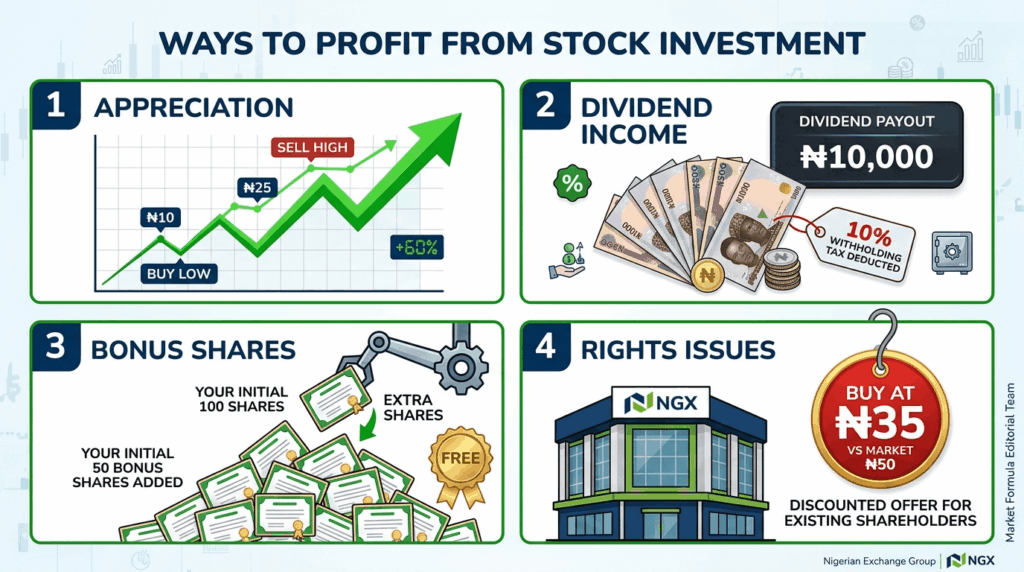
Many Nigerians think stock investing only means “buy low, sell high.” That is one way to make money — but it is not the only way, and it is not even the most reliable way for beginners. There are actually four ways NGX stocks can put money in your pocket. This section of the NGX basics beginner guide explains each one.
1. Capital Appreciation
This is the price going up. You buy Zenith Bank shares at ₦30 per share, and a year later they are trading at ₦42. You have made a ₦12 gain per share — a 40% return on that investment. This is what most people picture when they think of stock market profits.
Capital appreciation depends on the company growing, the sector performing well, and overall market sentiment improving. It is not guaranteed, which is why you cannot rely on it alone.
2. Dividend Income
Many NGX companies pay their shareholders a portion of their profits as cash — this is called a dividend. It is paid per share. If a company declares a dividend of ₦3.50 per share and you own 10,000 shares, you receive ₦35,000 in your bank account — for doing nothing except holding the shares.
In Nigeria, dividends are paid net of 10% withholding tax, which is automatically deducted before the payment reaches you. So if a company declares ₦3.50 per share, you receive ₦3.15.
Dividends are paid after the company’s AGM (Annual General Meeting), typically between March and June each year for most companies. To qualify for a dividend, you must hold the shares before the qualification date — missing it by even one day means you miss that payment entirely.
For many experienced Nigerian investors, dividend income is the primary goal — not trading. A portfolio of strong dividend-paying stocks can generate consistent naira income every year, almost like rent from property.
3. Bonus Shares
Instead of paying cash dividends, some companies reward shareholders with extra shares. For example, a “1 for 5” bonus issue means for every 5 shares you own, you receive 1 additional share free of charge.
Bonus shares increase the number of shares you hold, which means future dividends and price appreciation apply to a larger base. It is not an instant cash gain, but it compounds your position over time.
4. Rights Issues
A rights issue is when a company wants to raise new capital and gives existing shareholders the first opportunity to buy new shares — usually at a discount to the current market price.
For example, if shares are trading at ₦50 and the company offers you new shares at ₦35, you can buy at a discount and immediately hold shares worth more than you paid.
Rights issues are optional — you do not have to participate. But understanding them is important because if a company announces a rights issue and you do not act, your ownership percentage in the company shrinks as new shares are issued to others. This is called dilution and it is one of the silent ways new investors get caught off guard.
5. Action Plan: Your First Steps as an NGX Investor
Now that you have completed this NGX basics beginner guide, here is your practical action plan to get started.
Step 1: Open a brokerage account.
Choose a SEC-licensed stockbroker. Ensure they are registered with the NGX and the SEC. For a deeper dive into brokers and account setup, see Module 2 – Your Investor Toolkit.
Step 2: Get your CSCS number.
Your broker will generate this for you. Think of it as your unique “bank account number” for the stock market.
Step 3: Start with the NGX 30.
Focus on the 30 most liquid, most transparent stocks. They are the safest starting point for beginners.
Step 4: Learn to read financial statements.
Every listed company publishes quarterly and annual reports. Learn to spot revenue growth, profit margins, and debt levels.
Step 5: Think long-term.
The most powerful NGX strategy for a beginner: Find fundamentally strong companies that pay consistent, growing dividends. Hold them. Reinvest those dividends into more shares. Let time and compounding do the heavy lifting. You do not need to trade in and out constantly to build real wealth on the NGX.
6. Final Summary & The Bottom Line
The Nigerian stock market offers a genuine path to wealth building for anyone willing to learn the basics and stay disciplined. This NGX basics beginner guide has covered everything you need to start your journey.
  ┌──────────────────────────────────────────────────────────┐
  │       NIGERIAN STOCK MARKET STARTER KIT – KEY TAKEAWAYS  │
  ├─────────────────────┬────────────────────────────────────┤
  │ NGX                 │ Nigeria's official stock exchange, │
  │                     │ regulated by SEC Nigeria          │
  ├─────────────────────┼────────────────────────────────────┤
  │ ASI                 │ The scoreboard for the whole       │
  │                     │ market — your performance benchmark│
  ├─────────────────────┼────────────────────────────────────┤
  │ NGX 30              │ The 30 safest, most liquid        │
  │                     │ stocks — ideal starting universe  │
  ├─────────────────────┼────────────────────────────────────┤
  │ Market Cap          │ Total value of a company          │
  │                     │ = Price × Total Shares             │
  ├─────────────────────┼────────────────────────────────────┤
  │ Sectors             │ 7 key sectors, each reacting      │
  │                     │ differently to economic conditions│
  ├─────────────────────┼────────────────────────────────────┤
  │ Returns             │ 4 ways to profit: capital gains,  │
  │                     │ dividends, bonus shares,          │
  │                     │ rights issues                     │
  └─────────────────────┴────────────────────────────────────┘
The Bottom Line:
You do not need to be a finance expert to start building wealth on the NGX. You need a plan, a licensed broker, and the discipline to learn before you leap. Start with the NGX 30, focus on companies with strong fundamentals and consistent dividends, and let time do the heavy lifting. The Nigerian stock market is open to everyone. The only question is: will you take that first step?
Coming up in Module 2: How to actually open a brokerage account in Nigeria, which platforms are legitimate, and how to place your very first trade step by step — without making the common mistakes that cost beginners money before they even start.
For more weekly NGX updates and strategy guides, explore our market trends and analysis archive.
Disclaimer: This article is for informational purposes only and does not constitute investment advice. Always conduct your own research or consult a qualified financial advisor before investing. Past performance does not guarantee future results.