
NGX Market Review & Outlook: 0.81% Weekly Gain as FTSE Russell Catalyzes Late-Week Surge
By Kebira Aruna FCS FiCM. MD/CEO, Globalview Capital Limited/ August 31, 2026
Introduction
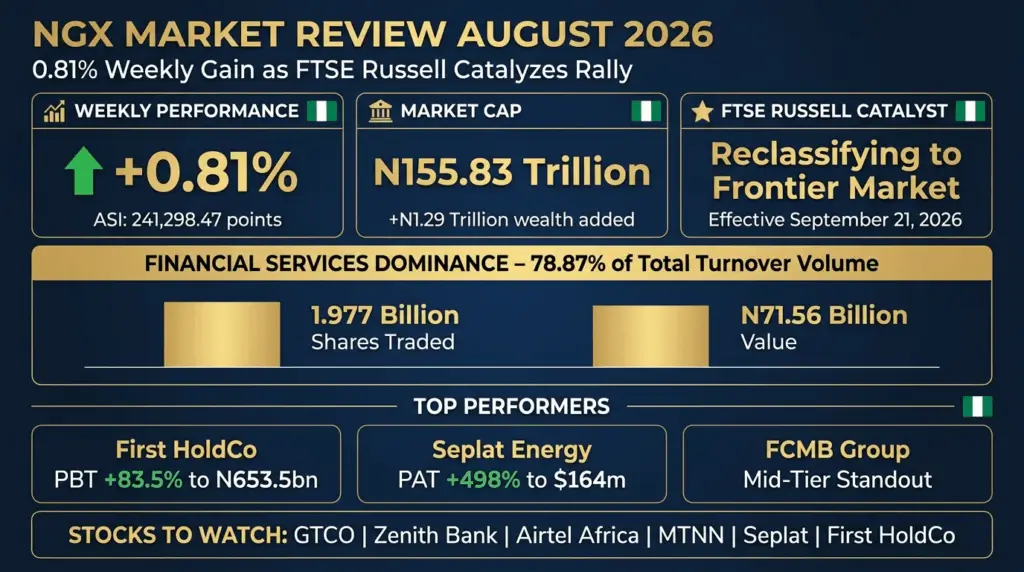
The Nigerian equities market closed the last week of August on a positive note, with the NGX All-Share Index (ASI) appreciating by 0.81% to settle at 241,298.47 points. Market capitalisation rose by 0.84% to N155.83 trillion, adding approximately N1.29 trillion to investors’ wealth.
Despite a shortened trading week—following the Federal Government’s declaration of Tuesday, August 25, 2026, as a public holiday to commemorate Eid-el-Maulud—investor sentiment remained resilient. The positive momentum was propelled by a combination of international index catalysts, banking sector momentum, and renewed appetite in tier-1 heavyweights.
The NGX market review August 2026 FTSE Russell covers the key drivers behind the weekly rally, the outlook for the new week, the catalysts behind specific stocks, and actionable insights for investors.
Let’s examine the NGX market review August 2026 FTSE Russell with clarity and strategic discipline.
1. Market Structure: What Drove the 0.81% Weekly Gain?
The positive momentum in the equities market was propelled by a combination of international index updates, banking sector momentum, and renewed appetite in tier-1 heavyweights.
FTSE Russell Index Reclassification
The single largest tailwind boosting market sentiment into the weekend was confirmation regarding FTSE Russell’s upcoming September index reclassification for Nigeria. On August 27, 2026, global index provider FTSE Russell confirmed that Nigeria’s reclassification from “Unclassified” to “Frontier Market” status will take effect from the open of trading on September 21, 2026.
The development provided a clear psychological boost, sparking position-building among foreign portfolio investors (FPIs) and institutional buyers expecting increased index weightings and foreign capital inflows.
The reclassification follows sustained improvements in foreign exchange liquidity, capital repatriation and market accessibility, and reflects the cumulative impact of the Federal Government’s macroeconomic and structural reform programme.
Tier-1 Banking & Financials Surge
The financial services sector continued to act as the core engine of the rally. The Financial Services Industry remained the dominant segment of the market by volume, accounting for 1.977 billion shares valued at N71.56 billion traded in 79,586 deals. The sector contributed 78.87% of total equity turnover volume and 58.08% of turnover value during the week.
Strong accumulation across tier-1 tickers—notably FirstHoldCo and FCMB—helped anchor market index gains, driven by:
- H1 Earnings Expectations: Continued position-taking in anticipation of strong mid-year dividend declarations and interim reporting
- Recapitalisation Mandates: Market confidence surrounding major banks’ structured balance sheet adjustments and capital raising frameworks
Oil & Gas and High-Cap Rebound
Renewed buying interest in major energy names—highlighted by heavy weighting surges in stocks like Seplat Energy—offset intermittent profit-taking in the consumer goods and insurance sub-sectors.
Macro Liquidity & Yield Re-alignment
As domestic yields on fixed-income instruments fluctuate, institutional funds and local pension fund administrators (PFAs) are actively rebalancing portfolios toward high-dividend equity yields, supplying steady liquidity to keep the All-Share Index elevated.
text
       ┌────────────────────────────────────────────────────────┐
       │      NGX MARKET REVIEW AUGUST 2026 – KEY DRIVERS       │
       └───────────────────────────┬────────────────────────────┘
                                   │
         ┌─────────────────────────┼─────────────────────────┐
         ▼                         ▼                         ▼
  [ FTSE RUSSELL ]          [ BANKING SECTOR ]         [ OIL & GAS ]
  Reclassification          Financial Services         Energy stocks
  effective Sept 21         dominates 78.87%          rebound offsets
  drives institutional      of turnover volume        sector weakness
  positioning
2. Outlook for the New Week
Following the late-week momentum that drove the ASI above the 241,000 mark, the Nigerian equities market enters the new week with strong bullish tailwinds. However, performance is expected to turn increasingly tactical as investors balance international index catalysts against short-term profit-taking.
1. FTSE Russell Pre-Reclassification Positioning
With FTSE Russell confirming Nigeria’s formal return to Frontier Market status effective September 21, 2026, market sentiment will be heavily anchored by global index dynamics.
Crucially, FTSE begins releasing its indicative review files on Wednesday, September 2, 2026. Expect heightened institutional accumulation around index-heavy liquid tickers—GTCO, Zenith Bank, Airtel Africa, and Seplat Energy—as fund managers position ahead of expected passive foreign inflows.
Temi Popoola, Group Managing Director and Chief Executive Officer of NGX Group, described the reclassification as “an important moment for Nigeria’s capital market” but stressed that “the real significance of returning to Frontier Market status is the opportunity it creates for the next phase of our market’s development”.
2. Late H1 Earnings & Dividend Announcements
As August transitions into September, market participants will continue monitoring remaining Tier-1 banking full-half corporate disclosures and dividend declarations. Tickers that deliver resilient profit growth and attractive interim yields are likely to sustain price support even during intraday pullback attempts.
3. Macro & FX Liquidity Confidence
External reserve growth—crossing $53.3 billion—alongside Moody’s positive outlook upgrade has significantly lowered foreign exchange risk perceptions. This improved macroeconomic backdrop provides local Pension Fund Administrators (PFAs) and institutional asset managers confidence to deploy capital into equity yields over lower-yielding fixed-income paper.
Market Strategy Outlook
| Time Horizon | Strategy |
|---|---|
| Short-Term | Expect mixed trading early in the week driven by mild profit-taking on recent gainers, followed by selective buying once the September 2 indicative files drop |
| Key Sectors | Financial Services (Tier-1 banks), Oil & Gas, and select Telecommunications constituents, which remain the primary vehicles for international portfolio allocation |
3. What Is Driving the Growth in University Press, First HoldCo and Seplat?
While operating in completely different sectors, University Press, First HoldCo, and Seplat Energy are each benefiting from distinct, powerful catalysts driving their growth trajectories.
1. University Press Plc (UPL): Seasonal Demand & Fundamentals
- Academic Calendar Cycle: The second half of the year coincides with the start of the new academic session in Nigeria. This triggers heavy, seasonal institutional demand for educational publishing materials, textbooks, and learning resources, driving sharp top-line momentum.
- Operational Revenue Growth: The company recorded strong full-year revenue expansion (~14.5% year-on-year growth to ₦3.89 billion), signalling pricing power resilience against inflation and driving low-float retail positioning on the NGX Main Board.
2. First HoldCo Plc: Explosive Earnings & Recapitalisation Progress
First HoldCo’s growth is anchored by stellar H1 2026 balance sheet performance. The company reported gross earnings of N1.93 trillion, representing a 16.7% year-on-year increase, while profit before tax rose by 83.5% to N653.5 billion.
Key Highlights:
- Non-interest income rose to N497.1 billion, supported by impressive performance across electronic banking, trade services, brokerage, funds transfer and other transaction-led businesses
- Cost-to-income ratio improved to 44.2% from 50.5% in H1 2025, reflecting disciplined cost management
- Impairment charges declined by 37.4% year-on-year, while approximately N91.9 billion in recoveries were achieved during the first half of the year
Femi Otedola Share Acquisition: On August 24, 2026, Otedola acquired 95,699,240 ordinary shares (representing ~0.21% of total outstanding shares) through his investment vehicle, Calvados Global Services Limited, for N131.48 per share, amounting to N12.58 billion. This latest purchase brings his overall shareholding to 12.14 billion shares, expanding his dominant position to 27.70% of First HoldCo’s total equity.
3. Seplat Energy Plc: Asset Integration & FX Hedging
Seplat Energy leads the energy sector’s top-line revenue performance, backed by steady production gains and strategic portfolio optimisation.
H1 2026 Highlights:
- Profit After Tax soared 498% to $164 million
- **Revenue grew to $1.82 billion**, up from $1.398 billion year-on-year
- Production averaged 139,509 boepd in 6M 2026, up 4% from 6M 2025 (134,492 boepd), within 2026 guidance (135–155 kboepd)
- Quarter 2 production averaged 149,070 boepd, up 9% from Q2 2025 and up 15% from Q1 2026
- Declared US 12.0 cents dividend per share for the period
Because Seplat’s revenues are foreign-currency linked, it serves as a natural inflation and foreign-exchange hedge for institutional asset managers. Dual-listed liquidity (NGX & LSE) combined with consistent quarterly dollar-denominated dividend distributions keeps high-net-worth liquidity anchored in the stock.
4. Why Is Fidson Healthcare Trending Down?
Fidson Healthcare Plc (FIDSON) has come under notable selling pressure on the NGX, experiencing a steep decline of nearly 20% across recent sessions—including dropping by the maximum daily limit of 9.98% on Thursday, August 27, to hit ₦75.80.
This downward adjustment is being driven by three primary market dynamics:
1. Aggressive Profit-Taking Post-Rally
Fidson experienced a major run-up earlier in the year, reaching a 52-week peak of ₦136.50—representing a year-to-date expansion of over 50% and a 1-year gain approaching 80%. Following such a substantial valuation expansion, institutional and retail position-holders are executing aggressive profit-taking moves to lock in realised gains.
2. Portfolio Rebalancing Toward Index Heavyweights
With major index catalysts dominating market sentiment—most notably FTSE Russell’s upcoming September Frontier Market reclassification—liquidity across the NGX is concentrating heavily into large-cap liquid counters (Tier-1 Banks, Seplat, and Telecoms). Portfolio managers are actively reallocating capital out of mid-cap healthcare and consumer counters to build positions in higher-weighted index stocks ahead of anticipated passive foreign capital inflows.
3. Sector-Wide Margin Squeeze Concerns
While Fidson posted revenue growth across earlier quarters, the broader pharmaceutical manufacturing sector continues to navigate elevated foreign-exchange procurement costs for Active Pharmaceutical Ingredients (APIs) and high local energy/operating expenses. Market participants are pricing in potential margin compression and assessing whether interim earnings performance can comfortably sustain the elevated Price-to-Earnings multiple (~22x) the stock commanded during its peak valuation run.
Despite the short-term pullback, broader brokerage consensus on Fidson remains generally positive, indicating the decline is primarily market-structure and liquidity-driven rather than operational collapse.
5. How Attractive Is Zichis at ₦14.50?
At ₦14.50, Zichis Agro-Allied Industries Plc presents a tactical, high-risk entry point. The valuation profile reflects a steep discount from its recent high, though underlying market structure realities warrant careful consideration.
Why It Looks Attractive
- 65%+ Pullback from Peak: Having traded near its 52-week high of ₦42.50 earlier in the year, the counter at ₦14.50 represents a sharp price correction. The stock still boasts a staggering 365.49% year-to-date nominal price gain.
- Agro-Sector Tailwinds: Operational exposure to livestock production and agro-processing positions the company favourably within Nigeria’s food-security drive and import-substitution policies.
- Low Entry Multiple: Trading at low historical price-to-earnings and low market capitalisation metrics relative to sector peers like Presco, Okomu, or Livestock Feeds.
Market Structure & Risk Considerations
- NGX Growth Board Listing: Listed via the NGX Growth Board in January, Zichis inherently trades with a lower free float and lower average daily liquidity than Main or Premium Board peers.
- Liquidity & Spread Risk: Low trading volume on the counter means buying into the stock can be simple, but exiting during periods of profit-taking can prove difficult without accepting wide price spreads.
- Opportunity Cost: Current NGX liquidity is concentrating heavily in Tier-1 financials and major FTSE Russell reclassification candidates. Mid/small-cap counters on the Growth Board may experience extended consolidation before seeing sustained institutional accumulation.
At ₦14.50, the stock is visually cheap and attractive for speculative, low-capital positions looking to capture a cyclical agro-sector rebound. However, for institutional or core portfolio allocation, the illiquidity and low float mean it should carry a tight risk allocation compared to large-cap equities on the exchange.
6. Is Honeywell Flour Mills a Good Buy at ₦16.20?
At ₦16.20, HONYFLOUR presents a strong fundamental value play for medium-to-long-term investors, though short-term traders should expect continued price volatility.
Core Investment Catalysts
- Earnings Growth & Margin Expansion: First-quarter earnings for Q1 2027 surged, with Net Profit after Tax jumping 167% year-on-year to ₦6.95 billion on revenues of ₦112.9 billion. Sales revenue increased 67.5% year-on-year to ₦112.9 billion in Q1.
- Operational Profit More Than Tripled: Operating profit rose to ₦8.6 billion from N2.7 billion, driven by a 30% reduction in selling and administrative expenses.
- Finance Income Nearly Tripled: Net finance income of ₦1.2 billion lifted pre-tax profit to N9.8 billion, a 190% increase compared to the same period last year.
- Attractive Earnings Multiple: At ₦16.20, the stock trades at an attractive Trailing Twelve Month P/E ratio under 6x, relative to an annualised EPS run-rate near ₦2.63+.
- Upcoming Corporate Action: A cash dividend of ₦0.20 per share has been declared with payment date on September 17, 2026.
- Parental Synergy: Continued integration under Flour Mills of Nigeria (FMN) has optimised raw material supply chains, grain sourcing logistics, and distribution footprints across West Africa.
Key Risks & Market Friction
- Macro Raw Material Costs: Wheat and logistics costs remain sensitive to international commodity pricing and foreign currency fluctuations. Production costs rose 68.6% to N101.7 billion, absorbing N41.4 billion of additional sales inflow.
- Low Dividend Yield: At ₦0.20 per share (yield ~1.2%), the counter does not appeal strongly to pure income-seeking playbooks compared to Tier-1 financial yields on the NGX.
- Rising Borrowings: Borrowings have risen to nearly ₦42 billion, up from ₦32.4 billion at the end of last year.
Investment Verdict
Honeywell Flour Mills at ₦16.20 offers a compelling value proposition for medium-to-long-term investors, underpinned by a 165% surge in Q1 earnings and significant operational improvements. The sharp reduction in selling expenses and tripling of finance income demonstrate effective cost management.
7. How Attractive Is MTN Nigeria at ₦774?
At ₦774.00, MTNN presents a highly attractive, defensive value proposition on the NGX Premium Board, sitting roughly 15% below its 52-week peak of ₦915.00.
Core Investment Catalysts
- FTSE Russell Reclassification Anchor: As a premier liquid bellwether with a massive market capitalisation, MTNN is a primary candidate for passive international fund inflows following the FTSE Russell index reclassification.
- Core Revenue Resilience: Data revenue and Mobile Money (MoMo) adoption continue to post robust year-on-year growth, providing a steady structural hedge against macroeconomic inflation.
- FX Normalisation Path: While historical unrealised foreign exchange losses weighed heavily on earlier income statements, ongoing currency stabilisation and tariff adjustments are improving operational cash flow quality.
- Dividend Yield Support: MTNN maintains its commitment to capital returns, offering high payout consistency for institutional cash flow strategies.
Risk Considerations
- Capital Expenditure Intensity: 5G expansion and infrastructure maintenance require high capital expenditure in hard currency, exposing margins to FX volatility.
- Regulatory & Tax Exposure: Sector levy assessments and regulatory directives remain key tail-risk factors to monitor for long-term equity valuation.
Valuation Verdict
| Investor Profile | Stance | Rationale |
|---|---|---|
| Institutional / Long-Term | Strong Buy | At ₦774, the entry point offers attractive risk-adjusted total return potential ahead of global index integration and earnings recovery |
| Short-Term Trader | Accumulate on Dips | Support is firm around ₦750–₦760, with momentum accelerating as volume builds into September index rebalancing files |
8. Stocks to Watch
With the FTSE Russell Frontier Market reclassification taking effect on September 21, 2026, and indicative review files dropping on Wednesday, September 2, institutional liquidity is aggressively funnelling into key market heavyweights and liquid counters.
1. FTSE Russell Index Front-Runners (High Liquid Beta)
| Stock | Catalyst |
|---|---|
| GTCO | Premium Board liquidity leader. Expect heavy positioning from foreign and domestic institutional portfolios as one of the top-weight candidates for global frontier funds |
| Zenith Bank | Strong H1 fundamentals coupled with tier-1 recapitalisation progress. Acts as a core proxy for passive index tracking capital |
| Airtel Africa & MTNN | Large-cap telecom bellwethers that stand to capture significant passive inflow allocations as indices re-balance weights back toward Nigeria |
2. Tier-1 Financials & Earnings Drivers
3. High-Yield Energy & Currency Hedges
4. Growth & Value Mean-Reversion Picks
9. Action Plan for Investors (Week of August 31 – September 4, 2026)
Step 1: Position for FTSE Russell index catalysts.
The indicative review files drop on September 2, 2026. Prioritise high-liquid beta stocks (GTCO, Zenith Bank, Airtel Africa, MTNN, Seplat Energy) that are primary candidates for passive foreign inflows.
Step 2: Focus on H1 earnings catalysts.
Monitor remaining Tier-1 banking disclosures and interim dividend announcements. First HoldCo’s stellar H1 performance (PBT up 83.5%) sets the tone for the sector.
Step 3: Be selective in consumer goods.
Honeywell Flour Mills offers compelling value at ₦16.20 with a 165% Q1 earnings surge, while Fidson Healthcare’s 20% pullback may present a value-hunting opportunity once selling pressure exhausts.
Step 4: Monitor fixed-income competition.
With the MPR at 26.5%, keep equity allocations selective. The FTSE Russell catalyst provides a unique opportunity for foreign inflows, but domestic yields remain competitive.
Step 5: Stay disciplined and selective.
The market is shifting from broad speculative buying to disciplined, stock-specific positioning. Quality of gains matters more than size.
10. Final Summary & The Bottom Line
The NGX market review August 2026 FTSE Russell reveals a market in transition. The 0.81% weekly gain and the FTSE Russell reclassification confirmation have provided a powerful catalyst for institutional positioning. The financial services sector continues to dominate, accounting for nearly 79% of total equity turnover volume.
text
  ┌──────────────────────────────────────────────────────────┐
  │      NGX MARKET REVIEW AUGUST 2026 – KEY TAKEAWAYS       │
  ├─────────────────────┬────────────────────────────────────┤
  │ Weekly Performance  │ ASI +0.81% to 241,298.47 points   │
  │                     │ Market Cap: N155.83 trillion       │
  ├─────────────────────┼────────────────────────────────────┤
  │ Key Catalyst        │ FTSE Russell reclassification      │
  │                     │ effective September 21, 2026       │
  ├─────────────────────┼────────────────────────────────────┤
  │ Financial Services  │ 78.87% of total turnover volume   │
  ├─────────────────────┼────────────────────────────────────┤
  │ Top Performers      │ First HoldCo (+4.65%), Seplat     │
  │                     │ Energy (production +4%), FCMB     │
  ├─────────────────────┼────────────────────────────────────┤
  │ Stocks to Watch     │ GTCO, Zenith Bank, Airtel Africa, │
  │                     │ MTNN, Seplat, First HoldCo        │
  ├─────────────────────┼────────────────────────────────────┤
  │ Key Date            │ FTSE indicative review files      │
  │                     │ (September 2, 2026)               │
  └─────────────────────┴────────────────────────────────────┘
The Bottom Line:
The Nigerian equities market has demonstrated remarkable resilience, closing August with a 0.81% weekly gain despite a shortened trading week. The confirmation of FTSE Russell’s reclassification has provided a significant psychological and structural boost, positioning Nigeria’s capital market for increased international visibility and potential foreign portfolio inflows.
As NGX Group CEO Temi Popoola noted, the reclassification should be viewed “as an opportunity to deepen the Nigerian capital market rather than simply as an index milestone”. The coming weeks will be critical as institutional investors position ahead of the September 21 effective date and the September 2 indicative review files.
For more weekly NGX updates and strategy guides, explore our market trends and analysis archive.
Disclaimer: This article is for informational purposes only and does not constitute investment advice. Always conduct your own research or consult a qualified financial advisor before investing. Past performance does not guarantee future results.