
Nigeria’s Return to Frontier Market Status: A New Chapter for the Nigerian Capital Market
By Market Formula Editorial Team / August 2026
Introduction
On August 27, 2026, global index provider FTSE Russell confirmed that Nigeria’s capital market will be reclassified from “Unclassified” to “Frontier Market” status, effective from the open of trading on Monday, September 21, 2026. The decision, announced via a market notice, marks Nigeria’s formal return to the global Frontier Market universe after nearly three years of exclusion.
The Federal Ministry of Finance welcomed the confirmation, describing it as “an important validation of Nigeria’s reform trajectory and a foundation for the next phase of the country’s capital market development”. Hon. Minister of Finance and Coordinating Minister of the Economy, Taiwo Oyedele, stated that the reclassification “is a meaningful signal to global capital that our market is open, orderly and improving.”
This Nigeria Frontier Market reclassification guide examines the journey back to Frontier status, what it means for the Nigerian Exchange (NGX), and how investors can position themselves for the opportunities ahead.
Let’s explore the Nigeria Frontier Market reclassification with clarity and strategic discipline.
1. The Backstory: How Nigeria Lost Its Frontier Market Status
Nigeria was removed from the FTSE Frontier Market index in September 2023 following persistent difficulties in foreign exchange execution and capital repatriation. International institutional investors faced significant delays in accessing dollars and repatriating investment proceeds, making the market effectively inaccessible.
FTSE Russell reclassified Nigeria from Frontier to “Unclassified” market status due to “significant and ongoing delays to the ability of international institutional investors to repatriate capital from Nigeria and the execution of foreign exchange (FX) transactions”.
The Road to Recovery
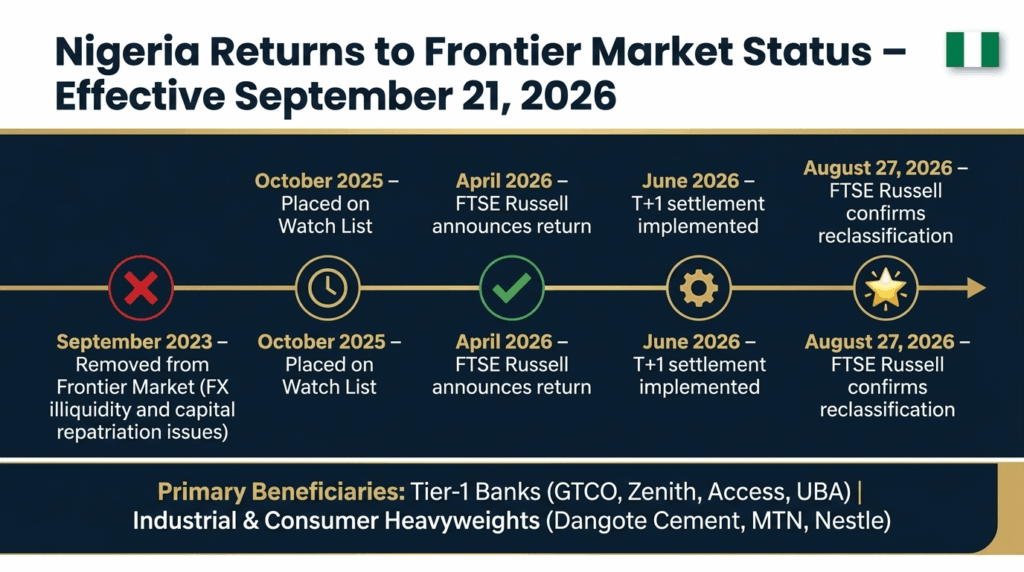
The path back to Frontier status began in October 2025, when FTSE Russell placed Nigeria on its Watch List for potential reclassification following improvements in foreign exchange liquidity, capital repatriation, and market accessibility.
In April 2026, FTSE Russell announced that Nigeria would return to Frontier Market status, setting September 21, 2026, as the effective date. However, the transition was later paused and subjected to an additional assessment following Nigeria’s migration from a T+2 to a T+1 settlement cycle on June 1, 2026.
text
       ┌────────────────────────────────────────────────────────┐
       │      NIGERIA FRONTIER MARKET RECLASSIFICATION TIMELINE │
       └───────────────────────────┬────────────────────────────┘
                                   │
         ┌─────────────────────────┼─────────────────────────┐
         ▼                         ▼                         ▼
  [ SEPTEMBER 2023 ]        [ OCTOBER 2025 ]           [ APRIL 2026 ]
  Nigeria removed            Nigeria placed             FTSE Russell
  from Frontier              on Watch List              announces return
  Market status                                       to Frontier status
  due to FX and                                       effective September
  capital repatriation                                21, 2026
  issues
                                   │
                                   ▼
                           [ JUNE 2026 ]
                           Nigeria migrates
                           to T+1 settlement
                           cycle; FTSE Russell
                           pauses reclassification
                           for further review
                                   │
                                   ▼
                           [ AUGUST 27, 2026 ]
                           FTSE Russell confirms
                           reclassification will
                           proceed effective
                           September 21, 2026
2. The T+1 Hurdle: Why the Reclassification Was Delayed
The transition to a T+1 settlement cycle—making Nigeria the first market in Africa to implement a one-day settlement framework for equities and commodities—created a late-stage hurdle.
The Concern
FTSE Russell raised concerns that settling trades one business day after execution could create a de facto prefunding requirement for international institutional investors. The index provider argued that investors operating across multiple markets and time zones might face challenges completing foreign exchange conversions, securing investment approvals, and transferring settlement funds within one business day.
The Resolution
To address these concerns, leadership from the Nigerian Exchange Group (NGX) and the Securities and Exchange Commission (SEC) engaged directly with FTSE Russell and international market participants throughout July.
The Securities and Exchange Commission clarified that foreign portfolio investors were not required to prefund their accounts under the new settlement framework. The Chartered Institute of Stockbrokers (CIS) reinforced this position, stating that Nigeria’s transition to a T+1 settlement cycle does not require foreign portfolio investors to prefund their transactions.
FTSE Russell’s Confirmation
Following the assessment, FTSE Russell, supported by feedback from the FTSE Equity Country Classification Advisory Committee, confirmed that:
“No material settlement, operational, or funding issues have been observed since the implementation of the T+1 settlement cycle.”
On this basis, the FTSE Russell Index Governance Board confirmed that Nigeria’s reclassification would proceed as scheduled.
Fiona Ahimie, 14th President and Chairman of Council of the Chartered Institute of Stockbrokers (CIS), noted that the reclassification “places Nigerian equities back on the radar of global frontier-market investors and gives index-tracking funds the opportunity to consider Nigerian stocks within their investment universe”.
Sehinde Adenagbe, Chairman of the Association of Securities Dealing Houses of Nigeria (ASHON), added that the return “enhances the international visibility and credibility of the Nigerian capital market… signals that some of the market-access concerns that previously limited Nigeria’s participation in global investment indices are being addressed”.
3. Market Impact: What the Reclassification Means for the NGX
The reclassification is expected to have significant structural and market-based ramifications for the Nigerian Exchange.
Immediate Market Reaction
The Nigerian equities market snapped an 11-day consecutive losing streak on August 27, 2026, as investor sentiment was buoyed by the FTSE Russell confirmation. The benchmark NGX All-Share Index advanced 0.20% to close at 239,156.09 points, adding approximately N305.56 billion to investor wealth.
The FUGAZ banking stocks (First HoldCo, UBA, GTCO, Access Holdings, and Zenith Bank) were the session’s clear bright spot:
| Stock | Gain | Closing Price |
|---|---|---|
| FirstHoldCo | +4.65% | N135.00 |
| Access Holdings | +4.36% | N28.75 |
| UBA | +3.74% | N45.80 |
| GTCO | +0.31% | N128.00 |
| Zenith Bank | +0.08% | N119.50 |
Why This Matters for Foreign Investment
Becoming a member of the FTSE Frontier Index Series will necessitate passive global asset managers, international exchange-traded funds (ETFs), and other global institutional asset management firms benchmarked on the index’s performance to re-weight their portfolios and invest more in Nigeria.
Temi Popoola, Group Managing Director and Chief Executive Officer of NGX Group, described the reclassification as “an important moment for Nigeria’s capital market” but stressed that “the real significance of returning to Frontier Market status is the opportunity it creates for the next phase of our market’s development”.
“We have to turn greater international visibility into broader participation, deeper liquidity and more capital for Nigerian businesses. Our ambition is to build a market that is increasingly competitive globally and more relevant to Nigeria’s economic growth.” — Temi Popoola, NGX Group
The Naira and Broader Economy
Analysts have noted that the reclassification could have wider economic benefits. Aruna Kebira, Managing Director of Globalview Capital Limited, explained that the move signals to global investors that Nigeria is “a new place to make money”. He noted that the move to T+1 settlement by CSCS was crucial, saying:
“Now that T+1 is working, the settlement risk has reduced. That is good and will help to attract more foreign investors.”
Adnori, Vice President of Highcap Securities Limited, added that if foreign investors bring in hard currency, “there will be a multiplier effect on the economy. It will boost the foreign exchange market and help to strengthen the Naira”.
4. Stocks to Watch: Who Benefits from Frontier Market Status
The reclassification is expected to drive passive foreign portfolio inflows into Nigeria’s largest and most liquid stocks.
Tier-1 Banking Stocks
Nigerian banks’ equities have traded at deep discounts to peers in emerging and frontier markets primarily because of a history of currency volatility. Access to international capital markets means that key banks can more readily raise equity capital, strengthen capital positions, and scale financing of large corporates and infrastructure projects.
Primary beneficiaries:
| Bank | Reason |
|---|---|
| GTCO | Primary beta driver for foreign capital |
| Zenith Bank | Primary beta driver for foreign capital |
| Access Holdings | Deep value discount; primary beta driver |
| UBA | Pan-African diversification; primary beta driver |
| Stanbic IBTC | Strong institutional franchise |
These stocks are showing bullish MACD crossovers on the latest daily chart with increasing institutional build-up.
Industrial and Consumer Heavyweights
Industrial and consumer heavyweights with high capitalisation are dominant weightings of index-tracking products.
| Stock | Reason |
|---|---|
| Dangote Cement | High capitalisation; dominant index weighting |
| BUA Cement | High capitalisation; dominant index weighting |
| Nestlé Nigeria | MNE subsidiary; FX backlogs settled; improved trading volumes |
| MTN Nigeria | Highest capitalisation telecom; considerable passive inflows expected |
MTN Nigeria may see considerable passive inflows as funds adjust portfolios to FTSE Frontier exposures. Nestlé Nigeria has been uniquely disadvantaged by FX illiquidity and currency devaluations, but the settlement of FX backlogs and normal FX flow under T+1 now signal to foreign parents and institutional investors that money does not move in unpredictable spurts.
5. What This Means for Retail Investors
For retail investors, the Nigeria Frontier Market reclassification creates several opportunities and considerations.
Increased Liquidity and Price Discovery
Enhanced visibility among international investors can improve price discovery and deepen market participation. As foreign capital flows into Nigerian equities, trading volumes are likely to increase, potentially narrowing bid-ask spreads and improving execution for all investors.
Potential for Portfolio Re-Rating
The reclassification signals to international audiences that Nigeria’s capital markets infrastructure has become more credible. This could lead to a re-rating of Nigerian equities, particularly in the banking and consumer goods sectors.
A Word of Caution
Fiona Ahimie of the CIS cautioned that “the immediate impact should not be overstated. Reclassification does not automatically translate into a significant surge of foreign capital”. The extent of any new foreign investment will depend on broader factors including market liquidity, investable opportunities, and investor confidence.
6. The Next Milestone
The next milestone will be the publication of the FTSE Frontier Index Series annual indicative review files for September 2026, which will reflect Nigeria’s reclassification and are scheduled to begin publication on Wednesday, September 2, 2026.
7. Action Plan for Investors
Now that you understand the Nigeria Frontier Market reclassification, here is your practical action plan.
Step 1: Review your banking exposure.
Tier-1 banking stocks are the primary beneficiaries of foreign portfolio inflows. Ensure your portfolio has adequate exposure to GTCO, Zenith Bank, Access Holdings, UBA, and Stanbic IBTC.
Step 2: Consider industrial and consumer heavyweights.
Dangote Cement, BUA Cement, Nestlé Nigeria, and MTN Nigeria are expected to see increased institutional interest.
Step 3: Monitor the FTSE Frontier Index review files.
The publication on September 2, 2026, will provide clarity on which Nigerian stocks will be included in the index.
Step 4: Watch for institutional accumulation.
Technical analysts will watch for price action breaking through resistance levels with high volume.
Step 5: Stay informed.
The reclassification is a milestone, not a destination. Nigeria’s ambition remains to earn Emerging Market status in the near term.
8. Final Summary & The Bottom Line
The Nigeria Frontier Market reclassification marks a significant milestone for the Nigerian capital market. Nearly three years after its exclusion in September 2023, Nigeria is returning to the global Frontier Market universe from September 21, 2026.
text
  ┌──────────────────────────────────────────────────────────┐
  │   NIGERIA FRONTIER MARKET RECLASSIFICATION – KEY FACTS   │
  ├─────────────────────┬────────────────────────────────────┤
  │ Effective Date      │ September 21, 2026                │
  ├─────────────────────┼────────────────────────────────────┤
  │ Previous Status     │ "Unclassified" (since Sept 2023)  │
  ├─────────────────────┼────────────────────────────────────┤
  │ Reason for Exit     │ FX illiquidity and capital        │
  │                     │ repatriation bottlenecks          │
  ├─────────────────────┼────────────────────────────────────┤
  │ Key Catalyst        │ Improved FX liquidity, capital    │
  │                     │ repatriation, market              │
  │                     │ accessibility, T+1 settlement     │
  ├─────────────────────┼────────────────────────────────────┤
  │ Primary Beneficiaries│ Tier-1 banks (GTCO, Zenith,      │
  │                     │ Access, UBA), industrial &        │
  │                     │ consumer heavyweights             │
  ├─────────────────────┼────────────────────────────────────┤
  │ Next Milestone      │ FTSE Frontier Index review files  │
  │                     │ (September 2, 2026)               │
  └─────────────────────┴────────────────────────────────────┘
The Bottom Line:
The Nigeria Frontier Market reclassification is a testament to the sustained improvements in foreign exchange liquidity, capital repatriation, and market accessibility. The coordinated efforts of the SEC, CBN, NGX Group, CSCS, and all capital market operators have been central to restoring Nigeria’s standing among global index providers.
For investors, the reclassification represents an opportunity to position ahead of passive foreign portfolio inflows. Tier-1 banking stocks and industrial heavyweights are the primary beneficiaries, as index-tracking funds will be required to re-weight their portfolios to include Nigerian equities.
However, as NGX Group CEO Temi Popoola noted, the real significance is the opportunity it creates for the next phase of market development. The priority must now be converting increased international visibility into broader participation, deeper liquidity, and greater access to capital for Nigerian businesses.
Your Next Steps:
- Review your portfolio – Ensure exposure to primary beneficiary stocks
- Monitor the FTSE review files – Publication begins September 2, 2026
- Stay informed – Follow developments from NGX Group, SEC, and FTSE Russell
- Think long-term – The reclassification is a foundation for future growth
For more weekly NGX updates and strategy guides, explore our market trends and analysis archive.
Disclaimer: This article is for informational purposes only and does not constitute investment advice. Always conduct your own research or consult a qualified financial advisor before investing. Past performance does not guarantee future results.