
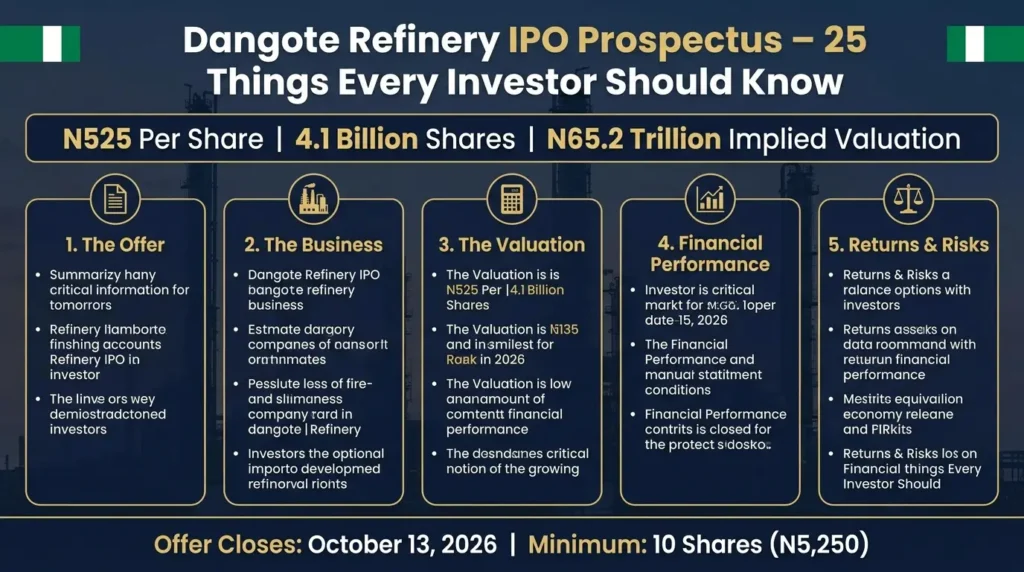
Dangote Refinery IPO Prospectus: 25 Things Every Nigerian Investor Should Know
By Market Formula Editorial Team / September 2026
SEO Metadata
| Element | Value |
|---|---|
| Focus Keyword | Dangote Refinery IPO prospectus guide |
| SEO Title | Dangote Refinery IPO Prospectus Guide: 25 Things Investors Must Know |
| Meta Description | Master the Dangote Refinery IPO prospectus guide. Learn the N525 offer price, 4.1 billion shares, N65 trillion valuation, financials, allotment rules, and key risks. |
| URL Slug | /dangote-refinery-ipo-prospectus-guide-25-things |
| Image Alt Text | Dangote Refinery IPO prospectus guide infographic showing 25 key facts for Nigerian investors including N525 per share and N65 trillion valuation |
Introduction
The Dangote Petroleum Refinery IPO is one of the biggest investment opportunities to enter the Nigerian capital market in recent years. But before investing, there is one document every serious investor should understand: the prospectus.
The offer is priced at N525 per share, with 4.1 billion new ordinary shares being offered to investors. At the offer price, the transaction is worth approximately N2.15 trillion. The offer opened on September 14, 2026, and is scheduled to close on October 13, 2026.
But the most important question is not simply: “How do I buy Dangote Refinery shares?”
The better question is: “What exactly am I buying at N525, and what does the prospectus tell me about the investment?”
This Dangote Refinery IPO prospectus guide breaks down 25 important things Nigerian retail investors should understand before subscribing.
Let’s examine the Dangote Refinery IPO prospectus guide with clarity and strategic discipline.
Part 1: The Offer Framework
1. The IPO Price Is N525 Per Share
The Dangote Refinery IPO is being offered at N525 per ordinary share. The minimum application is 10 shares, meaning an investor can apply with a minimum of N5,250. Applications can then be made in multiples of 10 shares.
The important point is that N525 is the offer price, not necessarily the price the shares will trade at after listing. Once listed on the NGX, the market price will be determined by supply and demand.
2. The Company Is Offering 4.1 Billion New Shares
The base offer consists of approximately 4.1 billion ordinary shares. These are new shares being issued by the company. At N525 per share, the gross proceeds equal approximately N2.15 trillion, making this one of the largest equity offerings in Nigerian capital market history.
3. This Is an Offer for Subscription
The Dangote Refinery transaction is structured as an Offer for Subscription, meaning investors are subscribing for newly issued shares. The money raised is intended to go into the company for its stated purposes rather than providing an exit for an existing shareholder. For investors, this means the IPO is partly about financing the company’s next stage of growth.
4. The IPO Is Intended to Raise Approximately N2.15 Trillion Before Expenses
At the N525 offer price, the gross proceeds from the 4.1 billion shares are approximately N2.1525 trillion. After applicable expenses, the net amount available to the company will be lower. The prospectus indicates that the proceeds are intended primarily to support the refinery’s expansion programme.
5. The Company Already Has a Huge Share Capital
The company has approximately 120.13 billion existing shares before the IPO. After the base offer of 4.1 billion new shares, the post-offer share count becomes approximately 124.23 billion shares.
This number is extremely important when calculating future earnings per share, P/E ratio, market capitalisation, and dividend per share. A common mistake is to look only at the N525 share price without considering the number of shares outstanding.
Part 2: What N525 Actually Values Dangote Refinery At
6. The Implied Market Capitalisation Is About N65 Trillion
This is one of the most important calculations in the entire IPO. Using approximately 124.23 billion post-offer shares:
124.23bn × N525 ≈ N65.2 trillion
Therefore, buying at N525 means investors are effectively valuing the post-IPO company at approximately N65 trillion. This is why investors should never analyse the IPO simply by saying: “N525 doesn’t look expensive because the share price is only N525.” The number of shares matters.
7. Only a Small Percentage of the Company Is Being Offered
The 4.1 billion base-offer shares represent approximately 3.3% of the post-offer share capital. That means the vast majority of the company will remain with existing shareholders. This is important because the eventual public float will be relatively small compared with the total number of shares outstanding. It also means investors should pay attention to liquidity and price discovery after listing.
8. Existing Shareholders Will Retain Significant Ownership
The prospectus shows a highly concentrated ownership structure, with major holdings associated with the Dangote Group and other strategic shareholders. The IPO therefore does not transform Dangote Refinery into a company where ownership is widely dispersed among millions of small shareholders. Retail investors will own a relatively small portion of the overall company.
       ┌────────────────────────────────────────────────────────┐
       │   DANGOTE REFINERY IPO PROSPECTUS GUIDE – KEY NUMBERS  │
       └───────────────────────────┬────────────────────────────┘
                                   │
         ┌─────────────────────────┼─────────────────────────┐
         ▼                         ▼                         ▼
  [ OFFER ]                 [ VALUATION ]              [ OWNERSHIP ]
  4.1bn new shares          N65.2 trillion             Public float:
  at N525 each              implied market cap         ~3.3% of total
  Minimum: 10 shares        Post-offer: 124.23bn       Concentrated
  (N5,250)                  shares                     ownership retained
Part 3: Understanding the Business
9. Dangote Refinery Is Much More Than a Petrol Company
It is easy to describe the company simply as “the Dangote petrol refinery.” But the business is broader. The refinery produces products including Premium Motor Spirit (PMS), Automotive Gas Oil (AGO/diesel), Aviation fuel, Fuel oil, LPG, Petrochemical products, and Polypropylene. This matters because the company’s future earnings will depend on several product markets rather than petrol alone.
10. The Refinery Is Operating at a Massive Scale
The refinery has a capacity of approximately 700,000 barrels per day under its current operating configuration. The company’s expansion plan targets approximately 1.4 million barrels per day. That would significantly increase the potential production capacity of the business.
But capacity is not the same thing as profit. Investors need to distinguish between: Installed capacity → actual utilisation → production → sales → margins → profit → cash flow.
11. The Company Plans a Major Expansion
The prospectus outlines a substantial expansion programme estimated at approximately $14.3 billion. This is one of the most important things investors need to understand. The IPO isn’t simply about buying into a finished refinery. It is also about participating in a company that plans to invest heavily in expanding its operations.
12. The IPO Proceeds Are Intended to Support Expansion
The approximately N2.15 trillion raised from the IPO is intended to support the company’s expansion programme. This is important because the money isn’t primarily being raised to pay existing shareholders. Instead, the company intends to deploy the capital toward increasing its productive capacity and supporting infrastructure.
For investors, this creates both an opportunity and a risk. If the expansion creates substantial additional earnings, shareholders could benefit. If the expansion encounters delays, cost overruns or financing challenges, the expected benefits could take longer to materialise.
Part 4: Understanding the Financial Performance
13. H1 2026 Revenue Was Approximately $13.91 Billion
The prospectus financial information shows approximately $13.91 billion in H1 2026 revenue. This represents a substantial increase compared with the corresponding previous period. In naira terms, reported first-half revenue was approximately N19.13 trillion. The rapid growth reflects the transition toward full commercial-scale operations.
14. H1 2026 Profit After Tax Was Approximately $1.82 Billion
The company reported approximately $1.82 billion profit after tax for the first half of 2026. In naira terms, this was approximately N2.5 trillion based on the reported figures. This is a very significant improvement compared with the company’s earlier financial performance.
However, investors should avoid making one common mistake: Do not automatically assume H1 profit × 2 = sustainable annual profit. The first half of 2026 provides evidence of earnings power, but it does not guarantee that the same profitability will continue indefinitely.
15. Refining Margins Are Extremely Important
A refinery’s profitability is influenced heavily by the difference between the cost of crude oil and other inputs, and revenue from refined petroleum products. This difference is affected by global commodity prices, product demand, refining margins, logistics and operating efficiency.
Therefore, Dangote Refinery’s future profitability will not depend only on how many barrels it processes. It will also depend on the economics of those barrels.
16. Revenue Growth Does Not Automatically Mean Proportional Profit Growth
Investors should watch the relationship between revenue, gross profit, operating profit, profit after tax, and free cash flow. For example, if revenue increases but margins decline, profit may not increase at the same rate. That is why simply comparing revenue growth isn’t enough.
17. Debt Matters
The prospectus reports approximately $5.67 billion of indebtedness as of June 30, 2026. This is significant. Investors should therefore look at both equity value and enterprise value. Enterprise value provides a broader picture because it incorporates the company’s debt position. For a capital-intensive business such as a refinery, this distinction is particularly important.
18. Profit Is Not the Same as Cash Available to Shareholders
A company can report substantial profit while still requiring large amounts of cash for debt repayment, working capital, maintenance, expansion, new infrastructure, and capital expenditure. Therefore: PAT ≠ Free Cash Flow ≠ Dividend. This distinction will become particularly important when evaluating Dangote Refinery’s future dividend potential.
Part 5: Oversubscription and Allotment
19. Investors May Not Receive Everything They Apply For
Suppose an investor applies for 100,000 shares. That does not necessarily mean the investor will receive 100,000 shares. If the IPO is heavily oversubscribed, applications may be scaled back according to the approved basis of allotment. Therefore: Application size ≠ final allocation. Investors should keep this in mind before assuming how much capital will ultimately be invested.
20. The Offer May Be Increased by Up to 30%
The prospectus provides for the possibility of increasing the number of shares offered by up to 30%, subject to the applicable regulatory approval. 30% of 4.1 billion shares is 1.23 billion shares. Therefore: 4.1bn + 1.23bn = 5.33bn shares. This is where the frequently mentioned 5.33 billion shares figure comes from. However, investors should not interpret this as an automatic increase. It is a mechanism that can be used subject to the relevant conditions and approval.
21. Oversubscription Does Not Mean the Company Can Issue Unlimited Shares
This is an important misconception. If investors apply for 8 billion or 10 billion shares, the company does not simply create 8 billion or 10 billion new shares because of demand. The prospectus provides a defined framework for dealing with additional demand. The potential 30% increase takes the offer to approximately 5.33 billion shares. Any remaining excess demand would still have to be dealt with through the approved allotment process.
Part 6: How Investors Can Potentially Make Money
22. There Are Two Major Potential Sources of Shareholder Return
Investors can potentially benefit from capital appreciation (if the share price rises above the investor’s purchase price) and dividend income (if the company declares dividends and the investor qualifies to receive them). The two sources of return should be analysed separately.
23. Dividends Are Not Guaranteed
Investors should be careful with social media claims suggesting that buying the IPO guarantees a particular dividend yield. Future dividends depend on factors such as profitability, cash flow, capital requirements, debt, expansion plans, board decisions, and applicable corporate and regulatory requirements. Therefore, a dividend should be treated as a potential future return rather than a guaranteed return.
24. Retail Investors Have a Potential Long-Term Holding Incentive
The IPO includes a retail investor incentive under which eligible investors may receive additional shares for maintaining qualifying holdings for specified periods, subject to the conditions in the offer. The reported structure provides for one additional share for every 10 qualifying shares held continuously for 12 months, with the possibility of another incentive after a further qualifying period. Investors should read the precise eligibility and holding conditions in the prospectus rather than treating the incentive as an immediate free-share offer.
Part 7: The Biggest Question
25. The Most Important Question Isn’t Whether Dangote Refinery Is a Good Company
This is where investors need to move from IPO excitement to valuation discipline. At approximately N65 trillion in implied post-offer market capitalisation, investors are paying a significant valuation for the company.
Therefore, the critical questions become:
- How much profit can the refinery sustainably generate?
- What happens if refining margins decline?
- How quickly can capacity increase?
- How will the $14.3 billion expansion be financed?
- How much debt will remain?
- How much free cash flow will be available?
- How much can eventually be distributed to shareholders?
- What valuation multiple should investors be willing to pay?
These questions are much more important than simply asking whether Dangote Refinery is a large or well-known company.
Valuation Stress Test
| Annual PAT | Approximate P/E at N65.2tn |
|---|---|
| N2 trillion | 32.6× |
| N2.5 trillion | 26.1× |
| N3 trillion | 21.7× |
| N4 trillion | 16.3× |
| N5 trillion | 13.0× |
| N6 trillion | 10.9× |
These are valuation scenarios, not forecasts.
Action Plan for Prospective Investors
Step 1: Read the prospectus yourself. Do not rely on social media summaries. The document is available at refinery.dangote.com.
Step 2: Calculate the implied valuation. At N525 per share and 124.23 billion post-offer shares, the implied equity value is around N65.2 trillion. Ask yourself what level of future earnings would justify that valuation.
Step 3: Understand allotment risk. If oversubscribed, you may receive fewer shares than applied for. Plan your cash flow accordingly.
Step 4: Separate PAT from free cash flow. A profitable company may still have limited cash available for dividends due to debt service and capital expenditure needs.
Step 5: Decide your holding horizon. The retail incentive rewards 12–24 month holding. Short-term flips carry liquidity risk given the low public float.
Step 6: Apply before October 13, 2026. Use approved electronic channels, SEC-registered stockbrokers, or compliant international platforms.
Final Summary & The Bottom Line
The Dangote Refinery IPO prospectus guide comes down to three separate questions that serious investors must distinguish.
  ┌──────────────────────────────────────────────────────────┐
  │   DANGOTE REFINERY IPO PROSPECTUS – 3 KEY QUESTIONS      │
  ├─────────────────────┬────────────────────────────────────┤
  │ 1. Capable of       │ Yes — H1 2026 PAT of N2.5 trillion │
  │    substantial      │ demonstrates earnings power        │
  │    earnings?        │                                    │
  ├─────────────────────┼────────────────────────────────────┤
  │ 2. What could       │ Depends on refining margins,       │
  │    normalised       │ capacity utilisation, expansion    │
  │    earnings be?     │ execution, and debt service        │
  ├─────────────────────┼────────────────────────────────────┤
  │ 3. Does N525        │ At N65.2 trillion valuation, the   │
  │    compensate for   │ answer depends on your earnings    │
  │    the risks?       │ assumptions and time horizon       │
  └─────────────────────┴────────────────────────────────────┘
The Bottom Line:
The Dangote Refinery IPO is a major event for the Nigerian capital market. But serious investors should separate three different questions: Is the business capable of generating substantial earnings? What could those earnings look like when normalised? Does N525 adequately compensate investors for the risks involved?
Those are three different questions. And that is why reading the prospectus matters.
Don’t ask only: “Is Dangote Refinery a good company?”
Ask: “At what price does the investment make sense based on its earnings, cash flow, growth and risks?”
In our next article, we will answer that question using five different earnings scenarios and calculate what Dangote Refinery’s N525 offer price implies.
For more weekly NGX updates and strategy guides, explore our market trends and analysis archive.
Disclaimer: This article is for educational purposes only and is not investment advice. Investors should read the full prospectus and consider their own circumstances before making an investment decision.