
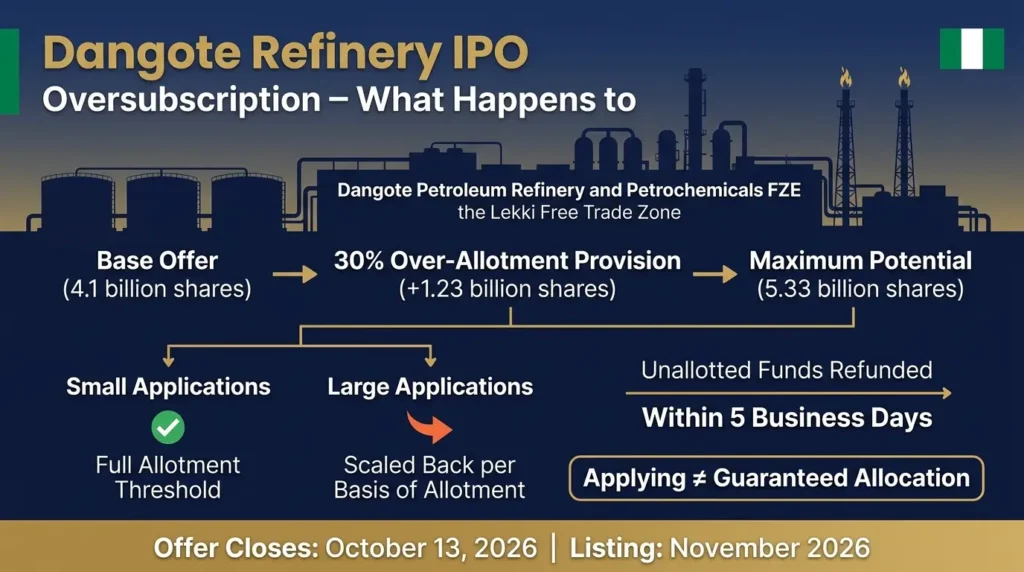
Dangote Refinery IPO Oversubscription: What Happens to Your Shares?
By Market Formula Editorial Team / September 2026
Introduction
The Dangote Refinery IPO has attracted enormous attention from Nigerian investors. With 4.1 billion shares offered at ₦525 each, many investors are asking a very practical question: What happens if more people apply for shares than the 4.1 billion shares available?
This is called oversubscription. And it is important to understand because applying for shares does not automatically mean you will receive all the shares you requested. The offer runs from September 14 to October 13, 2026.
This Dangote Refinery IPO oversubscription guide breaks down exactly what happens to your application, your money, and your potential allocation when demand exceeds supply.
Let’s examine the Dangote Refinery IPO oversubscription with clarity and strategic discipline.
1. What Does Oversubscription Mean?
An IPO is oversubscribed when investors collectively apply for more shares than are available under the offer. For example, suppose investors apply for 6 billion shares but the base offer is 4.1 billion shares. There is therefore demand for 1.9 billion more shares than the base offer provides.
That does not mean investors will automatically receive 4.1 billion shares on a first-come-first-served basis. The company has a specific process for dealing with excess demand.
The 30% Over-Allotment Provision
The base offer is 4.1 billion shares. However, the prospectus provides for the possibility of absorbing up to 30% additional shares in an oversubscription situation, subject to SEC approval.
30% of 4.1 billion = 1.23 billion shares
Therefore: 4.1bn + 1.23bn = 5.33bn shares
The potential maximum under this provision is approximately 5.33 billion shares. But there is an important distinction: 5.33 billion is a potential maximum, not an automatic allocation. The additional shares depend on the applicable approval and offer process.
       ┌────────────────────────────────────────────────────────┐
       │   DANGOTE REFINERY IPO OVERSUBSCRIPTION – KEY NUMBERS  │
       └───────────────────────────┬────────────────────────────┘
                                   │
         ┌─────────────────────────┼─────────────────────────┐
         ▼                         ▼                         ▼
  [ BASE OFFER ]             [ 30% OVER-ALLOTMENT ]    [ MAXIMUM ]
  4.1 billion shares         +1.23 billion shares      5.33 billion
  at ₦525 each               subject to SEC approval    potential maximum
  ₦2.1525 trillion           (green shoe provision)     if fully exercised
2. What Happens If You Apply for 100,000 Shares?
This is where many investors misunderstand IPOs. Suppose you apply for 100,000 Dangote shares. Your application cost would be:
100,000 × ₦525 = ₦52,500,000
Does that guarantee that you receive 100,000 shares? No. If the IPO is oversubscribed, your application may be reduced depending on the final Basis of Allotment.
The Full-Allotment Threshold
The prospectus provides for a Full-Allotment Threshold. Think of it this way: suppose, purely as an illustration, the final allotment process establishes a threshold of 1,000 shares.
An investor who validly applied for 500 shares could potentially receive all 500. Another investor who applied for 100,000 shares could receive less than the 100,000 requested because the demand above the threshold would be subject to the approved allocation process.
The company will establish a Full-Allotment Threshold. All valid applications at or below that threshold will receive their full applications. Shares remaining afterwards will be distributed among larger applications according to an SEC-approved Basis of Allotment and may be scaled back.
The actual threshold cannot be known until the offer closes and the allotment process is completed. So, do not assume that everyone who applies for 1,000 shares will get 1,000. That would be speculation.
3. What Happens to Large Applications?
Once applications have been processed, the available shares are distributed according to the approved Basis of Allotment. Where demand exceeds the shares available, larger applications can be scaled back.
For example, imagine an investor applies for 100,000 shares, but the approved allotment gives that investor 60,000 shares. The investor does not lose the remaining money. The amount relating to the 40,000 unallocated shares is returned according to the offer process.
What Happens to Your Excess Money?
Let us use the same example:
| Item | Amount |
|---|---|
| Shares applied for | 100,000 |
| Amount paid | ₦52,500,000 |
| Shares allotted | 60,000 |
| Cost of allotted shares | ₦31,500,000 |
| Excess to be refunded | ₦21,000,000 |
The reported prospectus terms indicate that surplus application money, together with applicable accrued interest or profit where specified, is expected to be returned within the stated timetable after allotment.
4. Does Oversubscription Mean You Will Lose Your Money?
No. Oversubscription does not mean that investors lose the money they paid for shares that they do not receive. There are essentially three possible outcomes:
1. Full allocation – You receive everything you applied for.
2. Partial allocation – You receive fewer shares than you requested, and the balance is refunded.
3. No allocation – If your application is unsuccessful, the applicable subscription funds are returned according to the offer process.
The Refund Timeline
Moniepoint’s published FAQ for the offer states that a completed subscription cannot be manually cancelled before the offer process is completed. Where an investor is not fully allotted, unallotted funds will be refunded within five business days after the allotment outcome is finalised.
Successful investors’ shares will be credited to their CSCS accounts within 15 business days after the SEC clears the basis of allotment.
That distinction matters because the ₦5,250 paid by a small investor today is not necessarily money that will be immediately used to acquire shares. If an investor applies for 100 shares, for example, ₦52,500 is committed to the application. If the final allotment is lower, part of that money remains refundable after the allotment process.
5. What About the 30% Additional Shares?
This is perhaps the most misunderstood part of the Dangote IPO. Let us say the IPO receives extremely strong demand.
The company may, subject to the applicable approval, increase the shares available from 4.1 billion to approximately 5.33 billion. But imagine investors have applied for 8 billion shares. Even after increasing the offer to 5.33 billion, there would still be:
8bn − 5.33bn = 2.67bn shares of excess demand.
Therefore: The 30% provision reduces the shortage; it does not eliminate oversubscription. The remaining shares still have to be allocated according to the approved process.
6. Will Small Investors Be Prioritised?
This is an important development for retail investors. Aliko Dangote has publicly said the company wants the IPO to create broad-based ownership and that retail and small investors should not be crowded out by very large subscriptions.
Dangote stated that retail investors seeking to buy smaller amounts of shares would receive priority over large institutional investors. He specifically mentioned those looking to invest ₦50,000, ₦100,000 and other smaller amounts.
He said: “The big institutional investors who request large allocations will not get everything they ask for. But the small retail investors who want to buy ₦50,000 worth, or some buying ₦100,000 worth, and so on, they are the ones who will be given priority allocations.”
However, investors should distinguish between management’s stated intention and the legally applicable Basis of Allotment. The final allocation will be determined through the formal offer process and regulatory approval. Therefore, small investors should not be told that they are guaranteed full allocation unless the final approved allotment terms specifically establish that.
7. A Simple Oversubscription Example
| Item | Example |
|---|---|
| Base offer | 4.1bn shares |
| Potential additional 30% | 1.23bn shares |
| Potential maximum | 5.33bn shares |
| Total applications | 8bn shares |
| Excess demand after 5.33bn | 2.67bn shares |
The important point is: Investors cannot all receive their full applications. The available shares have to be distributed according to the approved allocation mechanism.
8. What Happens After the IPO Closes?
The IPO is scheduled to close on October 13, 2026. After the offer closes, the applications are processed, and the proposed Basis of Allotment is prepared. The SEC and relevant advisers then review the allotment process. Investors subsequently receive confirmation of the shares actually allotted to them.
This means you should not expect to know your final allocation immediately after submitting your application.
When Will Your Shares Enter Your CSCS Account?
Successful applicants will ultimately have their allotted shares credited electronically through the capital-market infrastructure. For investors who already have a CSCS account and Clearing House Number (CHN) , the shares can be credited through their existing structure.
For first-time investors, the offer process also makes provision for applicants who do not yet have these details. The prospectus states that successful applicants without valid CHN and CSCS details will be allotted through a Registrar Identification Number (RIN) , a temporary number used to “warehouse allotted shares… under the Registrar’s custody at the CSCS.” The shares are transferred to the investor’s stockbroking account once valid CHN and CSCS details are provided.
Being allotted shares is different from merely submitting an application. You become a shareholder in respect of the shares that are validly allotted to you.
9. What If You Want to Sell Immediately After Listing?
The IPO price is ₦525. But ₦525 is not a guaranteed future trading price. Once the shares begin trading on the NGX, market supply and demand will determine the market price.
Three things could happen:
| Scenario | Outcome |
|---|---|
| Price above ₦525 | Capital gain for an investor who sells above their effective acquisition price |
| Price around ₦525 | Little or no price appreciation before considering costs |
| Price below ₦525 | Unrealised loss for an investor holding the shares |
The official Dangote IPO website itself warns that the value of the investment can rise or fall and that investors may not get back the amount invested. Listing is expected on the NGX Main Board sometime between early and late November 2026.
10. Action Plan: What to Do While Waiting for Allotment
Do not make the mistake of thinking: “I’ve applied, so my work is finished.” This is actually the point where you should continue analysing the company.
Step 1: Monitor the final IPO subscription level. How much demand did the IPO receive?
Step 2: Watch for the final Basis of Allotment. How were shares distributed?
Step 3: Confirm your actual allocation. How many shares did you receive?
Step 4: Track your refund. How much unused application money was returned?
Step 5: Monitor the listing price. At what price does the stock begin trading?
Step 6: Re-assess valuation post-listing. What P/E and other valuation multiples is the market assigning to Dangote Refinery?
11. Final Summary & The Bottom Line
The Dangote Refinery IPO oversubscription process is straightforward once you understand the mechanics.
  ┌──────────────────────────────────────────────────────────┐
  │   DANGOTE REFINERY IPO OVERSUBSCRIPTION – KEY TAKEAWAYS  │
  ├─────────────────────┬────────────────────────────────────┤
  │ Base Offer          │ 4.1 billion shares at ₦525         │
  ├─────────────────────┼────────────────────────────────────┤
  │ Maximum with 30%    │ 5.33 billion shares                │
  ├─────────────────────┼────────────────────────────────────┤
  │ Allotment           │ Full-Allotment Threshold for small │
  │                     │ applications; larger applications  │
  │                     │ scaled back                        │
  ├─────────────────────┼────────────────────────────────────┤
  │ Refund              │ Within 5 business days after       │
  │                     │ allotment outcome                  │
  ├─────────────────────┼────────────────────────────────────┤
  │ Retail Priority     │ Stated intention to prioritise     │
  │                     │ small investors                    │
  ├─────────────────────┼────────────────────────────────────┤
  │ Listing             │ Expected November 2026             │
  └─────────────────────┴────────────────────────────────────┘
The Bottom Line:
An oversubscribed IPO is not automatically good news for an investor. It tells us that demand for the offer exceeded the base number of shares available. But it does not tell us whether the shares are fairly valued. Remember: High demand ≠ cheap valuation.
If you applied for Dangote Refinery shares, don’t focus only on: “Will I get my shares?” There are actually three separate questions:
- Will I be allotted the shares?
- At what effective price did I acquire them?
- What are those shares actually worth after listing?
The first question is about IPO allocation. The second is about your investment position. The third is about valuation. And that third question is where investors need to do the real work.
Don’t just ask how many Dangote shares you can get. Ask what those shares are worth.
For more weekly NGX updates and strategy guides, explore our market trends and analysis archive.
Disclaimer: This article is for educational purposes only and does not constitute investment advice. Investors should read the approved Dangote Refinery prospectus and official allotment announcements before making decisions.