
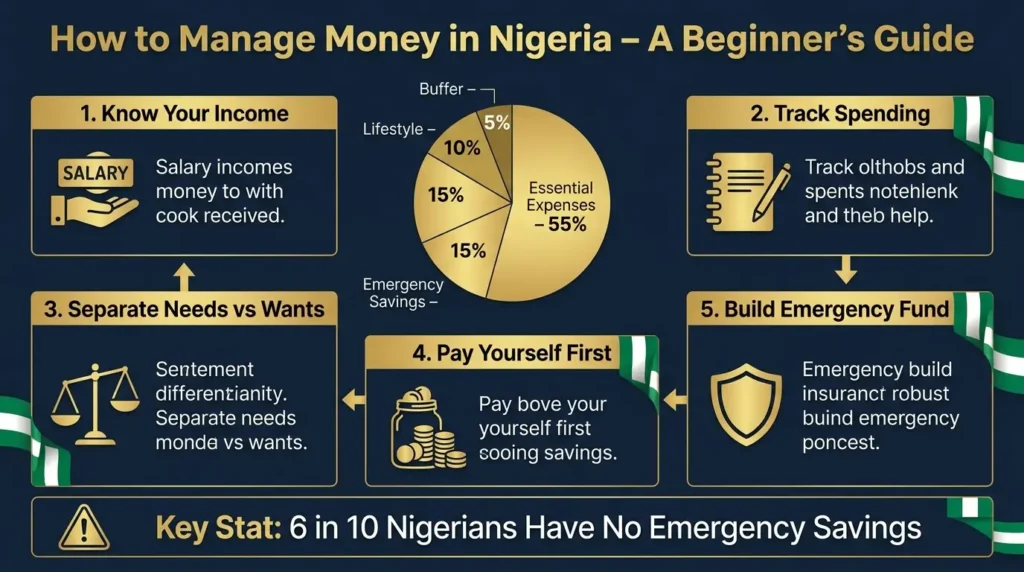
How to Manage Your Money in Nigeria: A Beginner’s Guide
By Market Formula Editorial Team / October 2026
Introduction
You can earn a good income and still struggle financially. Two people could each earn N500,000 every month and end the year in completely different financial positions. One may have savings, an emergency fund and investments. The other may have spent everything, accumulated debt and still be waiting for the next salary.
The difference isn’t always how much they earn. It is often what they do with the money after they receive it. That is why learning how to manage money in Nigeria is one of the first steps towards building long-term wealth.
This guide provides a practical approach to how to manage money in Nigeria — from understanding your income and controlling expenses to saving, dealing with debt and eventually investing. You don’t have to become rich before you start managing your money. You need to manage the money you have before you can build on it.
Let’s examine how to manage money in Nigeria with clarity and strategic discipline.
1. What Does It Mean to Manage Your Money?
Money management is simply the process of deciding what happens to your money before and after you receive it. It involves:
- Knowing how much you earn
- Tracking how much you spend
- Separating needs from wants
- Creating a budget
- Saving consistently
- Preparing for emergencies
- Managing debt
- Investing for future goals
- Reviewing your financial progress
The Central Bank of Nigeria (CBN) describes financial literacy as having the knowledge and skills needed to manage financial resources effectively and improve economic well-being. Its financial-literacy framework emphasizes budgeting, prioritising spending, saving income and understanding financial products.
The goal isn’t to stop yourself from spending money. The goal is to give every naira a purpose. A simple way to think about your financial system is:
Income → Expenses → Savings → Investments → Wealth
The challenge is making sure the arrows actually work.
       ┌────────────────────────────────────────────────────────┐
       │   HOW TO MANAGE MONEY IN NIGERIA – THE MONEY FLOW      │
       └───────────────────────────┬────────────────────────────┘
                                   │
         ┌─────────────────────────┼─────────────────────────┐
         ▼                         ▼                         ▼
  [ INCOME ]                 [ EXPENSES ]               [ SAVINGS ]
  Salary, business,          Needs vs wants             Emergency fund
  freelance, side            Essential first            and future goals
  hustles                    then lifestyle
                                   │
                                   ▼
                           [ INVESTMENTS ]
                           Stocks, bonds, funds
                           for long-term wealth
2. Step 1: Know How Much Money You Really Earn
Before creating a budget, you need to know your actual income. For someone with a regular salary, this may be relatively easy. But many Nigerians have multiple income sources. You might have salary, business income, freelance income, side hustles, dividends, interest income, rental income, commissions, and occasional income.
For example, imagine someone earns:
| Income Source | Amount |
|---|---|
| Salary | N350,000 |
| Side business | N100,000 |
| Freelance work | N50,000 |
| Total | N500,000 |
But don’t automatically treat irregular income as guaranteed income. If your freelance income varies between N20,000 and N100,000, your financial plan should not depend on receiving N100,000 every month. A safer approach is to build your basic budget around your reliable income and treat irregular income separately.
3. Step 2: Track Where Your Money Goes
This is where many people discover that the problem isn’t necessarily that they don’t earn enough. They simply don’t know where their money is going. For the next 30 days, track your spending. Don’t try to change everything immediately. Just record it.
You can divide your expenses into categories such as:
| Category | Examples |
|---|---|
| Housing | Rent, service charges, repairs |
| Food | Groceries, meals, eating out |
| Transportation | Fuel, public transport, ride-hailing |
| Utilities | Electricity, water, internet |
| Education | School fees, books, lessons |
| Family | Support, medical expenses |
| Debt | Loan repayments |
| Lifestyle | Entertainment, clothing, outings |
| Savings | Emergency fund and other savings |
| Investments | Stocks, funds, bonds and other investments |
At the end of the month, calculate how much you spent in each category. You may be surprised by the result. That is not necessarily a bad thing. You cannot improve what you don’t measure.
4. Step 3: Separate Needs From Wants
One of the simplest ways to improve your finances is to distinguish between needs and wants. A need is something essential to your current well-being or responsibilities. A want is something you would like to have but can live without.
| Need | Want |
|---|---|
| Food | Ordering restaurant food three times a week |
| Transportation | Choosing the most expensive option when cheaper alternatives exist |
| Internet access | Paying for several subscriptions you rarely use |
The problem isn’t having wants. You work hard and deserve to enjoy some of your money. The problem begins when your wants consistently consume the money that should have gone towards your financial goals.
5. Step 4: Create a Budget That Fits Your Reality
A budget is simply a plan for your money. It tells you how much money is coming in, where it should go and how much should remain for your future goals.
You may have heard of budgeting rules such as the 50/30/20 method. These frameworks can be useful starting points, but don’t treat them as laws. A Nigerian household paying high rent, supporting relatives, paying school fees and dealing with irregular electricity costs may have a very different financial structure from someone living in another country. Your budget should reflect your actual circumstances.
A simple framework is:
| Priority | Purpose |
|---|---|
| 1. Essential expenses | Money required for basic living and important responsibilities |
| 2. Financial protection | Emergency savings and necessary insurance |
| 3. Savings | Money being set aside for known future needs |
| 4. Investments | Money being allocated towards long-term wealth creation |
| 5. Lifestyle | Entertainment, leisure and other discretionary spending |
The percentages can change as your income and circumstances change. The important thing is that saving and investing should not depend entirely on whatever money happens to remain at the end of the month.
6. Step 5: Pay Yourself First
This is one of the simplest habits you can introduce into your financial system. Most people operate like this:
Income → Spending → Bills → Whatever remains = Savings
The problem? There may be nothing left.
A better approach is:
Income → Savings/Investment → Essential expenses → Lifestyle
For example, suppose you earn N300,000 monthly. Instead of spending the entire N300,000 and hoping to save whatever remains, you could decide that N30,000 will automatically go towards your financial goals.
| Item | Amount |
|---|---|
| Income | N300,000 |
| Savings/investment | N30,000 |
| Available for other expenses | N270,000 |
The amount doesn’t have to be N30,000. The important principle is consistency. Even if you start with N10,000, developing the habit can be more valuable than waiting until you can afford a large amount.
7. Step 6: Build an Emergency Fund
Before putting every available naira into investments, build some financial protection. An emergency fund is money kept aside for unexpected but important expenses.
Examples include medical expenses, emergency travel, temporary loss of income, major repairs, urgent family responsibilities, and unexpected bills.
The important point is that your emergency fund should be accessible. It isn’t the money you put into a long-term investment and hope you won’t need for five years. This is also why you should separate emergency money from investment money. If you invest your emergency fund in an asset whose value can fall sharply or whose money cannot be accessed quickly, you may be forced to sell at the wrong time.
How Much Should You Keep in an Emergency Fund?
There is no single number that works for everyone. A person with a stable salary and few financial responsibilities may need a different amount from someone who runs a business or supports a large household. A practical way to approach it is to calculate your essential monthly expenses.
For example:
| Expense | Amount |
|---|---|
| Food | N100,000 |
| Housing | N80,000 |
| Transportation | N40,000 |
| Utilities | N30,000 |
| Education/family obligations | N50,000 |
| Total essential expenses | N300,000 per month |
If you decide to build six months of essential expenses, your target would be:
N300,000 × 6 = N1.8 million
That doesn’t mean you must have N1.8 million before you can start investing. You can build the emergency fund gradually. The important thing is to have a target.
Why This Matters: According to the PiggyVest Savings Report 2025, the share of Nigerians saving monthly dropped to 40% in 2025 from 64% in 2023, while six in ten respondents have no emergency savings. Only 6% of Nigerians feel financially secure, highlighting widespread financial strain across households.
8. Step 7: Deal With Expensive Debt
Before chasing investment returns, look at the interest you are already paying. Suppose someone is paying a very high interest rate on consumer debt while looking for an investment that might generate a much lower return.
The first question shouldn’t be: “Which investment will give me the highest return?” It should be: “Can I reduce the expensive debt that is already working against me?”
This doesn’t mean every debt must be cleared before investing. Some debts may be relatively inexpensive or tied to productive assets. But high-cost consumer debt can make it much harder to build wealth. Prime lending rates in Nigeria currently range from as low as 19.5% to more than 40%, making consumer debt exceptionally expensive.
Your financial plan should consider both sides: money coming into your pocket and money leaving your pocket because of debt.
9. Step 8: Start Saving Before You Start Investing
Saving and investing are related, but they are not the same thing. Saving generally means setting money aside for future needs. Investing means committing money to an asset with the expectation of earning a return, while accepting some level of risk.
The SEC’s investor education materials make the same distinction: investment involves committing money to income-bearing assets over a period of time and carries both returns and risks.
| Savings | Investments |
|---|---|
| Rent | Retirement |
| School fees | Long-term wealth |
| Emergency expenses | Children’s future |
| A planned purchase | Capital growth |
| Short-term financial goals | Passive income / Financial independence |
The two should work together.
10. Step 9: Don’t Chase Returns Before Understanding Risk
This is one of the most important lessons for anyone beginning their wealth-building journey. If someone tells you: “This investment will give you 25%.” Don’t immediately ask: “How do I invest?” Ask: “What is the risk?”
Then ask:
- Is the return guaranteed?
- Who is offering it?
- Is the provider regulated?
- How long will my money be locked up?
- Can I withdraw early?
- What fees apply?
- What happens if the investment loses money?
- Does the return compensate me for the risk?
The SEC advises investors to establish clear investment goals, understand their risk tolerance, conduct research and diversify their portfolios. This is an important principle throughout this series: Never evaluate an investment by return alone. Return without context can be misleading.
11. Step 10: Understand the Difference Between Saving and Building Wealth
Saving money is important. But saving alone isn’t necessarily the final destination. Imagine you consistently save N50,000 every month. That’s excellent discipline. But over a long period, you also need to consider inflation, investment returns, purchasing power, reinvestment, and asset growth.
Nigeria’s average inflation rate fell to 15.51% in the first half of 2026 from 23.47% a year earlier. However, lower inflation means prices are increasing more slowly; it does not mean prices have returned to previous levels. Purchasing power erosion that occurred during the period of very high inflation has not been reversed.
This is where the journey moves from saving money to building wealth. The CBN’s financial-literacy materials specifically distinguish between saving for income smoothing and long-term asset building, and highlight the importance of budgeting and understanding compound interest.
12. Example: How to Manage a N500,000 Monthly Income
Let’s put everything together. Suppose you earn N500,000 per month. One possible financial structure could look like this:
| Purpose | Example Amount |
|---|---|
| Essential expenses | N275,000 |
| Emergency savings | N75,000 |
| Investments | N75,000 |
| Lifestyle | N50,000 |
| Buffer | N25,000 |
| Total | N500,000 |
This is not a universal formula. Your rent, family responsibilities, debt, income stability and financial goals may require a completely different allocation. The purpose of the example is to show the principle: Don’t allow your entire income to disappear into expenses. Give some of your money a future job.
If the N75,000 investment contribution continues for 12 months, you would have contributed N900,000. That is before considering any investment return. The same discipline over several years can become much more significant.
13. Common Money Management Mistakes to Avoid
1. Waiting until the end of the month to save. If saving is whatever remains after spending, you may never save consistently.
2. Increasing your lifestyle every time your income increases. A higher income should ideally create room for higher savings and investments—not only higher spending.
3. Keeping all your money in one place. Different types of money have different purposes. Your emergency fund does not necessarily belong in the same place as your long-term investment portfolio.
4. Investing your emergency fund. An investment can lose value or become difficult to access at the exact moment you need the money.
5. Chasing the highest return. Higher potential returns generally come with higher risk. Always ask what you’re being compensated for taking that risk.
6. Borrowing money to maintain a lifestyle. Debt can quietly consume future income.
7. Investing without understanding the product. If you cannot explain how an investment makes money, what could cause you to lose money and when you can access your funds, you probably need to understand it better before investing.
8. Having no financial target. “I’m saving money” is better than nothing. But “I’m building N1 million for my emergency fund” is much easier to measure.
14. A Simple Money Management System You Can Start Today
You don’t need a complicated spreadsheet to get started. Try this:
| Step | Action |
|---|---|
| Step 1 | Write down every source of income |
| Step 2 | Track your spending for 30 days |
| Step 3 | Separate essential expenses from wants |
| Step 4 | Set a monthly savings target |
| Step 5 | Create an emergency fund target |
| Step 6 | Review your expensive debts |
| Step 7 | Decide how much you can consistently invest |
| Step 8 | Automate your savings and investment contributions where possible |
| Step 9 | Review your finances at the end of every month |
| Step 10 | Increase your savings and investment contributions when your income increases |
The objective isn’t perfection. It’s financial consistency.
15. Final Summary & The Bottom Line
Building wealth doesn’t begin when you have millions of naira to invest. It begins with learning what happens to the money you earn today. If you earn N200,000, N500,000, N1 million or more every month, the principle remains the same: know what comes in, know what goes out, save deliberately, protect yourself from financial emergencies, manage debt, invest according to your goals and risk, and give your money time to grow.
text
  ┌──────────────────────────────────────────────────────────┐
  │   HOW TO MANAGE MONEY IN NIGERIA – KEY TAKEAWAYS         │
  ├─────────────────────┬────────────────────────────────────┤
  │ Know Your Income    │ Salary + side hustles + freelance  │
  │                     │ Treat irregular income separately  │
  ├─────────────────────┼────────────────────────────────────┤
  │ Track Spending      │ 30 days of recording every naira   │
  │                     │ You cannot improve what you don't  │
  │                     │ measure                            │
  ├─────────────────────┼────────────────────────────────────┤
  │ Pay Yourself First  │ Income → Savings → Expenses        │
  │                     │ Not Income → Expenses → Savings    │
  ├─────────────────────┼────────────────────────────────────┤
  │ Emergency Fund      │ 6× essential monthly expenses      │
  │                     │ 6 in 10 Nigerians have none        │
  ├─────────────────────┼────────────────────────────────────┤
  │ Manage Debt         │ Prime lending rates 19.5%–40%      │
  │                     │ Clear expensive debt first         │
  ├─────────────────────┼────────────────────────────────────┤
  │ Save Before Invest  │ Different purposes; both needed    │
  ├─────────────────────┼────────────────────────────────────┤
  │ Understand Risk     │ Never evaluate by return alone     │
  │                     │ Ask what could go wrong            │
  └─────────────────────┴────────────────────────────────────┘
The Bottom Line:
The goal isn’t simply to have money sitting in an account. The goal is to gradually move from earning money → managing money → saving money → investing money → building wealth. And that process can start with the next naira you receive.
Your Next Steps:
- Track your spending for 30 days – Know exactly where your money goes
- Set a savings target – Even N10,000 per month is a start
- Build an emergency fund – Aim for at least 3–6 months of essential expenses
- Review your debts – Prioritise clearing high-interest consumer debt
- Learn before you invest – Understand risk, returns, and liquidity
For more weekly NGX updates and strategy guides, explore our beginner’s guide archive.
Disclaimer: This article is for educational purposes only and should not be considered personalised financial or investment advice. Investment products carry different levels of risk, and past performance does not guarantee future results. Before investing, understand the product, its risks, fees, liquidity and the regulatory status of the provider.