
Growth Stocks vs Dividend Stocks in Nigeria: Which Strategy Builds More Wealth?
By Market Formula Editorial Team / October 2026
Introduction
Imagine you have N10 million to invest in the Nigerian stock market. You have two broad choices. You could buy companies that are reinvesting heavily in their businesses, hoping that rising earnings eventually translate into much higher share prices. Or you could buy companies with established earnings that return a meaningful portion of their profits to shareholders through dividends.
The natural question is: Which strategy will make you richer?
The uncomfortable answer is that there is no universal winner. More importantly, the usual argument that you must choose between a “growth stock” and a “dividend stock” is too simplistic for the Nigerian Exchange (NGX). Some of Nigeria’s strongest companies do both. GTCO, Dangote Cement, Zenith Bank and MTN Nigeria have all demonstrated the ability to return cash to shareholders while continuing to invest in their businesses.
This growth stocks vs dividend stocks Nigeria analysis provides a practical framework for Nigerian investors to evaluate both strategies using real NGX data.
Let’s examine growth stocks vs dividend stocks Nigeria with clarity and strategic discipline.
1. What Is a Growth Stock?
A growth company is one that can reinvest a significant portion of its earnings into opportunities that generate attractive future returns. Think about a small Nigerian business. Suppose a company makes N100 million in profit. It could distribute most of that profit to shareholders, or it could retain the money and use it to build another factory, open new distribution channels, acquire another company, expand production, invest in technology, increase capacity, or enter a new market.
If management can turn retained earnings into substantially higher future earnings, retaining the money may create more value than distributing it immediately. That is the economic argument behind growth investing.
But there is an important distinction: A company growing rapidly is not automatically a good investment. You can buy a rapidly growing company at an absurd valuation and still lose money. The business can grow while the share price performs poorly because investors originally paid too much for that growth. This is why business quality and share-price attractiveness are two different questions.
2. What Is a Dividend Stock?
A dividend-paying company distributes part of its profits to shareholders. For a Nigerian investor, the calculation is straightforward:
Dividend yield = Annual dividend per share ÷ Share price × 100
For example, if a company pays N10 per share and its share price is N100:
N10 ÷ N100 × 100 = 10% dividend yield
But yield alone tells you very little about whether the dividend is safe. A company paying a 15% yield is not automatically better than one paying 5%. The 15% yield could exist because the company has an exceptionally strong dividend. Or because its share price has collapsed because investors expect the dividend to be cut. That is why dividend investors need to look beyond yield.
       ┌────────────────────────────────────────────────────────┐
       │   GROWTH STOCKS VS DIVIDEND STOCKS NIGERIA – KEY TERMS │
       └───────────────────────────┬────────────────────────────┘
                                   │
         ┌─────────────────────────┼─────────────────────────┐
         ▼                         ▼                         ▼
  [ GROWTH STOCK ]           [ DIVIDEND STOCK ]         [ TOTAL RETURN ]
  Reinvests earnings         Distributes profits        Capital gains +
  into expansion             to shareholders            dividends received
  Focus: future earnings     Focus: current income      The true measure
3. The First Big Myth: A Dividend Is Not Free Money
This is one of the most important concepts for new investors. When a company goes ex-dividend, the market generally adjusts the share price to reflect the value of the dividend being separated from the shares, all else being equal.
Suppose you own shares worth N100,000 and the company declares a N2,000 dividend. Economically, you have not suddenly created N2,000 of new wealth simply because the company transferred N2,000 to you. You now have approximately N98,000 of shares and N2,000 of dividend cash, before considering market movements, taxes and other factors.
The company has transferred part of its value from the business to shareholders. This is why dividend income should not be confused with investment return. Your total shareholder return is what matters:
Total shareholder return = (Ending share value − Beginning share value + Dividends received) ÷ Beginning share value × 100
That is a much better measure of investment performance.
4. Why Nigerian Investors Still Care About Dividends
If dividends do not magically create wealth, why are they important? Because cash returned to shareholders can be extremely valuable.
1. Dividends provide cash flow. An investor approaching retirement may not want to sell shares every month to fund expenses. A portfolio generating dividends can provide part of that cash flow.
2. Dividends can be reinvested. This is where the compounding effect becomes powerful. Suppose you receive a dividend and use it to buy additional shares. Those additional shares can generate another dividend. You reinvest again. Over many years: shares → dividends → more shares → more dividends → even more shares. That is dividend compounding.
3. Dividends provide evidence of shareholder distributions. A dividend does not prove that a company is financially healthy, but a long record of sustainable distributions can provide useful evidence about its earnings capacity, cash generation and capital allocation. The word sustainable is critical.
5. Real NGX Examples: The Difference Is Not Black and White
GTCO: Dividend + Growth + Capital Strength
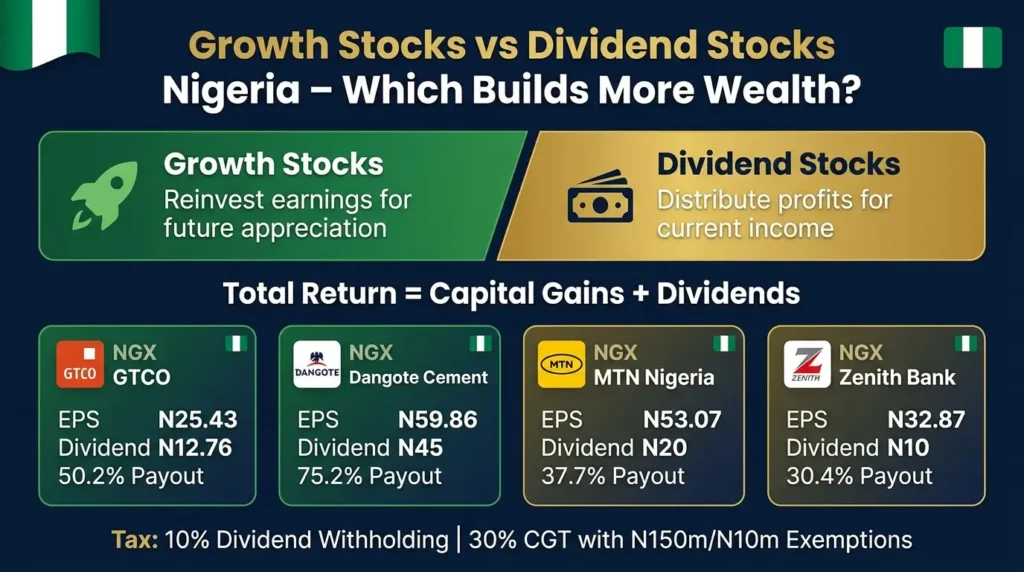
GTCO’s FY2025 annual report provides an excellent example of why the simple “growth versus dividend” argument can be misleading. For FY2025, GTCO reported basic EPS of N25.43, a total dividend per share of N12.76, and a profit after tax of N865.75 billion . The total dividend comprised a N1.00 interim dividend and a N11.76 final dividend .
Using the reported figures:
- Dividend payout ratio ≈ N12.76 ÷ N25.43 = 50.2%
GTCO was not simply a company handing out everything it earned. It retained roughly half of its earnings per share while distributing the other portion. It is better understood as a profitable financial-services business that combines shareholder distributions with continued business investment.
Dangote Cement: Reinvestment Plus Dividends
Dangote Cement is another excellent example. For FY2025, Dangote Cement reported profit after tax of approximately N1.015 trillion, EPS of N59.86, and a proposed dividend of N45 per share . The company also commissioned a 3Mta grinding plant in Côte d’Ivoire and expanded its production footprint.
The N45 dividend represented approximately:
- Payout ratio = N45 ÷ N59.86 = 75.2%
Dangote Cement was simultaneously growing earnings, investing in capacity, expanding regionally, and returning substantial cash to shareholders. That is not a pure growth stock. It is not a pure income stock either. It is a mature business with significant cash-generating capacity that can both reinvest and distribute capital.
MTN Nigeria: Growth Can Return as Dividends Too
MTN Nigeria provides another interesting case. The company’s FY2025 audited results showed profit after tax of approximately N1.11 trillion, EPS of N53.07, and a total dividend of N20 per share (N5 interim + N15 final) .
The dividend payout was approximately:
- Payout ratio = N20 ÷ N53.07 = 37.7%
Again, this is not a company choosing between “growth” and “dividends.” It was returning part of its earnings while retaining the remainder for the business. The company’s 2025 earnings represented a major recovery from the previous year’s loss of N400.44 billion .
Zenith Bank: Why Dividend Yield Alone Is Not Enough
Zenith Bank’s FY2025 results provide another useful lesson. The bank reported profit after tax of approximately N1.04 trillion, EPS of about N32.87, and a total dividend of N10 per share (N1.25 interim + N8.75 final) .
Using the reported figures:
- Dividend payout ratio ≈ N10 ÷ N32.87 = 30.4%
That means the dividend itself does not tell the whole story. An investor also needs to ask: Is earnings growth sustainable? Is capital adequate? Is asset quality improving? Is the share price attractive? Is the dividend likely to grow? What happens if earnings decline? The dividend is only one part of the investment thesis.
6. The Most Important Number Is Total Return
Imagine two Nigerian investors. Investor A buys a stock that pays no dividend but appreciates significantly. Investor B buys a stock that pays large dividends but barely appreciates.
Looking only at dividend income, Investor B appears to be winning. Looking only at share-price appreciation, Investor A appears to be winning. Looking at total shareholder return, we can finally compare them properly.
| Investment A | Investment B | |
|---|---|---|
| Starting investment | N10 million | N10 million |
| Ending share value | N18 million | N12 million |
| Dividends received | N500,000 | N5 million |
| Total value | N18.5 million | N17 million |
| Return | 85% | 70% |
Investor B received far more cash. But Investor A created more total wealth. That is why “How much dividend did I receive?” is the wrong first question. The better question is: How much total wealth did this investment create after considering dividends, price appreciation, costs, taxes and inflation?
7. Compounding Is Still the Most Powerful Argument for Long-Term Investing
Suppose you invest N1 million once and earn an average annual return of 10%, with all returns reinvested.
| Period | Approximate value |
|---|---|
| 10 years | N2.59 million |
| 20 years | N6.73 million |
| 30 years | N17.45 million |
This is hypothetical mathematics, not an NGX forecast.
Now reduce the assumed return to 8%. After 30 years, the same N1 million becomes approximately N10.06 million. The difference between 8% and 10% over 30 years is approximately N7.39 million. That is why seemingly small differences in long-term returns matter enormously.
But there is an equally important point: You don’t earn a compound return simply because you own a stock. You must survive the volatility. You must avoid destroying the compounding process by selling at the wrong time. And the company itself must continue producing acceptable returns.
8. The Nigerian Problem: Inflation Changes the Meaning of Your Returns
There is another investor many people forget: Inflation. Suppose your portfolio grows from N10 million to N20 million. That sounds like a 100% gain. But if prices have risen substantially over the same period, N20 million may not buy twice what N10 million bought originally.
This is why Nigerian investors should think in terms of nominal return vs real return. A stock can make you richer in naira while failing to increase your purchasing power sufficiently. For long-term wealth creation, what matters is not simply whether your account balance increased. It is whether your investment grew faster than inflation after considering taxes and costs.
9. Dividend Reinvestment: The Compounding Accelerator
This is where dividend investing becomes much more powerful. Suppose you receive N500,000 in dividends. You have two choices.
Option A: Spend it. The money becomes school fees, rent, food, travel, household expenses, or other consumption. That can be perfectly reasonable if income is the objective. But the money is no longer invested.
Option B: Reinvest it. You use the N500,000 to buy more shares. Those shares can produce future dividends and appreciate in value. Now your dividend has become productive capital.
This distinction is particularly important for younger investors. If you do not need the cash, reinvestment can turn dividend income into another source of compounding.
10. Nigeria’s Tax Framework: What Investors Must Know
Dividend Withholding Tax
Under Nigeria’s tax framework, dividend payments are subject to withholding tax at a rate of 10% for both corporate and individual shareholders . For non-resident shareholders, the tax deducted at source constitutes the final tax on dividend income.
If a Nigerian investor is entitled to a gross dividend of N1,000,000 and 10% withholding applies:
- Tax deducted = N100,000
- Net dividend = N900,000
Capital Gains Tax on Share Disposals
The Nigeria Tax Act 2025 introduced a new framework for chargeable gains on share disposals from January 1, 2026 . Under the new regime, assessable gains on disposal of shares are taxed at the applicable income tax rate of 30% for companies, with individuals taxed at graduated rates .
However, an exemption applies where, in any 12-month period:
- Aggregate disposal proceeds are below N150 million; and
- Chargeable gains do not exceed N10 million .
There are also provisions for reinvestment of disposal proceeds into shares of Nigerian companies. This matters because an investor’s final return is not necessarily the headline return shown on a stock chart. For larger portfolios, tax treatment can materially affect realised returns.
11. So Which Is Better: Growth or Dividends?
The answer depends on your objective.
If You Are Still Building Wealth
Growth and total-return investing generally deserve greater emphasis. You may have a long investment horizon, active employment income, no immediate need for portfolio income, the ability to reinvest dividends, and the ability to tolerate volatility. In that situation, you do not necessarily need your portfolio to produce a large cash payment today. Your priority may be to maximise long-term compounding while controlling risk.
If You Need Portfolio Income
Dividends become much more important. This could include retirees, investors approaching retirement, investors supplementing business income, investors funding recurring expenses, or investors who value cash distributions psychologically because they help them stay invested.
But even income investors should not blindly chase the highest dividend yield. A 12% yield from a deteriorating company can be much worse than a 5% yield from a company whose earnings and dividend are growing sustainably.
12. The Better Strategy: Think in Stages
The most useful framework for many Nigerian investors is not growth vs dividend. It is:
Accumulation → Compounding → Income → Capital Preservation
| Stage | Objective | Focus |
|---|---|---|
| Accumulation | Build investable capital | Savings rate, income growth, avoiding catastrophic losses |
| Compounding | Grow the portfolio | Earnings growth, valuation, reinvestment, dividend growth |
| Income | Generate cash flow | Sustainable dividends, strong balance sheets, acceptable payout ratios |
| Capital Preservation | Protect wealth | Lower volatility, quality companies, steady income |
13. Six Mistakes Nigerian Investors Should Avoid
Mistake 1: Chasing the highest dividend yield. A very high yield deserves investigation. Ask: Why is the yield so high? Is the dividend increasing? Has the share price collapsed? Is earnings coverage deteriorating? Never confuse a high yield with a high-quality investment.
Mistake 2: Chasing growth at any price. A company growing earnings by 30% is not automatically cheap. If investors are paying an extreme valuation for that growth, future returns may disappoint even when the business performs well.
Mistake 3: Ignoring valuation. There are two separate questions: Is this a good company? And is this a good price? You need both.
Mistake 4: Treating dividends as the entire return. A N20 dividend does not tell you whether the investment was successful. The stock may have fallen N50. Or risen N100. Always calculate total return.
Mistake 5: Concentrating too much. If 50% of your portfolio is one bank, you are making a major bet on Nigerian banking, interest rates, regulation, credit quality, monetary policy, the naira, and that company’s management. Diversification cannot eliminate risk, but it can prevent one mistake from destroying the portfolio.
Mistake 6: Expecting fast wealth. Compounding is boring before it becomes powerful. Long-term investing requires patience. But patience does not mean holding a bad company forever. It means giving a good investment enough time for its underlying economics to work.
14. Action Plan: Building Your NGX Wealth Strategy
Step 1: Define your objective. Are you in accumulation mode (building wealth) or income mode (needing cash flow)? Your stage determines your strategy.
Step 2: Apply the NAIRA framework. Score every stock across Numbers (growing?), Assets (solid?), Income (reliable?), Risk (managed?), and Advantage (clear?).
Step 3: Calculate total return, not just dividend yield. Use: (Ending value − Beginning value + Dividends) ÷ Beginning value × 100.
Step 4: Check payout sustainability. Dividend payout ratio = Dividend per share ÷ EPS × 100. A payout above 80% warrants scrutiny.
Step 5: Factor in taxes. Dividend withholding tax (10%) and capital gains tax (30% for companies, with exemptions below N150m proceeds and N10m gains) affect your net return.
Step 6: Reinvest dividends if you do not need the cash. This accelerates compounding.
Step 7: Diversify across sectors. Do not concentrate in one bank or one sector. Spread risk across banking, consumer goods, industrial goods, and energy.
15. Final Summary & The Bottom Line
The growth stocks vs dividend stocks Nigeria debate has no permanent winner. The better strategy depends on your age, investment horizon, income, financial obligations, risk tolerance, need for cash flow, valuation discipline, and the quality of the companies you own.
  ┌──────────────────────────────────────────────────────────┐
  │   GROWTH STOCKS VS DIVIDEND STOCKS NIGERIA – TAKEAWAYS   │
  ├─────────────────────┬────────────────────────────────────┤
  │ Growth Stocks       │ Reinvest earnings for future       │
  │                     │ appreciation; best for accumulation│
  ├─────────────────────┼────────────────────────────────────┤
  │ Dividend Stocks     │ Distribute profits; best for       │
  │                     │ income and compounding             │
  ├─────────────────────┼────────────────────────────────────┤
  │ Total Return        │ Capital gains + dividends; the     │
  │                     │ true measure of performance        │
  ├─────────────────────┼────────────────────────────────────┤
  │ NGX Examples        │ GTCO: 50.2% payout + growth;       │
  │                     │ Dangote Cement: 75.2% payout;      │
  │                     │ MTN: 37.7% payout; Zenith: 30.4%   │
  ├─────────────────────┼────────────────────────────────────┤
  │ Tax Framework       │ 10% dividend withholding; 30% CGT  │
  │                     │ with N150m/N10m exemptions         │
  ├─────────────────────┼────────────────────────────────────┤
  │ Best Approach       │ Quality companies that grow,       │
  │                     │ reinvest, and pay sustainable      │
  │                     │ dividends — at the right price     │
  └─────────────────────┴────────────────────────────────────┘
The Bottom Line:
For many Nigerian investors, the strongest approach is not choosing one side. It is building a portfolio of quality companies that can: grow earnings + reinvest capital + pay sustainable dividends + compound shareholder wealth.
GTCO demonstrates how a financial institution can combine strong profitability with significant distributions. Dangote Cement demonstrates that a company can expand capacity and earnings while returning substantial cash to shareholders. MTN Nigeria demonstrates that a business can recover strongly and resume meaningful shareholder distributions. Zenith Bank demonstrates the importance of looking at earnings, capital and payout together.
The key lesson is simple: Growth builds the wealth engine. Dividends can provide cash flow. Reinvestment can compound both. Valuation determines what you actually pay for the opportunity.
Do not ask only: “How much dividend will I receive?” Ask: “What is the business earning, what can it reinvest at attractive returns, what will it distribute, what am I paying for those earnings, and what is my total expected return after risk, tax, costs and inflation?”
That is a much more powerful way to invest on the NGX.
For more weekly NGX updates and strategy guides, explore our market trends and analysis archive.
Disclaimer: This article is for educational and informational purposes only. Historical company performance, dividend payments and calculated yields do not guarantee future returns. Stock prices, earnings, dividends, taxation and market conditions can change. Investors should conduct their own research and consider obtaining professional financial or tax advice where appropriate.