
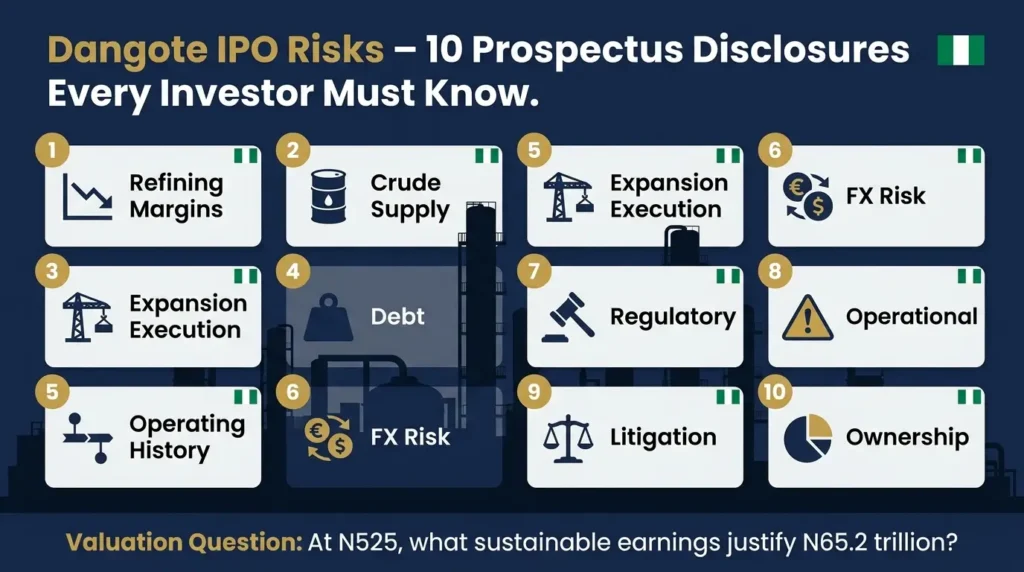
Dangote IPO: 10 Risks the Prospectus Reveals That Investors Shouldn’t Ignore
By Market Formula Editorial Team / September 2026
Introduction
The Dangote Refinery IPO has attracted enormous attention from Nigerian investors. At N525 per share, the company is offering 4.1 billion new ordinary shares to the public, potentially raising about N2.15 trillion before expenses. The refinery has also reported a dramatic turnaround in profitability, recording approximately $1.82 billion in profit after tax in the first half of 2026.
Those numbers naturally attract attention. But a serious investor should look at the other side of the story. What could go wrong?
This Dangote IPO risks analysis highlights 10 of the most important risks disclosed in the prospectus that Nigerian investors should understand before evaluating the N525 offer price.
Important: These are not predictions that these problems will happen. They are risks disclosed in the company’s IPO documentation. Investors should read the full prospectus before making an investment decision.
Let’s examine the Dangote IPO risks with clarity and strategic discipline.
1. Refining Margins Can Fall
Perhaps the biggest fundamental risk is that refinery profitability depends heavily on the refining margin — the difference between the cost of crude oil and the selling prices of refined petroleum products.
Dangote’s first-half 2026 results were exceptionally strong, with refining margins rising from $13.70 per barrel in 2025 to $24.50 per barrel in H1 2026. However, these margins were supported by geopolitical supply disruptions, including the Strait of Hormuz crisis, which pushed Brent above $118 a barrel.
The US Energy Information Administration forecasts Brent at $87 a barrel in 2026 and $69 in 2027, suggesting margins could moderate as markets normalise. A mid-cycle valuation using refining margins of $15-$18 a barrel produces a fair-value range of N176-N324 per share — well below N525.
The key question isn’t “How much profit did Dangote make in H1 2026?” It is: “What level of profit can the refinery sustainably generate across different refining cycles?”
2. Crude Oil Supply Could Become a Constraint
A refinery needs crude oil. And a very large refinery needs a large and reliable supply.
The prospectus highlights that approximately 60% of crude feedstock came from Nigerian grades in 2025, with the balance imported. Under its agreement with NNPC, the refinery has access to up to 350,000 barrels per day, subject to availability.
However, Nigeria’s crude production faces persistent constraints. The refinery alone requires approximately 552,500 barrels per day — about 35% of Nigeria’s total daily oil output. Records from May and June 2026 show that the Dangote refinery sourced only 78% of its crude oil supply from NNPC, with the remaining 22% imported.
The refinery has been forced to source crude from the United States, Libya, and other international markets — a significantly costlier route.
Why This Matters
Imagine a refinery capable of processing 1.4 million barrels per day but unable to consistently secure enough crude. The company would have the capacity, but not necessarily the throughput. That distinction is critical when valuing future earnings.
3. The $14.3 Billion Expansion Is a Major Execution Challenge
Dangote isn’t simply operating the refinery it has today. The company has an enormous expansion programme to double refining capacity from 700,000 to 1.4 million barrels per day by 2029, at an estimated cost of $14.3 billion.
That creates significant execution risk. Large industrial projects can experience cost overruns, delays, engineering problems, equipment problems, financing challenges, supply-chain disruptions, regulatory delays, and commissioning problems.
The refinery’s original construction cost $19 billion and took approximately seven years from commencement to first commercial production — materially longer than initially planned.
Why Investors Should Care
A valuation based heavily on future growth assumes that the growth actually happens. If the expansion is delayed or costs significantly more than expected, the company’s future earnings and cash-flow profile could differ materially. Capacity growth is not the same thing as guaranteed earnings growth.
4. Debt and Interest Obligations Matter
As of June 30, 2026, the prospectus reported approximately $5.67 billion of total secured debt**, down from **$6.24 billion at the end of 2025. Finance costs took N424 billion in H1 2026 alone.
That is important because debt creates fixed financial obligations. Unlike dividends, which can generally be reduced or suspended, debt repayments and interest obligations still have to be managed.
The expansion programme can also require additional financing. If refining margins weaken while debt obligations remain high, financial pressure can increase. This is why investors should examine the full chain: Debt → Interest expense → Cash flow → Capital expenditure → Free cash flow — not just profit alone.
5. The Company’s Recent Profitability Has a Relatively Short Operating History
The Dangote Refinery is an enormous industrial asset, but it does not have decades of operating history as a publicly listed company.
The refinery was commissioned in May 2023 and began commercial operations in January 2024. It only completed performance testing at its original 650,000 bpd capacity in February 2026 before being rerated to approximately 700,000 bpd in June 2026.
That means investors have less long-term public financial history with which to judge sustainable earnings. Compare that with an established listed company that has 10–20 years of audited financial statements, multiple commodity cycles, multiple economic cycles, a long dividend record, and years of public-market valuation history.
Why This Matters
A strong six-month performance is useful information. But it is not the same thing as demonstrating sustainable earnings across an entire commodity cycle.
6. Foreign Exchange Risk Can Affect the Business
The refinery operates in an environment where revenues, costs, debt and international transactions can involve different currencies. This creates foreign-exchange exposure.
In July 2026, the refinery switched domestic fuel sales from naira to US dollars for the third time since March 2025, citing the disparity between dollar-denominated crude procurement and naira-based product sales. The refinery receives fewer naira-denominated cargoes than dollar-priced ones, exposing it to currency risks.
For Nigerian investors, there is another important distinction: the shares will trade on the NGX in naira. Therefore, even if the company generates significant foreign-currency revenue, the market price of the shares remains subject to movements in the Nigerian capital market and the naira. Investors should not automatically treat the investment as a complete hedge against naira depreciation.
7. Regulatory and Free-Zone Risk
Dangote Petroleum Refinery and Petrochemicals FZE operates within the Dangote Industries Free Zone framework. The prospectus highlights that the interaction between free-zone regulations, Nigerian law and capital-market regulations can evolve.
In August 2026, the Nigerian Midstream and Downstream Petroleum Regulatory Authority (NMDPRA) issued a directive ordering the suspension of loading and truck-out of petroleum products from the refinery. A Federal High Court subsequently issued an interim injunction restraining the NMDPRA from shutting down or interfering with operations, with the court noting that the refinery’s case was that the NMDPRA lacked regulatory powers over operations within free zones.
The NMDPRA has stated that petroleum companies operating in free zones “remain fully subject to the provisions of the Petroleum Industry Act 2021”. This regulatory dispute remains unresolved.
Investors should recognise that the legal and regulatory framework is an important component of the investment case.
8. Environmental and Operational Risks
A refinery is a complex industrial facility involving crude oil, highly flammable petroleum products, high temperatures, high pressures, large industrial equipment, storage facilities, pipelines, and transportation infrastructure.
Operational incidents can result in production downtime, equipment damage, repairs, environmental liabilities, regulatory action, increased insurance costs, and lost revenue. Even a short period of downtime at a large refinery can have a meaningful financial impact.
This is why investors should not value a refinery solely based on its theoretical maximum capacity. The more useful question is: How much can it reliably produce and sell over an entire year?
9. Litigation and Legal Exposure
The prospectus discloses 14 pending court cases, with nine classified as material litigation involving claims totalling N4.08 billion and $216.12 million. Using an exchange rate of N1,350 to the dollar, the combined figure is approximately N295.8 billion.
The nine material cases relate to disputes involving unpaid debts, unpaid contractual sums, regulatory disputes, and alleged breaches of contract arising from the refinery’s ordinary business operations.
Crucially, that amount is neither a confirmed debt nor a court judgment. The prospectus states that the cases include claims brought by and against the refinery. The Joint Solicitors to the Issue concluded that an adverse decision is “unlikely to have a material adverse effect” on the Issuer.
10. Controlling Shareholder and Minority Investor Risk
After the IPO, Dangote-related interests are still expected to retain a very large ownership position. Analysis of the prospectus indicates that Aliko Dangote’s beneficial ownership would remain approximately 84.34% after a fully subscribed offer, while shares offered to the public would represent approximately 3.3% of the enlarged share capital.
A controlling shareholder can have significant influence over board composition, strategic direction, capital allocation, major corporate decisions, future share issuances, and dividend policy.
This does not mean that minority shareholders have no rights. Rather, it means investors should understand the difference between owning shares in a widely dispersed company and owning shares in a company controlled by a dominant shareholder. For a new NGX investor, this is an important corporate-governance consideration.
Dangote IPO Risks at a Glance
| Risk | What Investors Should Watch |
|---|---|
| 1. Refining margins | Can current margins be sustained? EIA forecasts Brent at $69 in 2027 |
| 2. Crude supply | Can the refinery consistently secure enough crude? 22% already imported |
| 3. Expansion execution | Can the 1.4m bpd expansion be delivered on time and budget? |
| 4. Debt | Can cash flow comfortably service $5.67 billion in debt? |
| 5. Limited operating history | How sustainable are recent earnings across a full cycle? |
| 6. FX risk | Dollar pricing and naira volatility affect costs and earnings |
| 7. Regulatory/free-zone risk | NMDPRA dispute remains unresolved |
| 8. Operational/environmental risk | What happens if there is major downtime or an incident? |
| 9. Litigation | N295.8 billion in claims, though not confirmed liabilities |
| 10. Ownership concentration | 84.34% retained by controlling shareholder |
The Biggest Risk May Be Valuation
There is another risk that isn’t simply an operational risk. It is the price investors are paying.
At N525 per share and approximately 124.23 billion shares post-offer, the implied equity value is roughly N65.2 trillion. Enterprise value is 9.5 times annualised H1 2026 EBITDA of $5.2 billion. International peers like Marathon Petroleum trade at about 8.21 times EV/EBITDA, against a cited industry median of 7.52 times.
The company doesn’t merely need to be profitable. It needs to generate enough sustainable future earnings and cash flow to justify the valuation investors are paying today.
Valuation Stress Test
| Annual PAT | Approximate P/E at N65.2tn |
|---|---|
| N2 trillion | 32.6× |
| N3 trillion | 21.7× |
| N4 trillion | 16.3× |
| N5 trillion | 13.0× |
| N6 trillion | 10.9× |
These are valuation scenarios, not forecasts.
Final Summary & The Bottom Line
The Dangote IPO risks are not reasons to automatically avoid the investment. A risk disclosure is not a prediction that the risk will occur. Every major company has risks. The purpose of the prospectus is to make investors aware of those risks so they can evaluate the business properly.
  ┌──────────────────────────────────────────────────────────┐
  │        DANGOTE IPO RISKS – KEY TAKEAWAYS                 │
  ├─────────────────────┬────────────────────────────────────┤
  │ Refining Margins    │ H1 2026 at $24.50/bbl; EIA         │
  │                     │ forecasts Brent at $69 in 2027      │
  ├─────────────────────┼────────────────────────────────────┤
  │ Crude Supply        │ 22% imported; NNPC supplies only   │
  │                     │ 78% of requirements                │
  ├─────────────────────┼────────────────────────────────────┤
  │ Expansion           │ $14.3bn to double capacity by 2029 │
  ├─────────────────────┼────────────────────────────────────┤
  │ Debt                │ $5.67bn secured; N424bn finance    │
  │                     │ costs in H1 2026                   │
  ├─────────────────────┼────────────────────────────────────┤
  │ Operating History   │ Commercial ops began Jan 2024      │
  ├─────────────────────┼────────────────────────────────────┤
  │ FX Risk             │ Dollar pricing; naira volatility   │
  ├─────────────────────┼────────────────────────────────────┤
  │ Regulatory          │ NMDPRA free-zone dispute           │
  │                     │ unresolved                         │
  ├─────────────────────┼────────────────────────────────────┤
  │ Litigation          │ N295.8bn in claims (not confirmed) │
  ├─────────────────────┼────────────────────────────────────┤
  │ Ownership           │ 84.34% retained by controlling     │
  │                     │ shareholder                        │
  └─────────────────────┴────────────────────────────────────┘
The Bottom Line:
Dangote Refinery has significant potential advantages: very large refining capacity, access to international markets, potential economies of scale, integrated petrochemical opportunities, and a strategic position in Nigeria and the wider African fuel market.
The investment question is not simply “Is Dangote Refinery risky?” Every equity investment carries risk. The more useful question is: “Are the potential future earnings and cash flows sufficient to justify the risks and the N525 valuation?”
That is a valuation question. And it is the question serious investors should investigate before making their own investment decision.
For more weekly NGX updates and strategy guides, explore our market trends and analysis archive.
Disclaimer: This article is for educational purposes only and does not constitute investment advice. Investors should read the approved Dangote Refinery prospectus and official allotment announcements before making decisions.