
NGX Market Review: 0.92% Rally, CBN’s 350bps Rate Cut, and the Hunt for Value
By Kebira Aruna FCS FiCM. MD/CEO, Globalview Capital Limited/September 2026
Introduction
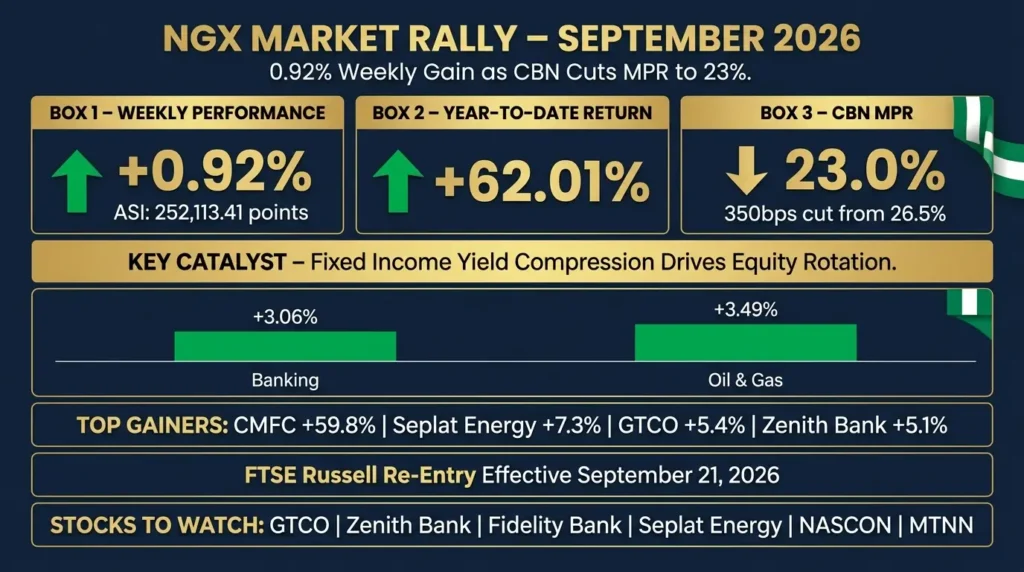
The Nigerian equities market closed the week of September 26, 2026, on a strong bullish note, with the NGX All-Share Index (ASI) gaining 0.92% week-on-week to close at 252,113.41 basis points . This pushed the market’s year-to-date return to an exceptional 62.01%, while market capitalisation rose to ₦163.655 trillion, adding approximately ₦1.5 trillion in value .
Supporting this momentum, weekly market turnover rose 45.0% by volume to 4.689 billion shares valued at ₦240.82 billion . The Financial Services Industry led the activity chart, accounting for 75.43% of total equity turnover volume .
This NGX market rally is being driven by a powerful combination of monetary policy easing, strong sectoral fundamentals, and expanding trading liquidity. This guide breaks down what is driving the rally, the impact of the CBN’s rate cut, stocks to watch, and the outlook for the new week.
Let’s examine the NGX market rally with clarity and strategic discipline.
1. How Sustainable Is This Rally?
The sustainability of this NGX market rally rests on three core drivers and two primary downside risks.
Core Drivers Supporting Sustainability
1. Macro Shift & Rate Cuts (The Key Catalyst)
The Central Bank of Nigeria’s 350 basis points reduction in the MPR triggered an immediate drop in Treasury bill stop-rates . Lower fixed-income yields make equities significantly more attractive, driving institutional funds and local asset managers to rotate liquidity back into high-dividend equity counters.
2. Strong Sectoral Fundamentals
| Sector | Weekly Gain | Key Drivers |
|---|---|---|
| Banking | +3.06% | Tier-1 liquidity flowed into GTCO (+5.4%) and Zenith Bank (+5.1%) amid recapitalisation momentum |
| Oil & Gas | +3.49% | Boosted by heavy buying in Seplat Energy (+7.3%), which hit an all-time high of ₦16,000 |
3. Trading Volume & Liquidity Expansion
Total traded volume expanded by 45.0% week-on-week, demonstrating genuine institutional participation rather than thin, low-volume price markups .
Key Downside Risks
- Short-Term Profit-Taking: The index experienced a minor pullback on Friday, September 25, signalling profit-taking in overbought counters following the multi-session winning streak.
- Macro Headwinds: Sustained inflation pressure and potential foreign exchange volatility could tempt foreign portfolio investors to lock in gains early.
       ┌────────────────────────────────────────────────────────┐
       │     NGX MARKET RALLY – KEY DRIVERS AND RISKS           │
       └───────────────────────────┬────────────────────────────┘
                                   │
         ┌─────────────────────────┼─────────────────────────┐
         ▼                         ▼                         ▼
  [ RATE CUT CATALYST ]     [ SECTOR MOMENTUM ]       [ LIQUIDITY ]
  350bps MPR cut to 23%     Banking +3.06%            Volume +45% WoW
  Treasury yields           Oil & Gas +3.49%          Institutional
  compressing               Seplat hits ₦16,000       participation
2. CBN’s 350bps Rate Cut: Impact on the Equity Market
The CBN’s decision at its 307th MPC meeting to cut the MPR by 350 basis points—from 26.5% to 23.0%—is a major catalyst for the Nigerian equities market . CBN Governor Olayemi Cardoso framed the cut as an “operational reset and recalibration” rather than a formal shift to outright monetary easing .
Key Impacts on the Equity Market
1. Fixed Income Yield Compression (The Valuation Trigger)
The 350 bps MPR cut, coupled with the recalibration of the Standing Facilities Corridor to +50/-300 bps, drives down yield expectations across short-dated money market instruments and Treasury Bills . Lower risk-free yields reduce the discount rates used in equity valuation models, immediately improving target valuations for listed stocks.
2. Institutional Portfolio Rotation
Pension Fund Administrators (PFAs), fund managers, and institutional investors who previously locked in risk-free rates above 20% in fixed income will face lower reinvestment yields as those bills mature. Capital will systematically rotate into high-dividend, blue-chip equities to defend real portfolio yields.
3. Reduction in Corporate Debt Service Costs
A lower benchmark eases refinancing pressures for highly leveraged corporate issuers. Lower interest expenses directly improve net profit margins for non-financial corporations, boosting earnings-per-share projections for upcoming quarters.
4. Boost to Banking Sector Liquidity & Valuations
With the Cash Reserve Ratio (CRR) held firm at 45% for Deposit Money Banks, banks maintain structured balance sheets, but lower yield environments typically encourage higher transaction volumes, corporate credit demand, and capital market advisory activity . Tier-1 banking tickers stand to benefit as liquidity rotates toward quality.
Potential Risks & Considerations
- Short-Term Profit Taking: Because the market anticipates these macro shifts early, expect periodic profit-taking sell-offs following initial momentum surges.
- FPI Behaviour: Foreign portfolio investors will closely monitor foreign exchange liquidity and reserve levels. If interest rate differentials narrow too fast without sufficient FX stability, foreign flows may remain cautious, leaving local institutional liquidity as the primary market engine.
3. Outlook for the New Week: Cautiously Bullish
The stock market outlook for the new week is cautiously bullish, with expected volatility driven by the ongoing structural shift in domestic liquidity. Having breached the historic 250,000-point threshold to close at 252,113.41 basis points, the market enters a phase where broad macro catalysts will contend with tactical profit-taking .
Primary Drivers Shaping the New Week
1. Post-MPC Rebalancing & Money Market Yield Compression
The aftermath of the CBN’s 350 bps MPR cut to 23.0% will continue to force asset managers and PFAs to reallocate capital away from maturing money market instruments and lower-yielding T-bills. Expect sustained buy-side demand in high-dividend yielders as institutional funds seek to maintain real portfolio returns.
2. FTSE Russell Re-Entry Inflows
Following Nigeria’s official return to the FTSE Russell Frontier Market Index on September 21, 2026, foreign portfolio managers tracking the index are adjusting model weightings . This provides structural support for index heavyweights (GTCO, Zenith, Seplat, Dangote Cement, MTNN).
3. Pre-Q3 Earnings Positioning
As Q3 draws to a close, smart money is actively building positions in expectation of 9-month financial results, particularly in banking and oil & gas counters where fundamentals remain robust.
Downside Risks to Monitor
- Intermittent Profit-Taking: After the multi-session winning streak was snapped by a minor pullback on Friday (-0.01%), expect short-term traders to continue locking in gains on rallies.
- Liquidity Diversion: Subscription flows into the ongoing ₦2.15 trillion Dangote Refinery IPO could periodically mop up retail and high-net-worth liquidity from the secondary market .
Key Takeaway: The week favours selective bargain hunting in blue-chip equities. While top-tier banking and energy stocks are well-positioned to lead further advances, pace entries carefully into momentum tickers showing overbought conditions.
4. CMFC: From Penny Stock to Critical Minerals Play
The 59.8% surge in Critical Minerals Financing Corp Plc (NGX: CMFC)—formerly DEAP Capital Management & Trust Plc—reflects a major repricing following its transition from a stagnant penny stock into a niche resource-finance platform . The rally to ₦3.26 per share is driven by three main catalysts.
Core Drivers Behind the Rally
1. Transformational ₦6.0 Billion Recapitalisation
Banklink Africa Private Equities Limited acquired a core stake in the firm via a ₦6.0 billion equity commitment . The capital injection resolves historical balance-sheet constraints and positions the firm to satisfy the SEC recapitalisation requirements for a Tier-1 Issuing House licence .
2. Strategic Pivot to Critical Minerals & Resources
Instead of competing in the crowded traditional financial services space, CMFC rebranded to capitalise on Africa’s mining, energy transition, and critical minerals sector (lithium, gold, cobalt, copper) . The appointment of Lamon Rutten (former founding CEO of Saudi Mining Exchange) as Chairman signalled a shift toward global transaction structuring .
3. Post-MPC Market Liquidity Search
The broader market context—specifically the CBN’s 350 bps rate cut—has accelerated domestic liquidity rotation out of money market instruments and into low-cap, high-upside equities undergoing enterprise restructuring.
Risks & Investor Outlook
- Low Free Float & High Volatility: Given CMFC’s historically low share count and new core equity concentration, price movements are prone to sharp, low-volume spikes and swift profit-taking sessions.
- Execution Risk: The long-term sustainability of the stock price depends on management converting its pipeline into fee-generating transaction mandates and Tier-1 underwriting revenues.
5. Stock Possibilities: NASCON, NAHCO, Fidelity Bank, and Cadbury
NASCON Allied Industries
Upside Drivers:
- Strong Pricing Power & Essential Commodity Moat: As a dominant national player in salt refining and food seasonings, NASCON enjoys pricing power that helps shield gross margins against domestic inflation. The stock trades at ₦160.00 with a market cap of ₦440.5 billion .
- Free Cash Flow & Dividend Track Record: NASCON maintains a clean, low-leverage balance sheet, making it a consistent dividend payer and a favourite for institutional income investors.
- Corporate Action Synergy: Any potential revival of corporate integration plans across the broader Dangote food/agro-allied ecosystem holds speculative upside.
Risks to Watch: Input cost inflation (raw salt imports, energy, freight) and supply chain bottlenecks.
NAHCO Aviance Plc
Upside Drivers:
- Aviation Freight & Passenger Recovery: As a market leader in ground handling and cargo processing, NAHCO directly benefits from expanding international flight schedules and higher freight traffic. The stock trades at ₦136.35 .
- Infrastructure Expansion: Investment in cold-chain logistics hubs and specialised cargo facilities diversifies revenue streams away from core flight-handling fees.
- High Dividend Yield Profile: Strong cash conversion has enabled NAHCO to offer attractive dividend yields.
Risks to Watch: Sensitivity to local currency volatility impacting airline capacity, jet fuel cost hikes, and concession lease cost pressures with FAAN.
Fidelity Bank Plc
Upside Drivers:
- Recapitalisation Progress & Tier-1 Ambitions: Fidelity Bank successfully concluded its recapitalisation, raising ₦259 billion and lifting eligible capital to ₦564.5 billion, exceeding the CBN’s ₦500 billion international banking threshold .
- Credit Expansion & Interest Yields: With an expanded capital base and lower benchmark interest rates, the bank is well-capitalised to capture corporate loan market share and grow non-interest income.
- Valuation Re-rating: Trading at attractive price-to-book and price-to-earnings metrics compared to traditional Tier-1 peers, successful capital execution could trigger a valuation catch-up.
Risks to Watch: Earnings dilution in the short term before full deployment of new equity proceeds, alongside credit quality management.
Cadbury Nigeria Plc
Upside Drivers:
- Balance Sheet De-risking & FX Recovery: Cadbury’s successful conversion of intercompany dollar loans into equity substantially eliminated foreign exchange loss exposure, restoring positive shareholders’ equity .
- Export Market Expansion: Export sales more than doubled to ₦7.2 billion from ₦3.2 billion, providing a growing, hard-currency revenue hedge driven by intermediate cocoa products .
- Cost Optimisation & Margin Rebound: Lower corporate finance costs give the company leeway to reinvest in Go-to-Market expansion.
Risks to Watch: Surging cocoa raw material prices, elevated distribution/freight costs, and pressure on consumer purchasing power.
6. Why Is Okomu Trending Down?
The recent downward pressure on Okomu Oil Palm Plc is driven by a combination of earnings friction, operational disruptions, and sector-specific rotational dynamics.
Key Drivers Behind the Downtrend
1. Weakening H1 Top-Line & Profit Margins
Okomu reported a ~16.4% decline in Profit After Tax for the first half of the year, caused by weaker realisation prices on palm oil sales alongside expanding cost of sales and elevated operational overheads. Rising local production expenses, fertiliser inflation, and elevated logistical costs have steadily squeezed gross operating margins .
2. Security & Field Operational Pressures
Okomu continues to face localised security challenges and militant/community disruptions across its Edo State plantations. Theft of fresh fruit bunches directly impacts field productivity.
3. Sector Rotation Out of High-Priced Agriculture Heavyweights
Following the ex-dividend markup earlier in the year (including the ₦15.00 final dividend payout), short-term institutional holders have systematically rotated capital out of high-nominal-price plantation stocks. With the CBN’s 350 bps MPR rate cut and ongoing tier-1 banking recapitalisation exercises, substantial market liquidity has migrated into financial services and high-yielding liquid counters.
Outlook
- Support Zone: Watch for buying interest around key technical support levels, as long-term investors evaluate whether the current discount adequately prices in H1 operational challenges.
- Rebound Catalysts: The stock’s primary upside triggers depend on H2 harvest recovery, stabilised local crude palm oil prices, and management’s ability to control plantation security.
7. Stocks to Watch
Tier-1 Banking Anchors (Yield Rotation & Capital Play)
| Stock | Catalyst | Why Watch |
|---|---|---|
| GTCO | Institutional index-tracking inflows and dividend yields | Completed major recapitalisation; primary target for volume accumulation by local funds |
| Zenith Bank | Yield rotation and FTSE index weighting | Over-capitalised; strong liquidity and dividend history |
| Fidelity Bank | Recapitalisation completion and valuation re-rating | One of the most actively traded counters by volume; exceeded ₦500bn capital threshold |
Energy & Resource Plays
| Stock | Catalyst | Why Watch |
|---|---|---|
| Seplat Energy | MPNU asset integration and gas monetisation | Hit all-time high of ₦16,000; leading the Oil & Gas Sector index |
| CMFC | High-beta speculative momentum | Gained ~59.8% in one week; monitor for profit-taking vs. consolidation |
Consumer Goods & Turnaround Stories
8. Action Plan for Investors
Step 1: Position for post-MPC yield rotation.
Prioritise high-dividend banking counters (GTCO, Zenith, Fidelity) as institutional funds rotate out of maturing fixed-income instruments.
Step 2: Monitor FTSE Russell re-entry flows.
With Nigeria back in the Frontier Market Index, index-heavyweights (GTCO, Zenith, Seplat, Dangote Cement, MTNN) should see structural foreign inflow support .
Step 3: Pre-position for Q3 earnings.
Smart money is building positions ahead of 9-month financial results, particularly in banking and oil & gas.
Step 4: Pace entries into momentum tickers.
Stocks like CMFC and NASCON have seen sharp rallies. Use dollar-cost averaging rather than chasing.
Step 5: Watch for liquidity diversion from the Dangote IPO.
Subscription flows into the ₦2.15 trillion offer could periodically mop up secondary market liquidity .
9. Final Summary & The Bottom Line
The NGX market rally is fundamentally supported by lower fixed-income yields and robust corporate turnover. The CBN’s 350 bps rate cut to 23% has triggered a structural rotation of institutional capital into high-dividend equities, while Nigeria’s return to FTSE Frontier Market status provides additional foreign inflow support.
  ┌──────────────────────────────────────────────────────────┐
  │         NGX MARKET RALLY – KEY TAKEAWAYS                 │
  ├─────────────────────┬────────────────────────────────────┤
  │ Weekly Performance  │ ASI +0.92% to 252,113.41 points   │
  ├─────────────────────┼────────────────────────────────────┤
  │ YTD Return          │ +62.01% (exceptional)             │
  ├─────────────────────┼────────────────────────────────────┤
  │ Key Catalyst        │ CBN MPR cut 350bps to 23.0%       │
  ├─────────────────────┼────────────────────────────────────┤
  │ Sector Leaders      │ Banking +3.06%, Oil & Gas +3.49%  │
  ├─────────────────────┼────────────────────────────────────┤
  │ Top Gainers         │ CMFC +59.8%, Seplat +7.3%         │
  ├─────────────────────┼────────────────────────────────────┤
  │ Risk to Watch       │ Profit-taking, Dangote IPO        │
  │                     │ liquidity diversion                │
  └─────────────────────┴────────────────────────────────────┘
The Bottom Line:
The rally is fundamentally supported in the near term by lower yields in the fixed-income market and robust corporate turnover. However, expect short-term consolidation as the market digests recent gains. The tactical approach is to focus on fundamentally sound blue-chip banking and dividend-paying stocks benefiting directly from yield rotation, while pacing entries into tier-2 momentum stocks that are prone to rapid profit-taking.
For more weekly NGX updates and strategy guides, explore our market trends and analysis archive.
Disclaimer: This article is for informational purposes only and does not constitute investment advice. Always conduct your own research or consult a qualified financial advisor before investing. Past performance does not guarantee future results.