
How to Pick NGX Stocks: Your Complete Selection Framework (Module 5)
By Market Formula Editorial Team / August 2026
Introduction
You have learned about the NGX, opened your brokerage account, mastered fundamental analysis, and understood technical timing. Now comes the moment of truth: how do you actually pick which stocks to buy?
This is the most practical module in the entire starter kit. Knowing how to analyze a company is one thing—knowing which companies to analyze in the first place is another. This module gives you a complete selection framework that separates quality opportunities from traps, and it teaches you how to fish rather than just handing you fish.
The Nigerian stock market has delivered exceptional returns in 2026. The NGX All-Share Index is hovering around 247,000 points, approaching record highs, with market capitalisation at approximately N158.3 trillion after a robust seven months of gains. However, beneath this headline performance lies a critical reality: not all stocks are created equal, and the days of buying just any stock and watching it “fly” are over.
This module equips you with a systematic framework for how to pick NGX stocks—a process that combines fundamental analysis, sector understanding, and disciplined decision-making. Whether you are a beginner building your first portfolio or an experienced investor refining your approach, this framework will help you make informed, confident investment decisions.
If you haven’t already, start with Module 1 – NGX Basics, Module 2 – Investor Toolkit, Module 3 – Fundamental Analysis, and Module 4 – Technical Analysis before diving into this module.
Let’s build your stock selection toolkit from the ground up.
1. The Three Categories of NGX Stocks
Before you can pick stocks, you need to understand the different types of stocks available on the NGX. Each category has distinct characteristics, risk profiles, and return expectations.
Category 1: Blue-Chip Stocks
What They Are: Blue-chip stocks are the largest, most established, and most financially stable companies on the NGX. They are the market leaders in their respective sectors with long track records of profitability and dividend payments.
Key Characteristics:
- Large market capitalisation – Typically among the top 20 stocks on the NGX
- High liquidity – Easy to buy and sell without significantly affecting the price
- Consistent dividends – Regular dividend payments, often with a history of increases
- Lower risk – More stable prices and resilient during market downturns
Examples on the NGX:
- Dangote Cement (DANGCEM) – Africa’s largest cement producer with a market capitalisation of approximately N17.45 trillion
- MTN Nigeria (MTNN) – Nigeria’s largest telecommunications company with a market cap of N17.57 trillion
- Airtel Africa (AIRTELAFRI) – The most valuable company on the NGX with a market cap of N21 trillion
- Zenith Bank (ZENITHBANK) – One of Nigeria’s largest and most profitable banks
- Seplat Energy (SEPLAT) – A leading independent energy company with dollar-denominated revenues
Who They’re For: Blue-chip stocks are ideal for beginners, income-focused investors, and anyone seeking stability and predictable returns. They form the foundation of a well-diversified portfolio.
Category 2: Growth Stocks
What They Are: Growth stocks are mid-cap companies that are expanding their revenue, earnings, and market share at an above-average rate. They may not pay high dividends because they reinvest profits back into the business.
Key Characteristics:
- Expanding revenue and margins – Consistent top-line and bottom-line growth
- Moderate liquidity – Tradable but may have lower volumes than blue chips
- Higher growth potential – Can deliver significant capital appreciation
- Moderate risk – More volatile than blue chips but less risky than penny stocks
Examples on the NGX:
- Aradel Holdings – Integrated energy player with significant upstream and midstream assets
- Presco Plc – A leading palm oil producer with strong export earnings
- Fidelity Bank – A mid-tier bank with strong deposit growth and operational efficiency
Who They’re For: Growth stocks suit investors with a longer time horizon who are willing to accept moderate volatility in exchange for higher potential returns. They work well as satellite holdings alongside blue-chip anchors.
Category 3: Speculative/Penny Stocks
What They Are: Penny stocks are low-priced, small-cap companies with limited liquidity and higher risk. They are often subject to manipulation and extreme volatility.
Key Characteristics:
- Very low market capitalisation – Often below ₦10 billion
- Low liquidity – Difficult to buy or sell without moving the price significantly
- High volatility – Can rise or fall 10% in a single session
- Higher risk – Susceptible to manipulation and sudden price crashes
Examples on the NGX: Some smaller companies on the Growth Board fall into this category.
How to Avoid Traps:
- Check liquidity – If a stock trades only a few thousand shares per day, avoid it
- Verify fundamentals – Does the company actually generate revenue and profit?
- Beware of hype – Social media “pumps” are common with penny stocks
- Read the annual report – Many penny stocks have questionable governance
Who They’re For: Penny stocks are generally not recommended for beginners. They should only be considered by experienced investors who can afford to lose their entire investment and have done extensive due diligence.
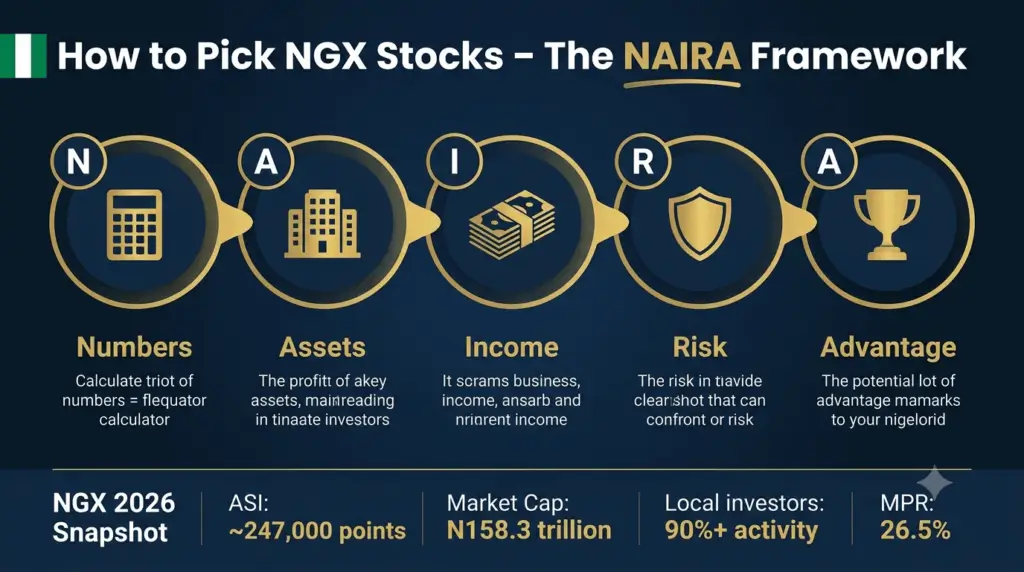
2. The NAIRA Framework for Stock Selection
The NAIRA framework is a branded, memorable system for evaluating any NGX stock. It covers the five essential dimensions of a quality investment and ensures you never buy a stock based on emotion or hype alone.
N — Numbers: Is the Company Growing Consistently?
The first step in how to pick NGX stocks is to examine the numbers. You need to confirm that the company is growing its revenue and profit consistently over time.
What to Check:
- Revenue growth – Is revenue increasing year after year?
- Profit growth – Is Profit After Tax (PAT) growing consistently?
- Earnings Per Share (EPS) – Is EPS trending upward?
- Return on Equity (ROE) – Is management generating strong returns on shareholder capital?
Real Example: Dangote Cement reported a 22.7% increase in profit after tax to N638.5 billion for the first half of 2026, with group revenue rising 21.4% to N2.514 trillion. Its Group EBITDA margin stands at an impressive 47.3%. These numbers confirm a company with strong operational performance.
A — Assets: Does It Own Hard Assets That Protect Against Inflation?
In Nigeria’s inflationary environment, companies that own tangible assets have a natural hedge. Hard assets—land, factories, equipment, oil reserves—tend to hold their value or appreciate during periods of currency devaluation.
What to Check:
- Property, Plant, and Equipment (PP&E) – Does the company own significant physical assets?
- Natural resources – Does it have oil, gas, or agricultural land?
- Brand value – Intangible assets like brand recognition also provide protection
Real Example: Seplat Energy owns significant oil and gas reserves, with production averaging 129,841 barrels of oil equivalent per day in Q1 2026. These physical assets generate dollar-denominated revenue, providing a natural hedge against naira devaluation.
I — Income: Does It Pay Dividends Regularly and Sustainably?
For many Nigerian investors, dividend income is the primary goal. A company that pays consistent, growing dividends is a sign of financial health and management confidence.
What to Check:
- Dividend history – Has the company paid dividends consistently for 5+ years?
- Dividend yield – Is the yield attractive compared to fixed-income alternatives?
- Payout ratio – Is the company paying out a sustainable portion of its earnings?
- Dividend growth – Is the dividend increasing over time?
Real Example: MTN Nigeria declared an interim dividend of N26.00 per share for H1 2026, backed by a 70.6% increase in profit after tax to N707.5 billion. The company’s revenue rose 25.9% to N2.99 trillion in the first half of 2026. This is a dividend backed by genuine earnings growth.
Seplat Energy declared an interim dividend of 12.0 US cents per share for H1 2026, with total expected dividends for 2026 reaching 68.3 US cents per share. The company’s mid-year profit surged by 498% to $164 million.
R — Risk: What Is the Debt Level? Is Management Trustworthy?
Understanding risk is as important as understanding potential returns. You need to evaluate both the company’s financial leverage and the integrity of its management.
What to Check:
- Debt-to-Equity Ratio – Is the company carrying excessive debt?
- Interest coverage – Can the company comfortably service its debt?
- Management track record – Have there been scandals or regulatory issues?
- Corporate governance – Is the board independent and effective?
Key Warning Signs:
- Debt-to-Equity ratio above 2.0 for non-financial companies
- Related-party transactions that benefit directors
- Frequent changes in auditors
- Regulatory fines or sanctions
Real Example: In Nigeria’s high-interest-rate environment (MPR at 26.5%), companies with high debt loads face significant interest expenses that erode profits. Companies with low or zero debt—like some agricultural exporters—are better positioned.
A — Advantage: Does It Have a Competitive Moat?
A competitive moat is a sustainable advantage that protects a company from competitors. The strongest moats allow companies to maintain pricing power, protect market share, and generate consistent profits.
What to Check:
- Brand strength – Is the brand well-known and trusted?
- Market share – Does the company dominate its industry?
- Regulatory barriers – Are there licenses or approvals that limit competition?
- Cost advantages – Can the company produce goods more cheaply than rivals?
- Network effects – Does the company’s value increase as more people use it?
Real Examples:
| Company | Competitive Moat |
|---|---|
| Dangote Cement | Africa’s largest cement producer; significant economies of scale; pan-African footprint |
| MTN Nigeria | Largest telecom network with 89.5 million subscribers; strong brand; tariff adjustments boost revenue |
| Airtel Africa | Pan-African telecom leader; N21 trillion market cap; 156% YTD gain |
| Presco / Okomu Oil | Export earnings in foreign currency; hard assets (palm oil plantations); inflation hedge |
3. Sector Analysis Snapshots (2026 Context)
Understanding sector dynamics is essential for how to pick NGX stocks. Different sectors respond differently to economic conditions, and 2026 presents a unique landscape.
Banking Stocks: What the CBN Interest Rate Environment Means for Margins
The banking sector has been the engine of NGX growth in 2026. The recapitalisation exercise, which concluded in March 2026, required international banks to hold a minimum capital base of ₦500 billion. This has fundamentally strengthened the sector.
Key Dynamics:
- High interest rates (MPR at 26.5%) – Banks earn more on loans and investments, expanding Net Interest Margins (NIMs)
- Recapitalisation – The “big six” banks—Access, Zenith, GTCO, UBA, FBNH, and Fidelity—successfully met the N500 billion threshold
- Market capitalisation surge – 12 deposit money banks saw combined market cap surge to N25.6 trillion in July 2026
Top Banking Picks:
- Zenith Bank – Q1 2026 pre-tax profit of N360.92 billion; gross earnings hit N1 trillion
- GTCO – Strong fintech and payments expansion; consistent dividend history
- Access Holdings – Pan-African footprint; analyst target of N39.34 (64.95% upside)
Consumer Goods: How Naira Dynamics Affect Nestlé, Unilever, NASCON
The consumer goods sector has faced significant headwinds from currency devaluation and inflation. Companies that import raw materials in dollars have seen margins compressed.
Key Dynamics:
- Naira sensitivity – Import-dependent companies suffer when the naira weakens
- Pricing power – Strong brands like Nestlé can pass costs to consumers; weaker brands cannot
- Inflation impact – Rising costs squeeze margins for companies without pricing power
Key Players:
- Nestlé Nigeria – Strong brand, pricing power, but exposed to imported raw materials
- Unilever Nigeria – Consumer goods giant; impacted by input cost inflation
- NASCON – Salt and seasoning manufacturer; recently entered the NGX 30
Telecom: MTNN and Airtel Africa — Infrastructure Plays in a Digital Nigeria
The telecommunications sector has been a standout performer in 2026, driven by surging data demand and tariff adjustments.
Key Dynamics:
- Data revenue surge – Nigerians spent approximately N1.7 trillion on MTN data services in H1 2026
- Tariff adjustments – Full impact of late 2025 tariff increases boosting revenue
- Digital transformation – Mobile money and fintech services driving growth
Key Players:
- Airtel Africa – NGX’s most valuable company with N21 trillion market cap; 156% YTD gain
- MTN Nigeria – N17.57 trillion market cap; H1 2026 revenue N2.99 trillion; profit before tax N1.09 trillion
Oil & Gas: Seplat Energy and the Energy Transition
The oil and gas sector has been driven by high crude prices and strategic corporate actions.
Key Dynamics:
- Dollar-denominated revenue – Natural hedge against naira devaluation
- Production growth – Seplat’s production averaged 129,841 boepd in Q1 2026
- Strategic transactions – Seplat agreed to sell a 10% JV stake to NNPC for $281.6 million
Key Players:
- Seplat Energy – Record $164 million mid-year profit; dollar dividends; 498% profit surge
- Aradel Holdings – Integrated energy player with refining capabilities
Agriculture: Undervalued and Overlooked
The agriculture sector is one of the most overlooked on the NGX—which often means it is undervalued.
Key Dynamics:
- Export earnings – Companies earn foreign currency, protecting against naira devaluation
- Hard assets – Palm oil plantations provide inflation protection
- Strong performance – Agro-allied stocks delivered 1,656% capital gain to investors in four years
Key Players:
- Presco Plc – Q1 2026 pre-tax profit of N69.24 billion; share price at N2,300
- Okomu Oil Palm – Share price at N1,418; strong export earnings
- Livestock Feeds – Overlooked player in the agricultural value chain
4. Stocks to Research: A Practical Walkthrough
This section shows you how to research specific NGX tickers using the NAIRA framework. This is not a buy recommendation—it is a teaching tool to help you learn the process.
Research Walkthrough: Zenith Bank
Step 1: Numbers
Zenith Bank reported a Q1 2026 pre-tax profit of N360.92 billion, up 2.87% year-on-year. Net interest income grew 7% to N634 billion. Revenue in the last twelve months reached N2.37 trillion.
Step 2: Assets
Zenith Bank holds significant hard assets and a robust loan book. Its deposit base has grown steadily, with customer deposits increasing year after year.
Step 3: Income
Zenith has a long history of consistent dividend payments. The Board has scheduled its meeting for July 29, 2026 to consider H1 numbers and recommend an interim dividend.
Step 4: Risk
As a tier-1 bank, Zenith has strong capital buffers, having surpassed the N500 billion international banking threshold. Debt levels are manageable for a bank of its size.
Step 5: Advantage
Zenith is one of Nigeria’s largest and most trusted banks, with a strong corporate and retail franchise. Its pan-African presence provides diversification benefits.
Verdict: Zenith passes all five NAIRA tests. It is a quality blue-chip stock suitable for long-term holding and dividend income.
Research Walkthrough: MTN Nigeria
Step 1: Numbers
MTN Nigeria reported H1 2026 revenue of N2.99 trillion, up 25.9% year-on-year. Profit before tax surged 75.4% to N1.09 trillion. Data revenue alone saw Nigerians spend approximately N1.7 trillion.
Step 2: Assets
MTN owns extensive telecommunications infrastructure—towers, fiber optic cables, and data centers. These are hard assets with long-term value.
Step 3: Income
MTN declared an interim dividend of N26.00 per share, payable September 7, 2026. The company has a strong track record of dividend payments.
Step 4: Risk
MTN has repaired its equity base after previous currency shocks. The N95.5 billion intra-group restructuring has de-risked the balance sheet.
Step 5: Advantage
MTN is Nigeria’s dominant telecom provider with 89.5 million subscribers. Its network effects, brand strength, and regulatory position create a powerful competitive moat.
Verdict: MTN passes all five NAIRA tests. It is a quality growth and income stock with significant long-term upside.
Research Walkthrough: Seplat Energy
Step 1: Numbers
Seplat reported a record $164 million** mid-year profit, up 498%. Revenue reached **$1.82 billion. Gross revenue in Q1 2026 was $840.7 million.
Step 2: Assets
Seplat owns significant oil and gas reserves, with production averaging 129,841 boepd. The company also holds stakes in strategic joint ventures with NNPC.
Step 3: Income
Seplat declared an interim dividend of 12.0 US cents per share. Total expected dividends for 2026 reach 68.3 US cents per share.
Step 4: Risk
Seplat has strong free cash flows and is deleveraging. The NNPC transaction will provide additional liquidity.
Step 5: Advantage
Seplat is one of Nigeria’s leading independent energy companies with dollar-denominated revenues. Its position in the energy sector provides a natural hedge against naira devaluation.
Verdict: Seplat passes all five NAIRA tests. It is a high-quality energy stock with dollar dividends.
5. Action Plan: How to Pick NGX Stocks
Now that you understand the framework, here is your practical action plan for how to pick NGX stocks.
Step 1: Build your watchlist.
Start with 10–15 companies from the NGX 30. Include a mix of blue chips, growth stocks, and sector leaders.
Step 2: Run the NAIRA framework.
For each stock, evaluate the Numbers, Assets, Income, Risk, and Advantage. Score each dimension from 1–5.
Step 3: Prioritize quality.
Focus on stocks that score 4 or above across all five dimensions. These are your quality candidates.
Step 4: Check valuation.
Use the P/E ratio, P/B ratio, and dividend yield to confirm that the stock is not overpriced.
Step 5: Apply technical analysis.
Use the tools from Module 4—support/resistance, moving averages, volume, and RSI—to time your entry.
Step 6: Size your position.
Never put more than 20% of your portfolio into a single stock. Most experienced investors keep positions between 8% and 15%.
Step 7: Monitor quarterly.
Check earnings releases, read annual reports, and re-evaluate each stock using the NAIRA framework at least once per quarter.
6. Module 5 — Quick Summary
| Concept | What You Now Know |
|---|---|
| Blue-Chip Stocks | Large, stable, dividend-paying leaders—Dangote Cement, MTNN, Zenith, Airtel |
| Growth Stocks | Mid-cap companies with expanding revenue and margins—Aradel, Presco |
| Penny Stocks | High risk, low liquidity—avoid as a beginner |
| NAIRA Framework | Numbers, Assets, Income, Risk, Advantage—your complete selection system |
| Banking Sector | Recapitalisation complete; high interest rates boost margins |
| Consumer Goods | Naira-sensitive; strong brands have pricing power |
| Telecom | Airtel (N21tn) and MTN (N17.57tn) dominate; data revenue surging |
| Oil & Gas | Seplat leads with dollar dividends; production at 129,841 boepd |
| Agriculture | Undervalued; Presco at N2,300, Okomu at N1,418; 1,656% 4-year gain |
7. Final Summary & The Bottom Line
How to pick NGX stocks is the most practical skill you will develop as an investor. The NAIRA framework provides a systematic, repeatable process for evaluating any company—whether it is a blue-chip giant like Dangote Cement or a growth stock like Presco.
text
  ┌──────────────────────────────────────────────────────────┐
  │         HOW TO PICK NGX STOCKS – KEY TAKEAWAYS          │
  ├─────────────────────┬────────────────────────────────────┤
  │ Blue-Chip Stocks    │ Dangote Cement, MTNN, Zenith,     │
  │                     │ Airtel – stability & dividends    │
  ├─────────────────────┼────────────────────────────────────┤
  │ Growth Stocks       │ Aradel, Presco – expanding        │
  │                     │ revenue and margins               │
  ├─────────────────────┼────────────────────────────────────┤
  │ Penny Stocks        │ Avoid as a beginner – high risk   │
  │                     │ and low liquidity                 │
  ├─────────────────────┼────────────────────────────────────┤
  │ NAIRA Framework     │ Numbers, Assets, Income, Risk,    │
  │                     │ Advantage – your selection system │
  ├─────────────────────┼────────────────────────────────────┤
  │ Banking Sector      │ Zenith N360.9bn Q1 PBT;           │
  │                     │ recapitalisation complete         │
  ├─────────────────────┼────────────────────────────────────┤
  │ Telecom Sector      │ MTN N2.99tn H1 revenue; Airtel    │
  │                     │ N21tn market cap                  │
  ├─────────────────────┼────────────────────────────────────┤
  │ Oil & Gas Sector    │ Seplat $164m H1 profit; dollar    │
  │                     │ dividends                         │
  ├─────────────────────┼────────────────────────────────────┤
  │ Agriculture Sector  │ Presco N69.24bn Q1 PBT; 1,656%    │
  │                     │ 4-year sector gain                │
  └─────────────────────┴────────────────────────────────────┘
The Bottom Line:
The NGX is hovering near record highs at approximately 247,000 points, with market capitalisation at N158.3 trillion. Local investors now account for over 90% of market activity, and the banking recapitalisation has fundamentally strengthened the sector. This creates a unique environment for disciplined stock pickers.
The most successful NGX investors are not those who chase the hottest tips or trade frequently. They are those who apply a systematic framework—like the NAIRA framework—to identify quality companies, buy them at fair or undervalued prices, collect dividends year after year, and hold patiently while others panic in and out.
Your Next Steps:
- Build your watchlist – Start with 10–15 NGX 30 stocks
- Apply the NAIRA framework – Score each stock across all five dimensions
- Research 2–3 stocks deeply – Read their annual reports and calculate the 8 key ratios from Module 3
- Wait for a good entry – Use technical analysis from Module 4 to time your purchase
- Start small and stay disciplined – Build your portfolio gradually
For more weekly NGX updates and strategy guides, explore our market trends and analysis archive.
Disclaimer: This article is for informational purposes only and does not constitute investment advice. Always conduct your own research or consult a qualified financial advisor before investing. Past performance does not guarantee future results. The stocks mentioned in this article are for illustrative purposes only and are not buy recommendations.
This has been insightful. Considering the order from the very first module till this.
I say thank you.
Thank you for staying through. we are glad to here this