
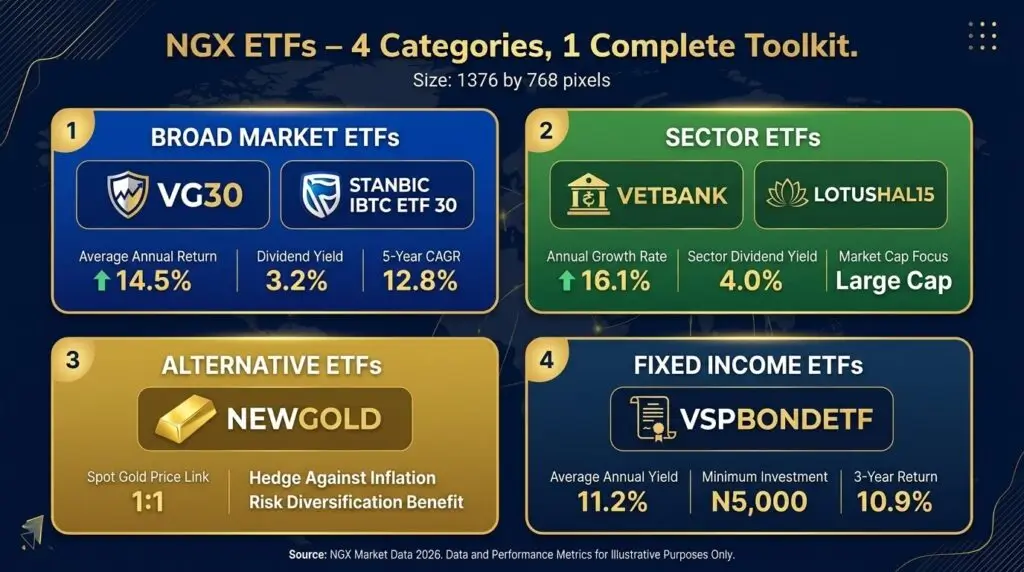
NGX ETFs: The Complete Investor’s Guide to Exchange-Traded Funds on the Nigerian Exchange
By Kebira Aruna FCS FiCM. MD/CEO, Globalview Capital Limited/ August 2026
Introduction
When building a profitable portfolio on the Nigerian Exchange (NGX), Exchange-Traded Funds (ETFs) offer a low-cost, systematic way to gain asset-class and sector-level exposure without the friction of stock picking. If you’ve heard the word “ETF” thrown around in investing circles and never quite understood what it means, this guide is for you.
An Exchange-Traded Fund (ETF) is a type of investment fund that holds a basket of assets—like stocks, bonds, or commodities—and trades on a stock exchange like a regular share. Think of it this way: instead of buying one stock, an ETF lets you buy a small piece of many stocks in a single purchase. If you buy the Vetiva Griffin 30 ETF (VG30), for example, you’re getting exposure to the 30 largest companies on the Nigerian Exchange in one transaction.
The combined value of all ETFs listed on the Nigerian Exchange crossed N69.65 billion in mid-January 2026—a 52.9% jump in two weeks and the largest movement in the segment’s history. This growth reflects rising investor confidence and deepening participation in capital market instruments.
This NGX ETFs guide 2026 covers the key ETFs available on the exchange, their underlying exposure, yield behaviour, and trading liquidity. Whether you are a beginner building your first portfolio or an experienced investor seeking diversification, this guide will help you understand how to use ETFs effectively.
Let’s examine the NGX ETFs guide 2026 with clarity and strategic discipline.
1. Broad Market & Core Growth Exposure
Broad-market equity ETFs are the most popular category on the NGX. These funds track a wide basket of Nigerian stocks and provide instant diversification across the market’s largest and most liquid companies.
Vetiva Griffin 30 ETF (VG30)
Ticker: VETGRIF30
What It Tracks: The NGX 30 Index—the 30 most liquid stocks on the exchange, including Dangote Cement, MTN Nigeria, Zenith Bank, GTCO, BUA Foods, and 25 others.
Market Position: The VG30 ETF holds the largest share of combined ETF assets on the NGX, accounting for approximately 43% of total NAV as of 2025. As of May 2026, its market capitalisation stood at approximately N14.56 billion.
Why Choose VG30:
- The “NGX Benchmark”: It functions as the Nigerian equivalent of an S&P 500 index fund. When you buy VG30, you are buying a slice of Nigeria’s 30 largest and most liquid companies.
- Liquidity & Institutional Flow: Being the largest equity ETF by market capitalisation, it consistently retains stronger trading volume and lower bid-ask spreads than most peers on the board. In July 2026, the VG30 ETF appreciated by 5.15% to close at N102.
- Diversified Blue-Chip Capture: You obtain broad exposure to Nigeria’s dominant commercial and telecommunications engines in a single transaction. The ETF holds slices of companies including MTN Nigeria, Dangote Cement, Zenith Bank, GTCO, and 25 others.
Recent Performance: In January 2026, the VG30 ETF posted a 36.64% gain. It rose by 29.28% in March 2026. In May 2026, it closed at N100.83, with a 3.95% weekly gain.
Stanbic IBTC ETF 30 (STANBICETF30)
What It Tracks: The NGX 30 Index, managed by Stanbic IBTC Asset Management.
Minimum Investment: 1,000 units.
Why Choose Stanbic IBTC ETF 30:
- High Trading Value: STANBICETF30 regularly records substantial weekly trading turnover, making it a primary choice for institutional block rebalancing. In April 2026, it recorded the highest trading value at N234.02 million.
- Remarkable Returns: The Stanbic IBTC ETF 30 delivered a remarkable 219.64% return in the first half of 2026, leading a broadly strong performance across ETFs listed on the NGX.
- Strong Track Record: The fund recorded a two-year average yield of 41.49% across 2024–2025.
Recent Performance: As of August 5, 2026, STANBICETF30 was trading at N2,700. The ETF has experienced volatility, falling 40.12% in February 2026 to close at N1,956.42.
SIAML Pension ETF 40
What It Tracks: The NGX Pension Index—large-cap stocks specifically screened for institutional PFA compliance (strong capital adequacy, consistent dividend tracks, low governance risk).
Why Choose SIAML Pension ETF 40:
- Quality Filter: The fund tracks the top 40 pension-eligible securities on the NGX, providing exposure to companies that meet institutional pension fund standards.
- Strong Performance: In July 2026, the SIAML Pension ETF 40 rose 18.98% to close at N3,103.00, crossing the N20 billion market capitalisation threshold for the first time.
- Institutional Grade: This ETF is designed for investors seeking exposure to companies that meet the rigorous standards of Pension Fund Administrators (PFAs).
2. Sector-Specific & Growth Outperformers
Sector ETFs focus on specific industries within the Nigerian economy. These funds allow you to make tactical bets on particular sectors without picking individual stocks.
Vetiva Banking ETF (VETBANK)
Ticker: VETBANK
What It Tracks: The NGX Banking Index.
Why Choose VETBANK:
- Recapitalisation Play: As Nigerian banks undergo regulatory recapitalisation cycles and asset realignments, banking stock volatility presents significant tactical upside. The banking sector has been the principal engine of NGX momentum in 2026.
- Strong Trading Volume: VETBANK routinely records high unit transaction volumes on the exchange. In July 2026, it led the market with 5.73 million units traded.
- Impressive Gains: In July 2026, the Vetiva Banking ETF followed the Greenwich Alpha ETF with a 28.29% gain, closing at N31.06 from N24.21, while its market capitalisation rose to N1.98 billion from N1.54 billion.
Recent Performance: As of July 2026, VETBANK was trading around N28.97–N30.40. The ETF has a one-year change of approximately +98.07%. In May 2026, it advanced by 3.70% to close at N28.
Lotus Halal Equity ETF (LOTUSHAL15)
Ticker: LOTUSHAL15
What It Tracks: The NGX Lotus Islamic Index—Sharia-compliant Nigerian equities screened for permissible business activities and financial ratios. It is the only Sharia-compliant ETF on the NGX.
Why Choose LOTUSHAL15:
- Outsized Return Profile: Filtering out highly leveraged companies and pure financial firms has historically yielded clean, high-performing corporate balance sheets. The fund recorded a strong historical yield averaging 64% over 2024–2025.
- Fundamental Resilience: Even for non-religious investors, the fund acts as a natural quality-filter screening for low-debt, cash-generative equities. It invests only in companies that meet Islamic finance criteria—no interest-bearing instruments, no alcohol or tobacco stocks.
- Two-Year Average Yield: The Lotus Halal ETF recorded a two-year average yield of 64% and maintained a strong NAV base of N2 trillion, representing more than 11% of total ETF market value.
Recent Performance: As of June 30, 2026, LOTUSHAL15 was trading at N126.80, up 3.88% on the day. In April 2026, it appreciated by 5.24% to close at N197.85. In July 2026, it advanced by 6.50% to close at N130.00.
3. Alternative Assets & Wealth Preservation
Commodity ETFs provide exposure to hard assets that can serve as inflation hedges and portfolio stabilisers.
NewGold ETF (NEWGOLD)
What It Tracks: The spot price of physical gold bullion.
Market Position: The NewGold ETF is the highest-priced ETF on the exchange, trading in the N149,000–N186,000 per unit range in recent months.
Why Choose NEWGOLD:
- Inflation & Currency Hedge: Because each unit represents a direct fractional ownership of physical gold, NEWGOLD provides local asset preservation against domestic inflation and foreign exchange adjustments.
- Capital Retention: Holds a strong track record of NAV expansion during macro uncertainty, serving as an effective portfolio stabiliser alongside equity holdings.
- Strong Performance: The NewGold ETF delivered an average yield of 88% across 2024 and 2025, sustaining momentum in 2025 with a return of about 60%. In April 2026, it gained 14.06% to close at N175,200.
Recent Performance: As of July 17, 2026, NEWGOLD was trading at N80,800.01, with a one-year change of +56.59%. In July 2026, it gained 15.31% to close at N110,000.00.
4. Defensive & Income Stability
Bond ETFs provide exposure to fixed-income instruments, offering lower risk and steady income profiles.
Vetiva S&P Nigeria Sovereign Bond ETF (VSPBONDETF)
What It Tracks: The S&P Nigeria Sovereign Bond Index—Federal Government of Nigeria Bonds.
Why Choose VSPBONDETF:
- Yield Isolation: Provides institutional-grade exposure to sovereign debt instruments without needing high entry capital for primary bond auctions.
- Risk Mitigation: Acts as a defensive anchor to lower total portfolio beta during periods of broad equity volatility.
- Steady Income: The fund distributes coupon interest from FGN bonds to unit holders. In May 2026, a final distribution of N5.00 per unit was paid.
Recent Performance: In May 2026, the VSPBONDETF gained 13.15% to close at N294.20, with market capitalisation rising to N1.04 billion. As of July 22, 2026, it was trading at N250.00. In July 2026, it closed at N230.00.
5. Summary Comparison Matrix
6. Core Execution Considerations
1. Liquidity Management
The NGX ETF market experiences varying daily liquidity across different counters. ETF price movements on the NGX may not fully reflect underlying asset values, as relatively thin liquidity can cause significant deviations from net asset value (NAV). Consequently, sharp price swings are often influenced more by trading activity than by changes in the fundamentals of the underlying assets.
For larger ticket orders, utilisation of limit orders or direct market maker channels helps minimise execution slippage. Investors should also be aware that the market price of an ETF should match its NAV—what one unit of the ETF is really worth based on all the assets inside the basket. In most global markets, these two numbers stay close.
2. Rebalancing Structure
A well-rounded ETF portfolio should balance core broad-market equity, tactical sector/asset hedges, and fixed-income stability.
Recommended Allocation:
- 60–70% Broad Equity/Quality ETFs (VG30, LOTUSHAL15) – for core growth and market exposure
- 20–30% Hedging & Fixed Income (NEWGOLD, VSPBONDETF) – for capital preservation and income
This provides a resilient asset distribution across macro cycles, allowing you to benefit from equity market growth while protecting against inflation and currency risk.
3. Understanding ETF Costs
ETFs are typically cheaper to run than mutual funds because most of them just track an index automatically—no fund manager needed to pick stocks daily. Lower fees mean more of your money stays invested and compounds over time.
4. How to Buy ETFs on the NGX
ETFs listed on the NGX are traded in the same manner as ordinary shares. Investors can buy or sell ETF units through licensed stockbrokers or, in some cases, directly through fund managers. You can purchase ETFs through the same brokerage account you use for regular stock trading.
7. ETF vs. Mutual Fund Comparison
8. Module — Quick Summary
9. Final Summary & The Bottom Line
ETFs on the Nigerian Exchange offer a powerful, low-cost way to build a diversified portfolio without the friction of picking individual stocks. The total value of all ETFs listed on the NGX crossed N69.65 billion in mid-January 2026, reflecting growing investor confidence and deepening participation in capital market instruments.
text
  ┌──────────────────────────────────────────────────────────┐
  │             NGX ETFs GUIDE 2026 – KEY TAKEAWAYS          │
  ├─────────────────────┬────────────────────────────────────┤
  │ Total ETFs Listed   │ 12 ETFs across 4 categories       │
  ├─────────────────────┼────────────────────────────────────┤
  │ Total NAV (Jan 2026)│ N69.65 billion (52.9% jump)      │
  ├─────────────────────┼────────────────────────────────────┤
  │ Largest ETF         │ VG30 (43% of total NAV)          │
  ├─────────────────────┼────────────────────────────────────┤
  │ Best Performing     │ Stanbic IBTC ETF 30 (+219.64%     │
  │ (H1 2026)           │ H1 2026)                         │
  ├─────────────────────┼────────────────────────────────────┤
  │ Best Historical     │ NewGold (88% avg yield 2024-2025) │
  │ Yield               │                                   │
  ├─────────────────────┼────────────────────────────────────┤
  │ Top Sector ETF      │ VETBANK (+28.29% July 2026)      │
  ├─────────────────────┼────────────────────────────────────┤
  │ Recommended Mix     │ 60-70% Equity ETFs + 20-30%       │
  │                     │ Hedging/Fixed Income ETFs         │
  └─────────────────────┴────────────────────────────────────┘
The Bottom Line:
ETFs provide a practical and cost-effective way to invest in the Nigerian stock market. Whether you want broad market exposure through the VG30 or Stanbic IBTC ETF 30, tactical sector plays through VETBANK, inflation protection through NEWGOLD, or fixed-income stability through VSPBONDETF, there is an ETF to match your investment goals.
The NGX ETF market has grown significantly, with the total NAV of all listed ETFs climbing from N12.77 billion in 2024 to N18.08 billion in 2025—a 41.7% increase. This growth reflects the increasing recognition among Nigerian investors that ETFs offer a simple, low-cost path to diversification.
Your Next Steps:
- Identify your investment goals – Are you seeking growth, income, or capital preservation?
- Choose your core ETF – Start with a broad-market ETF like VG30 or Stanbic IBTC ETF 30
- Add satellite positions – Consider sector ETFs (VETBANK) or commodity ETFs (NEWGOLD) for tactical exposure
- Balance with fixed income – Add VSPBONDETF for stability and income
- Trade through your broker – Buy and sell ETFs just like regular shares
- Monitor regularly – Track performance against your goals and rebalance as needed
For more weekly NGX updates and strategy guides, explore our market trends and analysis archive.
Disclaimer: This article is for informational purposes only and does not constitute investment advice. Always conduct your own research or consult a qualified financial advisor before investing. Past performance does not guarantee future results. ETF price movements may not fully reflect underlying asset values due to liquidity considerations.