
The Free Float Factor: Why Market Cap Misleads on the NGX
By Market Formula Editorial Team / October 2026
Introduction
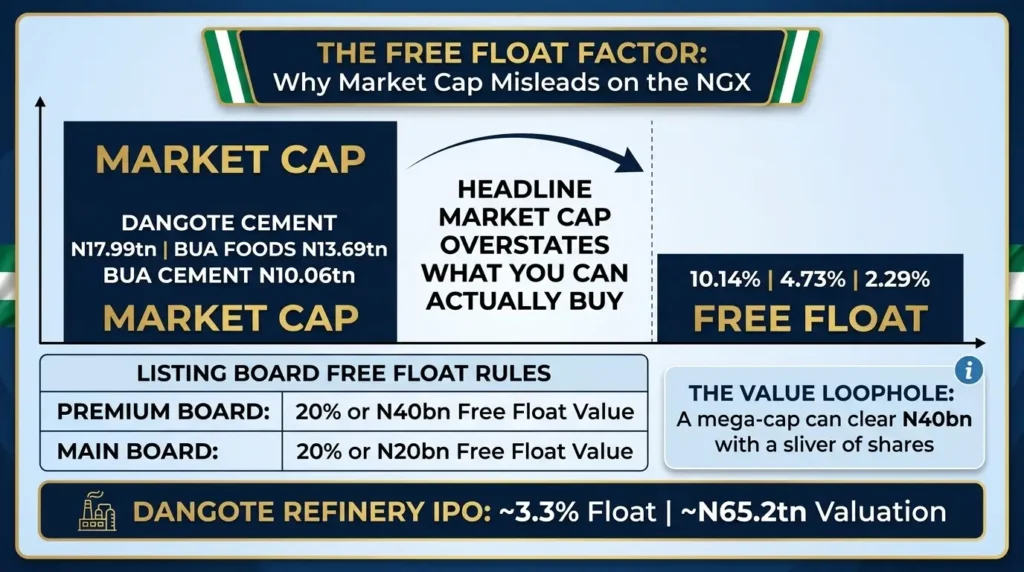
Dangote Cement, BUA Foods and BUA Cement made up about 29.5% of NGX market value in mid-2026, yet only a few percent of each company is held by the public. Headline market capitalisation overstates what investors can actually buy or sell.
This is the NGX free float paradox. A company can rank among the largest on the exchange while most of its shares sit with one owner who is not selling. That distinction matters to you in three ways: how easily you can exit, how reliable the price is, and how much of the index you are really buying.
This article explains the NGX free float framework, identifies the thinly floated giants, examines the 2026 regulatory review, and provides a practical checklist for investors in Nigeria and the diaspora.
Let’s examine the NGX free float factor with clarity and strategic discipline.
1. What Is Free Float?
The NGX rules define free float as the shares outstanding that are available for trading. They exclude shares held, directly or indirectly, by promoters, directors and their close relatives, strategic investors holding 5% or more, and the government.
Market capitalisation is share price times all shares in issue. Free float counts only the slice that can change hands.
       ┌────────────────────────────────────────────────────────┐
       │      NGX FREE FLOAT – MARKET CAP VS TRADABLE VALUE     │
       └───────────────────────────┬────────────────────────────┘
                                   │
         ┌─────────────────────────┼─────────────────────────┐
         ▼                         ▼                         ▼
  [ MARKET CAP ]             [ FREE FLOAT ]            [ LIQUIDITY ]
  Price × all shares         Shares available          Daily turnover
  Headline valuation         for public trading        and exit ease
2. The Thinly Floated Giants: Verified Figures
Dangote Cement
| Metric | Detail |
|---|---|
| Market Cap (Oct 2026) | ~N17.99 trillion |
| Free Float | 10.14% (1.71 billion shares) |
| Controlling Interest | Dangote Industries 86.65% + Dangote personally 0.17% |
BusinessDay notes that roughly 13.2% of Dangote Cement sits outside the controlling shareholder and related interests. The discrepancy between 10.14% and 13.2% reflects different dates and definitions—exactly why you must check the latest filing.
BUA Foods
| Metric | Detail |
|---|---|
| Market Cap (Oct 2026) | ~N13.69 trillion |
| Free Float | 4.73% (850.8 million units) |
| Controlling Interest | Abdul Samad Rabiu 89.85% directly; ~92.6% including related holdings |
BUA Foods is the clearest case. Its free float value was N679.7 billion as at December 31, 2025—comfortably above the N20 billion Main Board threshold, but only 4.73% of the company.
BUA Cement
| Metric | Detail |
|---|---|
| Market Cap (Oct 2026) | ~N10.06 trillion |
| Free Float | 2.29% (775.95 million shares) |
| Free Float Value | N266.6 billion as at June 30, 2026 |
BUA Cement has the thinnest float of the three, at just 2.29% of its 33.86 billion shares outstanding.
Summary Table
| Company | Market Cap | Free Float % | Implied Tradable Value |
|---|---|---|---|
| Dangote Cement | ~N17.99tn | 10.14% | ~N1.8tn |
| BUA Foods | ~N13.69tn | 4.73% | ~N0.65tn |
| BUA Cement | ~N10.06tn | 2.29% | ~N0.23tn |
3. Why the Numbers Disagree
Two lessons follow from the data.
First, float figures depend on date and definition. Dangote Cement’s float has been quoted anywhere from 5.21% to about 11% to 10.14% and 13.2% across different periods and sources. Always check the shareholding pattern in the company’s latest half-year statement before relying on any number.
Second, BUA Foods is the clearest case. Its chairman held 89.85% directly and his family’s combined interest about 95% as of June 2023, and the float has stayed near 5% since.
A small float does not make a stock untradeable. Even 5% of BUA Foods is hundreds of billions of naira. What limits you is how much trades on a normal day and whether holders are willing to sell.
4. The NGX Free Float Rules and the Value Loophole
On the NGX rule text, a company meets the free float test with either a percentage of shares in public hands or a minimum market value of that float:
| Board | Percentage Test | Minimum Shareholders | Or Free Float Worth At Least |
|---|---|---|---|
| Premium | 20% of issued shares | 300 | N40 billion |
| Main | 20% of issued shares | 300 | N20 billion |
| ASeM | 15% | 51 | N50 million |
| Growth, Standard | 15% | 51 | N50 million |
| Growth, Entry | 10% | 25 | Not specified |
The Loophole
The value alternative is the loophole. A company with a market cap of N17 trillion clears N40 billion with a sliver of its shares. Some press reports state the large-company value test as N40 billion without separating the boards; the NGX document is the authoritative source, though it is undated, so confirm the current version with the exchange.
The rules also require issuers to test their float at least every half-year and state compliance in the half-year statement. A company that falls short can be marked “Below Listing Standard” in the exchange’s X-Compliance Report, face trading suspension, and ultimately be delisted if it misses its compliance plan.
5. The 2026 NGX/SEC Review
On March 16, 2026, NGX Group said it was talking to the SEC about whether current requirements still fit the market. The scope includes improving float levels, the accuracy of float data, and whether index construction should rely less on market capitalisation alone. NGX published an exposure draft of amendments in March 2026, but the text was not publicly accessible at the time of writing. No final amended rule was found as of October 22, 2026.
Proposals on the Table
6. How a Thin Float Distorts Price Discovery
Analysts quoted by Blueprint say concentrated ownership distorts price discovery and raises manipulation risk, and that low-float stocks can become value traps: cheap on price-to-earnings or price-to-book, but hard to sell in a downturn. Former Chartered Institute of Stockbrokers president Adebola Onagoruwa says the main effect is poor liquidity, because large trades are hard to execute without moving the price.
Evidence 1: Scarcity Can Inflate Multiples
In 2025, Geregu Power traded at a price-to-earnings ratio of 104.72x with a 16.85% float, which Proshare read as scarcity rather than fundamentals. At points, the P/E was quoted as high as 122x. That is a 2025 snapshot—check the current multiple.
Evidence 2: Float-Adjusted Indices Have Behaved Differently
In the week to August 7, 2026, Proshare’s float-adjusted total return index was up 73.05% year to date, against 46.71% for its market-cap-weighted index and 57.81% for the NGX All-Share Index. These are Proshare’s own indices, not NGX benchmarks, and a single period does not prove cause—but the divergence is instructive.
The reverse also happens: a thin stock can sit still. BUA Foods stayed at N939 from June to mid-July 2026. A flat price on little volume tells you little about fair value.
7. The Dangote Refinery Listing: The Next Test Case
The refinery offer is 4.1 billion new shares at N525 each, against 120.13 billion existing shares. If fully taken up, the offer is about 3.3% of the enlarged share count and raises roughly N2.15 trillion. Aliko Dangote was reported to hold 92.3% before the offer.
Arithmetic (Will Move if Greenshoe Used)
- All 124.23 billion shares at N525 value the refinery near N65.2 trillion.
- Against a market capitalisation of N159.67 trillion on October 20, that is roughly 29% of the combined total.
- The N2.15 trillion offered is far above the N20 billion and N40 billion value tests, so the listing would pass on value while the public holds only about 3.3% of shares.
Whether shares sold in the July private placement count as free float depends on NGX’s definition and the holders’ terms—and that could not be confirmed.
If the All-Share Index stays weighted by market capitalisation, a company with a roughly 3% float could carry a large index weight. That is the exact issue the NGX review on index construction raises, and it is why the outcome of the review matters beyond the refinery.
8. Investor Checklist for Nigeria and the Diaspora
1. Find the float yourself.
Open the company’s latest half-year statement, which must show the shareholding pattern and whether float complies with its board’s rule. Subtract holders of 5% or more, directors and government.
2. Compare the float with your order.
Look at the stock’s typical daily traded value and keep your position small enough to exit over days, not minutes. Use limit orders, not market orders, in thin names.
3. Do not trust a low multiple on its own.
A cheap price-to-earnings or price-to-book ratio on a thinly floated stock is a candidate value trap, as analysts quoted above note.
4. Watch the compliance list.
A “Below Listing Standard” mark in the NGX X-Compliance Report is a warning that a stock may face suspension.
5. Track index methodology.
If NGX moves toward float-adjusted weights, funds that track the index would rebalance, and large, tightly held stocks could lose weight.
6. Mind the diaspora mechanics.
You generally need a Non-Resident Nigerian Investment Account, a BVN obtained remotely and a CSCS account via a licensed broker. Nigerian trades have settled on T+1 since June 1, 2026, so allow for faster funding. Shares are priced in naira, so your return in dollars or sterling includes the exchange rate when you exit.
7. Know the tax.
A 10% withholding tax applies to dividends, deducted at source. Since January 1, 2026, individual gains on shares are taxed at personal income tax rates, with an exemption where proceeds are under N150 million and gains under N10 million. How this applies to non-residents is less settled, so take advice.
9. Action Plan for Investors
Step 1: Check the free float before you buy.
Do not rely on market cap headlines. Find the float percentage in the latest half-year statement.
Step 2: Match your position size to liquidity.
If daily turnover is thin, keep your order small enough to exit without moving the price.
Step 3: Use limit orders in thin names.
Market orders can execute at significantly worse prices when volume is low.
Step 4: Treat low multiples with suspicion.
A low P/E on a 2% float may reflect scarcity, not value.
Step 5: Monitor the NGX/SEC review.
If a mandatory 20% float is enforced, large tightly held stocks could face rebalancing pressure.
Step 6: Watch the Dangote Refinery listing.
A ~3.3% float with a ~29% index weight would be the clearest test of the free float framework.
10. Final Summary & The Bottom Line
The NGX free float factor is one of the most important—and most overlooked—concepts in Nigerian equity investing. Market capitalisation tells you what the whole company is worth on paper. Free float tells you how much of it you can actually trade.
  ┌──────────────────────────────────────────────────────────┐
  │       NGX FREE FLOAT FACTOR – KEY TAKEAWAYS              │
  ├─────────────────────┬────────────────────────────────────┤
  │ Definition          │ Shares available for public trading│
  │                     │ (excludes 5%+ holders, directors)  │
  ├─────────────────────┼────────────────────────────────────┤
  │ Dangote Cement      │ 10.14% float, N17.99tn market cap  │
  ├─────────────────────┼────────────────────────────────────┤
  │ BUA Foods           │ 4.73% float, N13.69tn market cap   │
  ├─────────────────────┼────────────────────────────────────┤
  │ BUA Cement          │ 2.29% float, N10.06tn market cap   │
  ├─────────────────────┼────────────────────────────────────┤
  │ NGX Rules           │ 20% or N40bn Premium, N20bn Main   │
  ├─────────────────────┼────────────────────────────────────┤
  │ 2026 Review         │ NGX/SEC reviewing value loophole   │
  ├─────────────────────┼────────────────────────────────────┤
  │ Dangote Refinery    │ ~3.3% float, ~N65.2tn valuation    │
  └─────────────────────┴────────────────────────────────────┘
The Bottom Line:
A small float does not make a stock untradeable—even 5% of a mega-cap is worth hundreds of billions of naira. But it does mean that exit liquidity, price reliability and index exposure are not what the headline market cap suggests.
Check the float. Match your order to the liquidity. Treat cheap multiples on thin floats with scepticism. And watch the NGX free float review—because if the rules change, the market’s structure changes with them.
For more weekly NGX updates and strategy guides, explore our market trends and analysis archive.
Disclaimer: This is general information, not investment, tax or legal advice. Float percentages, prices and market caps change; where sources conflict, ranges are shown. Verify current data with the NGX and company filings before trading.