
Why Is the NGX Pulling Back? What Nigerian Investors Should Know
By Market Formula Editorial Team / October 2026
Introduction
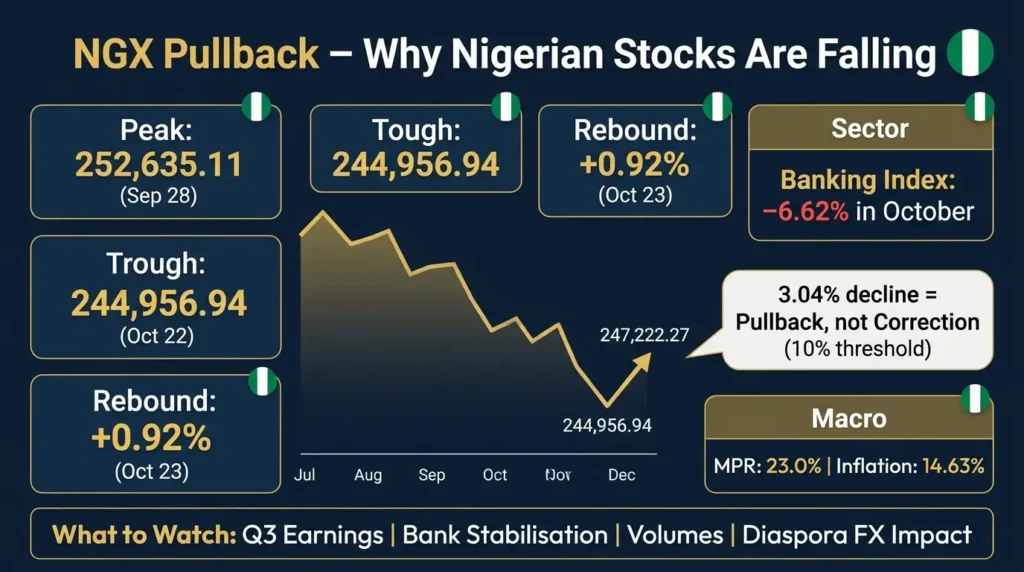
The NGX All-Share Index (ASI) has pulled back about 3% from its record close—a pullback, not a crash. It peaked at 252,635.11 on September 28, 2026, fell to 244,956.94 on October 22, and rebounded 0.92% to 247,222.27 on October 23.
If you are asking why the Nigerian stock market is falling, the short answer is that a very strong run has paused. The ASI was up 61.17% for the year at the start of October and then lost ground over three weeks, led by bank stocks. In the week to October 16, the banking index fell 3.15%, yet the oil and gas index rose 3.13% and 50 stocks gained against 30 that fell. The headline index hides how differently individual stocks have behaved.
This NGX pullback guide covers how far the index has fallen, how to tell a pullback from a correction, why bank stocks have led the decline, how large companies move the index, and how to judge a Nigerian stock when prices drop. It also explains what an NGX pullback means for investors abroad, whose returns depend on the exchange rate as well as the share price.
Let’s examine the NGX pullback with clarity and strategic discipline.
1. How Far Has the NGX Fallen?
The ASI closed 3.04% below its September 28 peak on October 22, the lowest close tracked here, and 2.14% below it after the October 23 rebound.
Total market capitalisation tells the same story. It stood at N163.66 trillion in the week to September 25 and at N160.52 trillion on October 23—about N3.1 trillion or 1.9% lower. That is a large number in naira and a small one in percentage terms.
text
       ┌────────────────────────────────────────────────────────┐
       │      NGX PULLBACK – KEY NUMBERS AT A GLANCE            │
       └───────────────────────────┬────────────────────────────┘
                                   │
         ┌─────────────────────────┼─────────────────────────┐
         ▼                         ▼                         ▼
  [ PEAK ]                  [ TROUGH ]                [ REBOUND ]
  252,635.11 (Sep 28)       244,956.94 (Oct 22)       247,222.27 (Oct 23)
  Record close              3.04% below peak          +0.92% recovery
2. Pullback or Correction? The 10% Yardstick
The usual convention calls a fall of 10% or more from a recent peak a correction, and a smaller fall a pullback. These labels are conventions, not official categories. By this yardstick, a 3.04% decline is a pullback, and the ASI is a long way from correction territory.
Three NGX Rules That Change How a Fall Unfolds
1. A 10% daily price limit.
A stock can move no more than 10% either way from the previous day’s close. A Nairametrics commentary notes that once a stock hits its limit it stops trading for the day, with no reopening auction. A sharp sell-off in one stock can therefore play out over several sessions, and you may be unable to sell on a limit-down day.
2. Minimum volumes before a price changes.
NGX’s pricing rules require a minimum number of units to trade before the published price moves, and the minimum depends on the share price. The 100,000-unit figure applies to the lowest-priced shares (below N5), with lower minimums for higher-priced shares.
3. Index circuit breakers.
If the ASI moves 5% from the previous close between 10:15am and 1:45pm, trading in all equities halts for 30 minutes and reopens with a 10-minute auction. A further 5% move in the same direction after reopening halts trading for the rest of the day. The ASI’s largest daily move in this period was under 1%, so no halt has been close.
3. Why Is the NGX Pulling Back?
It helps to separate what the data shows from what might explain it.
What the Data Shows
- The decline followed a large rally: the ASI was up 61.17% for the year at October 2.
- The fall is uneven: in the week to October 16, the banking index fell 3.15%, while oil and gas rose 3.13% and the commodity index rose 2.36%.
- Trading thinned: turnover in that week fell 38.9% in shares and 38.0% in value, to 1.659 billion shares worth N98.1 billion. Volume on October 22 was 360.71 million shares, then jumped 69.57% to 611.66 million on October 23.
What May Explain It (Interpretations, Not Proven Causes)
Profit-taking.
Market reports describe the selling as investors locking in gains after the rally. That fits the data, but no source reviewed shows which investors sold.
Lower interest rates.
The Central Bank of Nigeria reset its policy rate to 23% at its September 21–22 meeting, from 26.5% in July. Headline inflation was 14.63% in September, against 20.98% a year earlier. Lower rates can support equities, but they can also change expectations for bank earnings. The evidence so far does not show which effect is stronger.
Thin trading.
When fewer shares change hands, a given amount of selling moves prices more.
Who is trading.
Domestic investors accounted for N8.4 trillion, or 87.93%, of the N9.61 trillion traded in the first half of 2026, up from 72.92% a year earlier. Foreign investors accounted for 12.07%, down from 27.08%. Trading share shows who is active in the market, not who sold during a particular fall.
4. Why Are Nigerian Bank Stocks Falling?
Bank stocks have led the decline, but the picture changed quickly on October 23.
- The NGX Banking Index closed at 2,614.79 on October 9 and 2,452.40 on October 22, about 6.2% lower. It then rose 2.57% to 2,515.47 on October 23.
- In the week to October 16, Zenith Bank fell 6.46% to N126.00 and GTCO fell 5.10% to N124.80.
- On October 21, Access Holdings fell 6.12%, First HoldCo 4.59%, Ecobank Transnational (ETI) 1.47% and Zenith 1.21%.
- On October 23, First HoldCo rose 10% to N144.10 and Fidelity Bank rose 9.09% to N24.00.
The sources reviewed describe these falls but do not establish why banks fell more than other sectors, so we avoid naming a single cause. These are the questions worth checking before you form a view: whether the stock had rallied strongly before the fall, how the lower policy rate may affect the bank’s earnings, what its latest results and dividend say, and whether the bank has any capital or regulatory news.
5. How Large Stocks Influence the NGX All-Share Index
NGX says its indices are built on a market-capitalisation methodology, so larger companies have more influence. A company’s official weight in the ASI depends on the index rules, so the table below shows each company’s share of total NGX market capitalisation, which is not the same thing as its exact ASI weight. Even so, the ASI’s daily percentage changes have matched total market capitalisation: on October 22 both fell 0.065%, and on October 23 both rose 0.92%.
Eleven companies made up 75.14% of the NGX’s N163.105 trillion market capitalisation on September 30, 2026.
| Company | Market Cap, Sep 30 2026 (N trillion) | Share of Total NGX Market Cap |
|---|---|---|
| Airtel Africa | 23.68 | 14.52% |
| Dangote Cement | 17.99 | 11.03% |
| MTN Nigeria | 17.57 | 10.77% |
| BUA Foods* | 13.72 | 8.41% |
| BUA Cement | 10.06 | 6.17% |
| Seplat Energy | 9.60 | 5.89% |
| First HoldCo | 7.27 | 4.46% |
| Aradel Holdings | 6.65 | 4.08% |
| HBM Nigeria | 5.72 | 3.51% |
| Zenith Bank | 5.50 | 3.37% |
| GTCO | 4.80 | 2.94% |
| Eleven companies | 122.56 | 75.14% |
BUA Foods market cap was derived by subtracting the ten stated figures from ThisDay’s N122.56 trillion total.
A worked example. A 2% fall in Airtel Africa, at 14.52% of total market capitalisation, removes about 0.29% of the total, or N0.47 trillion. A 10% fall in a hypothetical company worth 0.1% of the market removes just 0.01%. One heavyweight can matter more than a dozen small stocks, but its effect is proportional to its size, not unlimited.
Concentration works in both directions. On October 23 the two biggest gainers, Dangote Cement and First HoldCo, each rose 10% to N1,111.00 and N144.10, and the market gained N1.47 trillion. On October 22, 22 stocks fell and 16 rose, and the ASI was down just 0.065%.
6. Is an NGX Pullback a Buying Opportunity?
Not automatically. A falling price is only cheap if the business is worth more than the price suggests, and that depends on earnings, cash flow, debt, valuation and the reason the price fell. A stock that drops 20% because investors are nervous may be good value. A stock that drops 20% because its profits are shrinking may simply be worth less.
Before treating any NGX pullback as an opportunity, weigh these risks:
- Prices can keep falling. A 3% pullback after a 61% rise says nothing about what comes next.
- Liquidity. The 10% daily limit and minimum-volume rules can make it hard to sell quickly, especially in thinly traded shares.
- Concentration. With eleven companies holding three-quarters of market capitalisation, the index can look calm while individual stocks swing sharply.
- Inflation and alternatives. The policy rate is 23% against headline inflation of 14.63%. Compare current treasury bill and bond yields with the return you can realistically expect from equities.
7. How to Evaluate Nigerian Stocks During a Pullback
Use the same eight questions for every stock, and write down the answers before you act. This framework helps you assess a company; it does not tell you what to buy or sell.
| Factor | Question to Ask | Where to Look |
|---|---|---|
| Business fundamentals | What does the company sell, who pays for it, and what could disrupt it? | Annual report, investor presentation |
| Earnings and cash flow | Are profits growing, and is real cash coming in, not just accounting profit? | Income statement, cash flow statement |
| Valuation | How does the price compare with earnings, book value or cash flow, against the company’s own history and its peers? | P/E, P/B, EV/EBITDA, dividend yield |
| Debt and financial strength | Can it handle its debt if conditions worsen? For banks, how strong are capital and loan quality? | Balance sheet; for banks, capital adequacy and NPLs |
| Dividend sustainability | Is the payout covered by earnings and cash flow? | Payout ratio, dividend history |
| Sector risks | What do regulation, interest rates, exchange rates or commodity prices mean for this sector? | Sector reports, regulator announcements |
| Liquidity and exit | How many shares trade each day, and could you sell your position given the 10% daily limit? | NGX daily trading data |
| Investment thesis | Why did you buy, and has the reason changed or only the price? | Your own notes |
How to use it. Mark each factor green, amber or red. A lower price improves the maths only if the first six factors are intact. If the price fell because earnings, debt or sector conditions worsened, the cheaper price may simply reflect a worse business. If nothing about the business has changed and only the price has moved, that is a different situation that deserves a closer look.
8. What the NGX Pullback Means for Diaspora Investors
If you invest from the UK, US, Canada or elsewhere, your real result is what you receive in your own currency. That depends on three things: the change in the share price in naira, the change in the exchange rate, and the costs of buying, selling and moving money.
The official rate was about N1,332 to the dollar in early October, so the exchange rate has not made this NGX pullback worse for dollar-based investors. That can change, so judge any Nigerian position by its result in the currency you will spend.
Hypothetical example (illustrative numbers, not market data or a forecast).
You invest $1,000 when the rate is N1,500 to the dollar. Buying and selling costs are 1.5% each way. The share price rises 10% in naira.
| Step | Rate Unchanged (N1,500) | Naira Weakens 10% (N1,650) |
|---|---|---|
| Naira invested | N1,500,000 | N1,500,000 |
| After 1.5% buying cost | N1,477,500 | N1,477,500 |
| After a 10% share-price gain | N1,625,250 | N1,625,250 |
| After 1.5% selling cost | N1,600,871 | N1,600,871 |
| Converted back to dollars | $1,067 | $970 |
| Result on $1,000 | +6.7% | −3.0% |
A 10% gain in naira turned into a loss in dollars once a 10% weaker naira and transaction costs were included. Actual charges differ by broker and route, so check yours, including how your broker converts and repatriates funds.
9. Action Plan for Investors
Step 1: Measure the fall from the peak, not from last week.
Compare it with the 10% correction yardstick. A 3% decline is a pullback.
Step 2: Find out which sectors fell and which rose.
A bank-led fall is not a market-wide fall.
Step 3: Check how much of the market your stock represents.
A handful of heavyweights can move the index.
Step 4: Look at volumes.
A fall on thin trading means less than one on heavy trading.
Step 5: Run the eight-factor framework on each stock before you act.
Step 6: Remember the 10% daily limit.
Plan position sizes so you are never forced to sell in a hurry.
Step 7: Compare expected equity returns with T-bill and bond yields, inflation and dividends.
Step 8: If you live abroad, measure results in your home currency after all costs.
Step 9: Write your buy and sell rules down before prices move, not during the fall.
10. Frequently Asked Questions About NGX Pullbacks
Why is the Nigerian stock market falling?
The ASI fell about 3% from its September 28 peak to 244,956.94 on October 22 after rising 61.17% for the year to early October. Market reports point to profit-taking, with thin trading and lower interest rates as possible factors, but no source establishes a single cause.
Is it a good time to buy Nigerian stocks?
A falling price is not a reason to buy on its own. It depends on each company’s earnings, valuation, debt and liquidity, and on your time horizon. Use the eight-factor framework above and compare the expected return with fixed-income yields.
Is this a correction?
Not by the usual 10% yardstick. On October 22, the lowest close tracked here, the ASI was 3.04% below its peak, which is a pullback.
Does a falling ASI mean every stock is falling?
No. In the week to October 16 the ASI fell 0.33% while 50 stocks gained and 30 fell, and oil and gas stocks rose.
Can I always sell when prices fall?
Not always. Each stock can move only 10% a day, and a stock that hits its limit stops trading for the day. Thinly traded shares can be harder to sell at the price you want.
11. Final Summary & The Bottom Line
An NGX pullback does not mean every listed stock is falling, and a falling price does not mean a stock is cheap. The recent NGX pullback has been modest and uneven: banks fell hardest, other sectors held up or rose, and the index rebounded 0.92% on October 23.
text
  ┌──────────────────────────────────────────────────────────┐
  │          NGX PULLBACK – KEY TAKEAWAYS                    │
  ├─────────────────────┬────────────────────────────────────┤
  │ Peak (Sep 28)       │ 252,635.11                         │
  ├─────────────────────┼────────────────────────────────────┤
  │ Trough (Oct 22)     │ 244,956.94 (−3.04%)               │
  ├─────────────────────┼────────────────────────────────────┤
  │ Rebound (Oct 23)    │ 247,222.27 (+0.92%)               │
  ├─────────────────────┼────────────────────────────────────┤
  │ Correction Threshold│ 10% — not reached                  │
  ├─────────────────────┼────────────────────────────────────┤
  │ Banking Index       │ −6.62% in October                  │
  ├─────────────────────┼────────────────────────────────────┤
  │ MPR / Inflation     │ 23.0% / 14.63%                     │
  ├─────────────────────┼────────────────────────────────────┤
  │ Key Driver          │ Profit-taking after 61% YTD rally  │
  └─────────────────────┴────────────────────────────────────┘
The Bottom Line:
What matters is each company’s fundamentals, valuation and liquidity, and whether you decide using a defined framework rather than reacting to daily moves. The NGX pullback is a test of discipline, not a signal to act blindly.
For more weekly NGX updates and strategy guides, explore our market trends and analysis archive.
Disclaimer: This article is for education and information only. It is not investment advice, a recommendation to buy or sell any security, or a forecast of market direction. Figures are taken from the sources listed below and are accurate to the dates shown. Check current prices and data with the Nigerian Exchange and your broker before you act.