
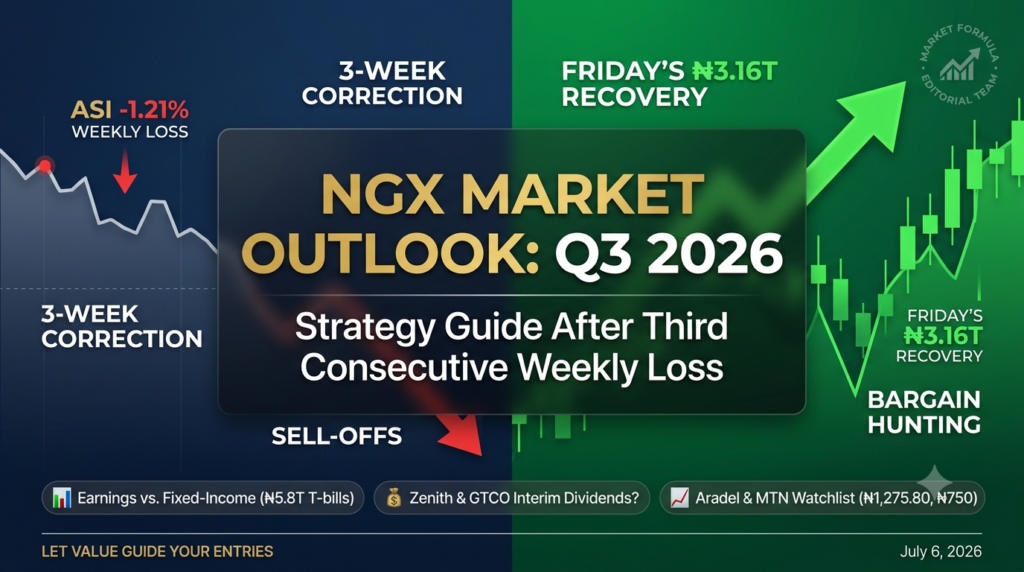
NGX Market Outlook Q3 2026: Strategy Guide After Third Consecutive Weekly Loss
By Kebira Aruna FCS FiCM. MD/CEO, Globalview Capital Limited
Introduction
The Nigerian equities market recorded its third consecutive weekly loss last week, with the All-Share Index (ASI) shedding 1.21% to close at 229,240.34 basis points. This marks the continuation of a correction that has now erased a significant portion of the spectacular gains achieved in the first half of 2026.
Despite a dramatic N3.16 trillion recovery on Friday—driven by late surges in heavyweights like Airtel Africa, Zenith Bank, and MTN Nigeria—the intense sell-offs earlier in the week, particularly on Wednesday and Thursday, kept the weekly return firmly in negative territory. Heavyweights including Aradel Holdings, Dangote Cement, and GTCO bore the brunt of the selling pressure across the five trading days.
The NGX market outlook Q3 2026 suggests that this correction, while painful, is not entirely unexpected given the aggressive run the market had in the first half of the year, which finished with the ASI up over 47% year-to-date. As we step into the new week and the broader third quarter, investors are facing a complex landscape of competing forces: robust corporate earnings versus massive fixed-income liquidity mop-ups by the Central Bank of Nigeria.
This comprehensive guide breaks down:
- The outlook for the new week and the broader Q3 2026
- What is driving growth in Airtel Africa, Regency Alliance, and UPDC
- Why University Press is trending down
- Whether to expect interim dividends from Zenith and GTCO
- How attractive Aradel Holdings and MTN Nigeria are at current levels
- A curated watchlist and actionable trading plan
Let’s examine the NGX market outlook Q3 2026 with clarity and strategic discipline.
1. Market Structure: NGX Market Outlook Q3 2026 – What Really Happened
The 1.21% weekly decline marks the third consecutive week of losses for the NGX, confirming that the market has firmly entered a corrective phase. While Friday’s late rebound provided a glimmer of hope, the overall sentiment remains cautious.
Key Market Signals
| Signal | Observation |
|---|---|
| Third consecutive weekly loss | Sustained selling pressure across multiple sessions |
| Friday’s N3.16 trillion rebound | Late surge in Airtel Africa, Zenith, MTNN suggests bargain hunting at support levels |
| Sector-wide weakness | Banking (-3.72%), Consumer Goods (-4.56%), Industrial Goods (-4.93%) all in the red |
| Heavyweight pressure | Aradel Holdings, Dangote Cement, GTCO took the biggest hits |
| NGX 30 reshuffle | Oando and Transcorp exited; NASCON and Unilever entered, creating mechanical volume volatility |
| H1 2026 performance | Market still up over 47% year-to-date despite recent correction |
The Structural Context
The primary pressure points currently cut across all major sectors, reflecting broad-based profit-taking rather than isolated weakness:
- Banking (-3.72%): Still heavily trapped in a corrective zone as institutional investors rebalance amidst ongoing capitalisation requirements and the recent NGX 30 index reshuffle.
- Consumer Goods (-4.56%): Dragged down heavily by names like NASCON and International Breweries, which faced significant selling pressure.
- Industrial Goods (-4.93%): Hit by substantial profit-taking on heavyweights like Dangote Cement.
Market Insight: The NGX market outlook Q3 2026 suggests that Friday’s robust rebound indicates bargain hunters are actively waiting at support lines to scoop up value at these lower entry points. However, the structural headwinds from the fixed-income market will likely cap any aggressive rallies.
2. Outlook for the New Week and Q3 2026: NGX Market Outlook Q3 2026
The financial landscape for the coming week and the rest of Q3 2026 is shaping up to be a dynamic tug-of-war between strong corporate earnings and massive fixed-income liquidity mopping by the CBN.
A. Outlook for the New Week (July 6 – July 10, 2026)
Expect a mixed, highly selective trading pattern with a slight bullish bias early in the week, carrying over from Friday’s late N3.16 trillion market rescue.
- Bargain Hunting vs. Profit Taking: Institutional investors are looking closely at tier-1 banks (like Zenith and GTCO) and heavily discounted consumer goods names that were pummeled during June’s -8.44% slide. Friday’s positive market breadth (41 gainers vs. 14 losers) proves that local funds are ready to step in at major support lines.
- Early Corporate Positioning: Trading volumes will likely stay moderate but transition away from panic selling to selective accumulation as fund managers position ahead of the Q2/H1 earnings season.
- Sector Focus: The Banking sector will likely lead any near-term index recovery, closely followed by defensive heavyweights in Telecommunications (Airtel Africa and MTNN), which anchored Friday’s bounce.
B. Broad Outlook for Q3 2026 (July – September)
Moving deeper into the quarter, the NGX will face structural headwinds from the fixed-income market, meaning the spectacular 47.4% gains seen in H1 2026 will transition into a more calculated, volatile consolidation phase.
Key Drivers to Watch:
| Driver | Impact |
|---|---|
| Fixed-Income Magnet | CBN planning N5.8 trillion T-bills auction; DMO scheduling N4 trillion FGN Bond issuance across Q3. Could trigger capital flight if yields rise. |
| H1 Earnings Catalyst | Audited H1 2026 results starting late July/August will serve as a major fundamental trigger for stock-specific rallies. |
| Banking Capitalisation | Race to meet SEC and CBN capital thresholds intensifies; rights issues and private placements will keep banking stocks volatile. |
| Emerging Sectors | Agribusiness and niche industrial turnarounds (like Zichis Agro-Allied on the Growth Board) will attract alpha-seeking capital. |
text
       ┌────────────────────────────────────────────────────────┐
       │         Q3 2026 NGX OUTLOOK – KEY FORCES              │
       └───────────────────────────┬────────────────────────────┘
                                   │
         ┌─────────────────────────┼─────────────────────────┐
         ▼                         ▼                         ▼
  [ BULLISH FORCES ]         [ BEARISH FORCES ]        [ NEUTRAL ]
  H1 Earnings Catalysts      CBN/DMO T-bill/Bond       Selective
  Interim Dividends          Auctions at high          Accumulation
  Bargain Hunting            yields                    Phase
The Structural Takeaway: Q3 2026 will not be a rising-tide-lifts-all-boats environment. Success will require strict bottom-up stock selection, focusing on companies with solid cash flow defence, manageable exposure to foreign currency liabilities, and high earnings visibility to withstand macro interest rate pressures.
3. What’s Driving the Growth in Airtel Africa, Regency Alliance, and UPDC?
The recent buying interest and underlying momentum in these three stocks are tied to strong fundamental triggers, corporate actions, and strategic repositioning.
A. Airtel Africa – Massive Bottom-Line Recovery
Airtel Africa’s strong performance is anchored by its FY 2026 full-year earnings report, which revealed massive operational improvements and a complete recovery from previous foreign exchange shocks.
| Metric | Performance |
|---|---|
| Profit After Tax | $813 million (up from $328 million prior) |
| Revenue Growth (Constant Currency) | 24.0% overall; Nigeria +47.5% |
| Data Usage | 8.9 GB per customer per month |
| Airtel Money Value | $215 billion annualised total value |
| EBITDA Margin | 49.3% |
Key Drivers:
- Derivative and foreign exchange gains of $127 million (compared to heavy FX losses last year)
- Explosive data demand and mobile money surge
- Operational efficiency gains supporting self-funded $884 million capital expenditure program
B. Regency Alliance Insurance – Rights Issue Catalyst
Regency Alliance’s primary catalyst is strategic corporate restructuring driven by regulatory capital requirements and the execution of its capital raise.
- The N3 Billion Rights Issue: Regency recently signed and executed its Rights Issue Agreement to raise capital by offering 3.2 billion ordinary shares at 95 kobo each. The acceptance window closed on July 3, 2026, focusing significant market attention on the stock.
- Solvency and Underwriting Firepower: The proceeds are directly aimed at meeting NAICOM’s push for higher capital bases. Investors like that the new funds will enhance Regency’s capacity to underwrite larger, more complex risks in oil, gas, and infrastructure, while accelerating their digital transformation for the retail and SME market.
C. UPDC Plc – Structural Turnaround to Asset Management
UPDC is experiencing a strong structural turnaround, transitioning from a pure-play property developer into a highly diversified asset manager.
- Diversified Revenue Streams: Facility management subsidiary crossed N1.6 billion turnover; Festival Hotel upgrades turned hospitality into a stable cash generator.
- Explosive Rental and Project Growth: Brompton City development brought in over N8.7 billion in revenue; UPDC REIT posted 82.78% rental income growth to N759.8 million in Q1 2026.
- N100 Billion Fund Ambition: The market is responding favourably to UPDC’s forward-looking expansion plans, including a proposed N100 billion Real Estate Investment Fund.
4. Why Is University Press Trending Down?
The downward pressure on University Press, which saw its stock price drop roughly 17.54% to close last week at N4.70, is driven by a mix of market-wide cooling, margin compression, and structural sector challenges.
Key Factors Behind the Decline
1. Significant Margin Erosion in FY 2026 Results
While revenue grew by 14% year-on-year to N3.89 billion, Net Income plummeted by 57% to N195.3 million. The net profit margin shrank from 13% to just 5.0%, signalling that escalating overhead and operating expenses are severely eating into profitability.
2. Squeezed by Skyrocketing Paper and Production Costs
The entire domestic publishing sector is battling an acute inflationary crisis. Because Nigeria remains heavily dependent on imported paper and printing materials, UPL’s cost of sales and distribution logistics expanded at a pace that price hikes on textbooks couldn’t match.
3. Profit-Taking After the May Rally
UPL experienced a powerful speculative rotation back in mid-to-late May 2026, where it surged 28% in a single week. Now that the broader market has entered a consolidation phase, short-term traders are aggressively locking in profits.
4. Modest Dividend Yield
The Board recommended an increased dividend of 18 kobo per share (a 20% bump). However, at its previous price point, this translated to a trailing dividend yield of roughly 3.8% – insufficient incentive in the current high-interest-rate environment.
5. Should We Expect Interim Dividends from Zenith and GTCO?
Yes, you can confidently expect interim dividend declarations from both Zenith Bank and GTCO for their Q2/H1 2026 earnings. Both institutions have deeply entrenched structural corporate habits of paying semi-annual dividends.
Zenith Bank Plc
- Board Meeting: Scheduled for July 29, 2026, to consider H1 2026 audited financial statements and recommend an interim dividend.
- Historical Context: Zenith has paid a mid-year interim dividend for over a decade. Last year (H1 2025), they declared N1.25 per share. An interim payout at or slightly above the N1.00–N1.25 range is highly anticipated.
Guaranty Trust Holding Company (GTCO)
- Historical Context: GTCO holds the crown as the NGX banking sector’s premier income play, having recently paid a record-breaking total dividend of N12.76 per share for FY 2025.
- Expected Payout: GTCO has consistently paid a N1.00 per share interim dividend for its H1 results over consecutive recent cycles. No fundamental reason to expect a departure from this trend.
The Audit Delay Factor
While both boards will meet in late July to approve these numbers and dividends, do not panic if the actual announcements do not hit the NGX portal until late August or early September 2026. Because both submit fully audited half-year accounts, their results must first undergo regulatory review and sign-off by the CBN – typically introducing a 3- to 4-week lag.
Why the Market Cares More Than Usual This Year
With the CBN aggressively pushing multi-trillion-naira Treasury Bill auctions at high yields, these banks must deliver strong interim numbers and payouts to convince fund managers to keep their capital parked in equities rather than rotating entirely into risk-free fixed income.
6. How Attractive Is Aradel at N1,275.80?
At N1,275.80, Aradel Holdings presents a highly compelling entry point for value-driven and institutional investors. The stock has undergone a significant technical correction, retracing roughly 37% from its all-time high of N2,024.00 achieved in late April 2026.
The Bull Case
| Metric | Attractiveness |
|---|---|
| Price-to-Earnings (P/E) | ~7.8x – incredibly cheap for a high-growth integrated energy stock |
| Q1 2026 Revenue | Skyrocketed 265% year-on-year to N728.5 billion |
| Q1 2026 Net Income | Jumped 96% to N66.2 billion; EPS of N15.24 for single quarter |
| Immediate Dividend | N23.00 per share final dividend; ex-date July 10, 2026 – 1.8% return in less than a month |
| Strategic Assets | 53.3% stake in Renaissance consortium, 81.67% target stake in ND Western |
The Risks
- Insider Selling Sentiment: Executives selling blocks of shares totalling roughly N10.9 billion creates near-term technical pressure.
- Compressed Net Margins: Net profit margins compressed to 9.1% (from 17% in Q1 2025) due to integration costs.
- Fixed-Income Headwinds: Trailing yield under 3% cannot compete with high-yield Treasury Bills.
The Strategic Verdict: At N1,275.80, Aradel is a classic growth at a reasonable price (GARP) play. The technical correction has wrung out speculative froth, leaving a highly profitable, dollar-hedged energy powerhouse trading at a single-digit P/E.
7. Is MTN a Good Buy at N750?
At N750.00, MTN Nigeria presents a highly attractive buy for both medium-term growth and income-focused institutional portfolios. The stock recently retraced roughly 18% from its all-time high of N915.00 in May.
The Bull Case
| Metric | Performance |
|---|---|
| Q1 2026 Service Revenue | Surged 41.8% year-on-year to N1.49 trillion |
| Q1 2026 Profit After Tax | Skyrocketed 165.9% to N355.5 billion |
| Q1 2026 EPS | N16.95 – annualised run-rate above N60 |
| EBITDA Margin | 55.3% – up 8.7 percentage points |
| Data Revenue | Jumped 56.2%; 55 million active data users |
| Fintech Revenue | Surged 190.6% (excluding Xtratime) |
| Strategic De-risking | N95.5 billion intra-group restructuring; N152.1 billion balance sheet injection |
The Headwinds
- Fixed-Income Competition: Trading at TTM P/E of roughly 11.8x, faces asset-allocation competition from high-yield Treasury Bills.
- Capex Intensity: Q1 capex nearly doubled to N390.3 billion – builds competitive moat but strains free cash flow.
The Strategic Verdict: At N750.00, you are buying the dominant market leader (89.5 million subscriber base) at a clear discount, precisely as its earnings power is compounding. With an annualised EPS run-rate comfortably tracking above N60, the stock is trading at a forward P/E of under 4x. Barring an unforeseen macro currency shock, N750 represents a highly secure structural support level.
8. Action Plan for Traders & Investors (Week of July 6–10, 2026)
Step 1: Position for the early-week bullish bias.
Carry over from Friday’s N3.16 trillion rebound. Look for accumulation in tier-1 banks and telecom heavyweights.
Step 2: Focus on earnings-driven bargain plays.
GTCO, Zenith, and MTNN are top priorities. Zenith’s board meets July 29 – position ahead of interim dividend confirmation.
Step 3: Monitor corporate action catalysts.
Aradel’s ex-dividend date is July 10 – watch for dividend seekers to defend the N1,275.80 floor. Regency Alliance enters price discovery post-rights issue.
Step 4: Avoid speculative, low-liquidity names.
Focus on stocks with clear short-term triggers – audited earnings releases, corporate restructurings, or dividend ex-dates.
Step 5: Maintain strict risk management.
With the CBN continuing large-scale T-bill and OMO auctions, overall market volume will remain selective. Use tranche-based entries and take partial profits into strength.
9. Stocks to Watch
For the current week and heading into the Q2/H1 earnings season, stocks fall into three categories: earnings-driven bargain plays, corporate action/restructuring targets, and defensive consumer plays with turnaround momentum.
A. Earnings & Dividend Targets (Bargain Hunting)
| Stock | Catalyst |
|---|---|
| GTCO | Top priority for bargain hunters; expect N1.00+ interim dividend |
| Zenith Bank | Board meets July 29; interim dividend anticipated |
| MTN Nigeria | Fresh off Friday’s 4.17% rebound to N750; operational de-risking and triple-digit earnings growth |
B. Corporate Restructuring & Capital Raise Catalysts
| Stock | Catalyst |
|---|---|
| Aradel Holdings | July 10 ex-dividend date (N23.00); trading at corrected N1,275.80 |
| Regency Alliance | Post-rights issue price discovery; 3.2 billion shares at 95 kobo |
| UPDC Plc | Structural pivot to asset management; N100 billion real estate fund ambition |
C. The Turnaround Play
| Stock | Catalyst |
|---|---|
| PZ Cussons | Explosive 388% net profit growth to N49.1 billion; net asset position back to positive |
10. Final Market Summary & The Bottom Line
The NGX market outlook Q3 2026 is not a reversal of the macro bull run – it is a transition from a rising-tide-lifts-all-boats environment to a highly selective, stock-picker’s market. The correction is healthy and expected after a 47%+ H1 rally.
text
  ┌──────────────────────────────────────────────────────────┐
  │            NGX MARKET SEGMENT ROLES (Q3 2026)            │
  ├─────────────────────┬────────────────────────────────────┤
  │ Tier-1 Banks        │ Interim dividends; recap plays     │
  ├─────────────────────┼────────────────────────────────────┤
  │ Telecom (MTNN, Airtel) │ Earnings recovery; operational de-risking │
  ├─────────────────────┼────────────────────────────────────┤
  │ Energy (Aradel)     │ High-beta; dividend capture; GARP  │
  ├─────────────────────┼────────────────────────────────────┤
  │ Insurance (Regency) │ Rights issue; price discovery      │
  ├─────────────────────┼────────────────────────────────────┤
  │ Property (UPDC)     │ Structural turnaround; fund ambition│
  └─────────────────────┴────────────────────────────────────┘
The Bottom Line:
The most profitable approach in Q3 2026 is selective accumulation and strict bottom-up stock selection – not aggressive buying. Focus on companies with solid cash flow defence, manageable foreign currency exposure, and high earnings visibility. Banking and telecom names offer structural anchors; energy and insurance provide high-beta opportunities. Respect the competition from fixed-income yields, maintain strict discipline, and let value guide your entries.
The coming weeks will determine whether earnings catalysts and interim dividends can outweigh profit-taking pressures and competing yields. Stay disciplined, stay selective, and keep your eyes on the long-term horizon.
Disclaimer: This article is for informational purposes only and does not constitute investment advice. Always conduct your own research or consult a qualified financial advisor before trading.
Thank you for this great insights. NGX is a place to be provided you know what you are doing. Well-done.