
NGX Market Outlook: Navigating the 3.59% Bearish Pullback – Strategy Guide for the New Trading Week (June 2026)
By Kebira Aruna FCS FiCM. MD/CEO, Globalview Capital Limited
Introduction
The Nigerian equities market endured another punishing week, shedding 3.59% week‑on‑week as broad‑based sell‑offs erased substantial value from investors’ portfolios. This marks the second consecutive week of significant declines, reinforcing the risk‑off sentiment that has gripped the exchange.
As we step into the new week beginning June 22, 2026, the NGX market outlook bearish week presents a delicate environment. Investors are caught between competing forces: attractive fixed‑income yields, persistent inflationary pressures, and the potential for bargain hunting in oversold blue‑chip names.
This guide breaks down:
- The outlook for the new week and key factors to watch
- What is driving the growth in Cornerstone Insurance
- Why First HoldCo is trending down – and whether ₦55 is a buy
- The possibilities in Zichis, NEM Insurance, Oando, and Ellah Lakes
- How attractive GTCO, Zenith Bank, and Access Holdings remain
- A curated watchlist and actionable trading plan
Let’s examine the NGX market outlook bearish week with clarity and discipline.
1. Market Structure: What Really Happened Last Week
The NGX experienced significant volatility last week, characterised by broad‑based selling that erased substantial value from portfolios. The 3.59% decline follows a similar pattern from the previous week, suggesting a sustained risk‑off attitude among market participants.
Key Market Signals
| Signal | Observation |
|---|---|
| Two consecutive sell‑off weeks | Heavy losses in back‑to‑back sessions indicate cautious sentiment. |
| Fixed‑income competition | DMO planning ₦1.2 trillion bond reopenings; CBN adjusting T‑bill yields higher. |
| Inflation sensitivity | Investors highly reactive to any news suggesting further erosion of purchasing power. |
| Volatility remains high | Some stocks hitting 10% daily limits in both directions – active trading persists. |
| Bargain hunting potential | Some blue‑chip stocks may be perceived as oversold, triggering technical rebounds. |
The Fixed‑Income Factor
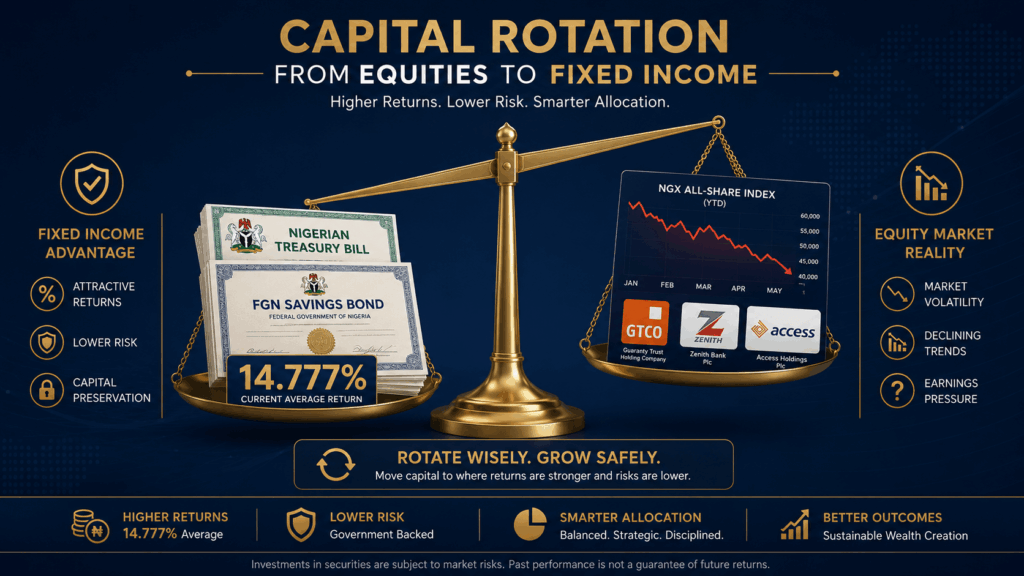
A major factor currently weighing on equities is the increased attractiveness of fixed‑income instruments. With the Debt Management Office (DMO) planning significant bond reopenings and the Central Bank of Nigeria (CBN) adjusting Treasury bill yields higher to combat inflation, many investors are rotating capital out of stocks and into the relative safety of government securities.
Market Insight: The NGX market outlook bearish week suggests that any recovery will likely be gradual. Investors should not expect a V‑shaped rebound, as fixed‑income yields will continue to compete aggressively for institutional flows.
2. Outlook for the New Week: Possibilities and Risks
Whether the market continues to slide or begins a recovery will likely depend on how investors process several competing macroeconomic and corporate signals.
Bullish Possibilities
- Bargain hunting – After a week of heavy losses, institutional and retail investors may perceive certain blue‑chip stocks as oversold, potentially triggering a technical rebound early in the week.
- Regulatory support – The return to the tiered price discovery framework by the NGX could stabilise certain segments.
- Corporate actions – Any unexpected dividends, capital raises, or major share acquisitions could shift individual stock sentiment.
Bearish Risks
- Continued fixed‑income rotation – With yields remaining attractive, risk‑averse capital will likely continue to flow into government securities.
- Persistent profit‑taking – If negative sentiment persists, rallies may be short‑lived.
- Macroeconomic headwinds – Inflation and high interest rates remain persistent concerns.
The Most Likely Scenario
Given the current bearish momentum, the NGX market outlook bearish week points to a cautious start, with potential for selective bargain hunting in oversold names. However, any rallies are likely to be capped by the ongoing rotation into fixed‑income instruments.
text
       ┌────────────────────────────────────────────────────────┐
       │         NGX OUTLOOK FOR THE NEW WEEK (JUNE 22–26)      │
       └───────────────────────────┬────────────────────────────┘
                                   │
         ┌─────────────────────────┼─────────────────────────┐
         ▼                         ▼                         ▼
  [ BARGAIN HUNTING ]        [ CAUTIOUS ]               [ CONTINUED SELL-OFF ]
  if blue-chips               Most likely scenario:     if fixed-income
  appear oversold.           selective accumulation.    yields rise further.
3. What’s Driving the Growth in Cornerstone Insurance?
Cornerstone Insurance has demonstrated significant growth recently, characterised by strong top‑line revenue increases and a substantial improvement in profitability. This performance is being driven by a combination of strategic operational reforms, technological adoption, and a favourable (albeit challenging) industry environment.
A. Strategic Operational Reforms
- Disciplined underwriting & risk selection – Management has shifted focus toward selective risk management, improving claims efficiency and underwriting margins.
- Cost optimisation – Rigorous cost‑management initiatives have translated revenue growth into higher bottom‑line profitability.
- Retail business restructuring – A deliberate effort to reorganise the retail business has broadened market penetration and customer base.
B. Technological Innovation
- Digital transformation – Cornerstone has positioned technology as a central pillar, developing proprietary applications such as their Motor Inspection App.
- Process efficiency – Embracing technology for internal processes has improved service delivery speeds.
C. Market Expansion and Partnerships
- Enhanced stakeholder relationships – Strengthening ties with insurance brokers and corporate clients has directly supported business volume growth.
- Product innovation – Developing products that meet the specific needs of the Nigerian market has attracted new policyholders.
D. Industry and Regulatory Tailwinds
- Nigeria Insurance Industry Reform Act (NIIRA) 2025 – Cornerstone is proactively responding to regulatory changes, including the planned unbundling of its composite structure into separate Life and General entities.
- Increased compulsory insurance – NIIRA 2025 expanded compulsory policies from 6 to 11, driving broader industry demand.
- Solvency and capital adequacy – The company maintains strong capital position significantly above regulatory requirements.
The HoldCo Structure: Impact on Valuation
The restructuring of Cornerstone Insurance into a Holding Company (HoldCo) structure is a significant strategic evolution. This transition typically affects valuation in several key ways:
| Factor | Impact on Valuation |
|---|---|
| Sum‑of‑the‑parts (SOTP) valuation | Allows analysts to assign more accurate multiples to Life and General insurance separately. |
| Strategic focus | Specialised management for each entity improves underwriting performance. |
| Capital allocation flexibility | Parent company can move funds between subsidiaries, raising debt at HoldCo level. |
| Transparency and governance | Clear separation enhances regulatory compliance and institutional investor confidence. |
| Dividend stability | Centralising surplus management can provide more predictable returns. |
4. Why Is First HoldCo Trending Down? Is It a Good Buy at ₦55?
The recent downward trend in the share price of First HoldCo (FBN Holdings) is a reflection of broader market volatility affecting the NGX, compounded by specific factors unique to the bank.
Why Is First HoldCo Trending Down?
- Broad market sentiment – The entire NGX has been under bearish pressure; large‑cap stocks are often the first to be sold by institutional investors rebalancing portfolios.
- Persistent macroeconomic pressure – Investors remain concerned about inflation and high interest rates impacting the banking sector.
- Profit‑taking after Q1 outperformance – Following a strong Q1 2026, some investors may be selling to lock in gains.
- Asset quality sensitivity – Despite the clean‑house strategy executed in 2025, investors remain sensitive to any indicators of further credit impairment.
Is It a Good Buy at ₦55?
The Argument for Buying (Value Play)
- Strong fundamental pivot – After massive impairment charges in 2025, the bank has emerged with a cleaner balance sheet. Q1 2026 results demonstrated a return to strong profitability.
- Market position – As one of the largest financial institutions in Nigeria, First HoldCo is often considered a must‑have in long‑term portfolios.
- Valuation multiples – A price dip can make P/E or P/B ratios look more attractive compared to historical averages.
The Risks to Consider
- Continued volatility – If the broader market continues to decline, the stock could test lower support levels.
- Macroeconomic headwinds – The banking sector’s performance is deeply tied to the health of the Nigerian economy.
- Short‑term sentiment – The stock price may be driven more by technicals than by immediate fundamental value.
Strategic Considerations
- Dollar‑cost averaging – Rather than buying all at once at ₦55, consider accumulating in smaller tranches.
- Focus on fundamentals – If your goal is long‑term, evaluate whether you believe in the bank’s strategy.
- Monitor technical levels – Watch for signs of exhaustion in selling pressure.
5. Possibilities in Zichis, NEM Insurance, Oando, and Ellah Lakes
These four stocks operate in very different sectors, and their possibilities for the coming week are driven by distinct factors.
| Stock | Sector | Key Driver for the Week Ahead |
|---|---|---|
| Zichis | Agriculture | Sentiment recovery vs. volatility from previous rapid gains |
| NEM Insurance | Insurance | Market‑wide bearish sentiment affecting financial stocks |
| Oando | Oil & Gas | Ongoing volatility related to debt and operational shifts |
| Ellah Lakes | Agriculture | Transition from investment to production phase |
Zichis Agro‑Allied Industries (ZICHIS)
Zichis has experienced intense volatility since its listing, characterised by massive spikes followed by regulatory scrutiny. The market is currently digesting news of a ₦2 billion non‑equity strategic capital injection and ambitious plans to increase animal feed capacity. Expect continued volatility; the stock is highly speculative.
NEM Insurance (NEM)
NEM, like other financial institutions, is currently caught in the risk‑off sentiment. While it is a solid dividend payer, recent analyst consensus has shifted toward a more cautious stance due to the stock tracking ahead of earnings growth. Watch to see if it finds support after its recent decline.
Oando (OANDO)
Oando remains one of the most polarising stocks on the exchange. The company is managing a delicate balance of ambitious upstream expansion and a heavy debt burden. Positive news often conflicts with investor anxiety over debt sustainability and transparency. Watch for updates on capital structure or production guidance.
Ellah Lakes (ELLAHLAKES)
Ellah Lakes is in a transition phase, shifting from long‑term development to production. Investors are looking for proof that heavy investments are now translating into actual revenue and profit. However, it faces major risks, including high stock price volatility and a need for capital.
Critical Investor Perspective: All four stocks are currently experiencing heightened volatility. They are growth/speculative plays that react sharply to news or broader sector trends. Prioritise volume analysis – a price move without significant volume may be a head fake.
6. How Attractive Are GTCO, Zenith Bank, and Access Holdings?
GTCO, Zenith Bank, and Access Holdings – the Tier‑1 giants of the Nigerian banking sector – are central to the NGX. Their attractiveness depends on whether you are looking for short‑term speculative gains or long‑term fundamental value.
Sector Overview: The 2026 Context
- Recapitalisation milestone – All major banks have successfully met the new CBN paid‑up capital requirements as of Q1 2026, removing a major layer of regulatory uncertainty.
- Normalisation – After bumper earnings of 2024–2025, profit growth is normalising. Investors are shifting focus to earnings quality rather than FX gains.
- Market sentiment – Because these are index heavyweights, they are frequently sold off during market‑wide bear runs.
Comparison of the Big Three
| Feature | GTCO | Zenith Bank | Access Holdings |
|---|---|---|---|
| Market Reputation | Efficiency, corporate governance, strong retail digital banking | Capital strength, corporate/private banking leadership | Aggressive expansion strategy, pan‑African footprint |
| Key 2026 Focus | Maintaining high ROE while navigating digital competition | Leveraging upgraded systems and African/European expansion | Cross‑continental infrastructure and financial services |
| Current Sentiment | Highly sensitive to investor sentiment; experiencing volatility | Solid performance but affected by broad profit‑taking | Navigating complex transition; largest footprint |
The Buy Case
- Fundamental strength – These banks are better capitalised than ever.
- Long‑term value – They act as proxies for Nigerian and African economic growth.
- Dividend history – Traditionally strong dividend payers.
The Risk Case
- Short‑term catching a falling knife – Buying now does not guarantee the price won’t dip lower.
- Normalisation of earnings – If Q2/Q3 2026 reports show slowing growth, it could create negative pressure.
- Macroeconomic sensitivity – Sensitive to inflation, CRR changes, and broader economic policy.
Verdict: For long‑term investors, current price dips are often viewed as opportunities to accumulate high‑quality assets. For short‑term traders, the environment is high‑risk and requires strict stop‑loss discipline.
7. Action Plan for Traders & Investors (Week of June 22–26, 2026)
Step 1: Prioritise defensive positioning.
Focus on companies with strong fundamentals, consistent dividend histories, and resilience to inflationary pressure.
Step 2: Monitor trade volume.
Watch which stocks are being most heavily traded – this indicates where institutional money is moving.
Step 3: Implement strict risk management.
Maintain strict stop‑loss discipline, as the market is currently in a state of high sensitivity to macroeconomic announcements.
Step 4: Look for oversold opportunities.
Consider blue‑chip stocks that may have been excessively beaten down. Use dollar‑cost averaging rather than lump‑sum entries.
Step 5: Watch fixed‑income yields.
With T‑bills and FGN Savings Bonds remaining attractive, keep equity allocations selective. Do not expect a V‑shaped recovery.
8. Stocks to Watch
Given the current bearish sentiment, analysts categorise stocks into two types: Defensive/Value Leaders (for long‑term stability) and Strategic/Growth Plays (for potential rebound or specific corporate triggers).
Defensive & Market Anchors (The Watch & Accumulate List)
| Stock | Why Watch |
|---|---|
| GTCO & Zenith Bank | Primary barometers for banking sector; watch for stabilisation |
| MTN Nigeria (MTNN) | Defensive choice due to essential nature of data and connectivity |
| Dangote Cement (DANGCEM) | Proxy for Nigerian infrastructure sector |
Sector‑Specific Plays (The Strategic List)
| Stock | Why Watch |
|---|---|
| Stanbic IBTC / United Capital | Benefit from broader financial market activities |
| Seplat Energy | Sensitive to global oil price fluctuations and production updates |
| NEM Insurance | Regulatory tailwinds from NIIRA 2025 |
Summary Checklist for the New Week
- Volume vs. Price – If price is falling, are volumes high (institutional exit) or low (panic selling)?
- Support Levels – Can blue‑chip stocks hold at critical psychological price points?
- Corporate Announcements – Earnings previews, capital raising updates, or major contract awards can override general sentiment.
9. Final Market Summary & The Bottom Line
The NGX market outlook bearish week is not a reversal of the macro bull run – it is a healthy consolidation and rotation phase. However, the current environment demands caution and selectivity.
text
  ┌──────────────────────────────────────────────────────────┐
  │            NGX MARKET SEGMENT ROLES (JUNE 2026)          │
  ├─────────────────────┬────────────────────────────────────┤
  │ Tier‑1 Banks        │ Liquidity anchors, value plays     │
  ├─────────────────────┼────────────────────────────────────┤
  │ Insurance (Cornerstone, NEM) │ Regulatory tailwinds, HoldCo reforms │
  ├─────────────────────┼────────────────────────────────────┤
  │ Energy (Oando, Seplat) │ High‑beta, commodity‑driven       │
  ├─────────────────────┼────────────────────────────────────┤
  │ Agriculture (Zichis, Ellah Lakes) │ Speculative, transition plays │
  └─────────────────────┴────────────────────────────────────┘
The Bottom Line:
The most profitable approach this week is defensive positioning and selective accumulation – not aggressive buying. Banking and insurance names offer structural anchors; energy and agriculture stocks provide high‑beta opportunities for traders with higher risk tolerance. Respect the competition from fixed‑income yields, maintain strict stop‑loss discipline, and let value – not fear or greed – guide your entries.
The coming weeks will determine whether bargain hunting can outweigh profit‑taking pressures and competing yields. Stay disciplined, stay selective, and keep your eyes on the long‑term horizon.
Disclaimer: This article is for informational purposes only and does not constitute investment advice. Always conduct your own research or consult a qualified financial advisor before trading.