
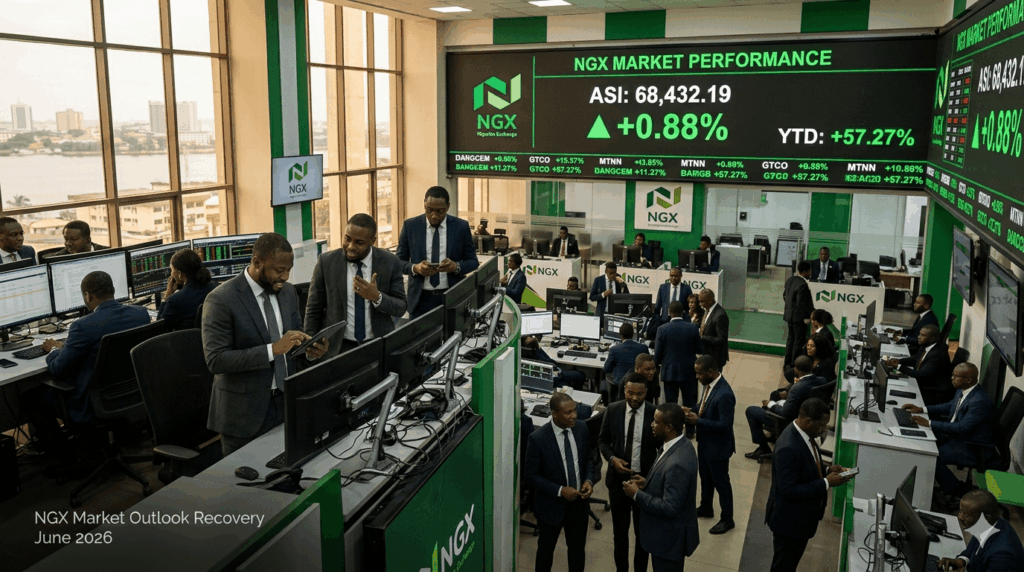
NGX Market Outlook: Recovery Rally & Strategic Plays for the New Trading Week (June 2026)
Introduction
The Nigerian equities market rebounded last week, posting a 0.88% week‑on‑week gain – a welcome recovery after the steepest single‑week decline of 2026. The All‑Share Index (ASI) closed at 244,738.74 points, while market capitalisation settled at N156.97 trillion. Year‑to‑date returns have now climbed to 57.27%, reinforcing that the macro bull run remains intact despite recent volatility. According to the Nigerian Exchange Group (NGX)
This recovery was not accidental. Bargain hunters stepped into fundamentally sound counters following the aggressive profit‑taking that had pushed valuations to more attractive levels. However, the NGX market outlook recovery is not a signal to throw caution to the wind. The market is still navigating a complex landscape of elevated fixed‑income yields, selective institutional buying, and lingering profit‑taking pressures. This guide examines the NGX market outlook recovery and what it means for your portfolio.
This guide breaks down:
- The sustainability of the 0.88% rally
- The outlook for the new trading week
- What is driving explosive growth in ABC Transport, Consolidated Hallmark, and Abbey Mortgage Bank
- Investment possibilities in NEM Insurance, First HoldCo, and Oando
- Why Fidson is trending down (despite strong fundamentals)
- Whether Okomu Oil is a good buy at N1,575
- A curated watchlist and actionable trading plan
Let’s examine the NGX market outlook recovery with clarity and discipline.
1. Market Structure: How Sustainable Is the 0.88% Rally?
Last week’s advance followed a sharp correction – the largest of 2026 – which had erased a significant portion of earlier gains. The rebound reflects renewed bargain hunting, particularly in counters with resilient earnings and attractive dividend profiles. The sustainability of the NGX market outlook recovery depends on market breadth.
Drivers of the Recovery
| Factor | Impact |
|---|---|
| Valuation support | The pullback brought blue‑chip and dividend stocks into more appealing valuation ranges, drawing institutional and retail interest. |
| Earnings season momentum | Ongoing corporate releases and interim dividend expectations are keeping fundamentally strong companies in focus. |
| Portfolio rebalancing | Investors are rotating into stocks with resilient earnings outlooks and competitive dividend yields. |
Risks That Could Cap the Rally
- Profit‑taking not yet exhausted – Stocks that delivered substantial gains earlier in the year may still see periodic selling.
- Fixed‑income competition – High yields from Treasury bills and FGN Savings Bonds continue to divert institutional flows.
- Macro sensitivity – Any deterioration in foreign exchange stability or investor sentiment could trigger fresh volatility.
Market Insight: The sustainability of the NGX market outlook recovery depends heavily on market breadth and trading volumes. A durable rally requires broad sector participation, not just isolated gains in a handful of heavyweight names. If buying interest widens and liquidity improves, the market could consolidate and retest recent highs. Otherwise, the advance remains technical and vulnerable to another round of selling.
2. Outlook for the New Week: Cautious Optimism
The recovery momentum suggests that bargain hunters are gradually re‑entering the market, particularly in fundamentally strong stocks whose valuations became attractive after the recent selloff.
Bullish Signals
- Improved risk appetite among value‑oriented investors.
- Attractive entry points in quality names across banking, consumer goods, and energy.
- Historical tendency for post‑correction rebounds to extend for 1–2 weeks if supported by volume.
Bearish Risks
- Short‑term traders may lock in gains from last week’s rally, creating intermittent volatility.
- Fixed‑income yields remain persistently attractive, capping the pace of equity inflows.
- Low market breadth could signal a false dawn.
The Most Likely Scenario: A moderately positive week with selective buying rather than a broad market surge. Investors should expect cautious accumulation, with market direction determined by institutional participation and the ability of the recovery to attract fresh capital. The NGX market outlook recovery faces headwinds from fixed‑income yields. Monitor CBN’s monetary policy page for rate decisions
       ┌────────────────────────────────────────────────────────┐
       │         NGX OUTLOOK FOR THE NEW WEEK (JUNE 15–19)      │
       └───────────────────────────┬────────────────────────────┘
                                   │
         ┌─────────────────────────┼─────────────────────────┐
         ▼                         ▼                         ▼
  [ BULLISH ]                [ CAUTIOUS ]               [ BEARISH ]
  if breadth widens          Most likely scenario:     if profit-taking
  and volume picks up.       selective accumulation.    intensifies.
3. What’s Driving the Growth in ABC Transport, Consolidated Hallmark, and Abbey Mortgage Bank?
Three mid‑cap stocks have decoupled from the broader market, delivering strong upward momentum. Each has its own unique catalyst.
ABC Transport – From Passenger Hauler to Logistics Powerhouse
The primary driver behind ABC Transport’s surge is its remarkable earnings recovery and operational diversification. The company has successfully expanded beyond traditional passenger transportation into:
- Logistics and haulage
- Freight services
- Waybill operations
These new revenue streams have substantially strengthened profitability. Recent financial results revealed significant turnover and profit growth, reinforcing investor confidence that ABC Transport is transforming into a broader logistics and mobility business. The market is now pricing in the benefits of this diversification and improved operational efficiency.
Consolidated Hallmark – Insurance Sector Tailwinds
The rally in Consolidated Hallmark is driven by sustained investor interest in insurance stocks. The sector is benefiting from:
- Recapitalisation expectations – market anticipation of stronger capital bases
- Stronger underwriting performance
- Increasing confidence in long‑term industry growth
Investors are positioning ahead of potential balance‑sheet expansion and earnings improvements as insurance operators continue to strengthen capital adequacy and operational resilience.
Abbey Mortgage Bank – From Mortgage to Regional Commercial Banking
Abbey Mortgage Bank’s growth story is fundamentally earnings‑driven, reinforced by a significant corporate transformation. Beyond strong profitability, the market has responded positively to the bank’s transition from a Primary Mortgage Bank to a Regional Commercial Bank, following shareholder approval at an Extraordinary General Meeting on January 24, 2025.
What this transformation means:
- Expanded business scope beyond mortgage financing
- New revenue streams: deposits mobilisation, lending, payments, treasury operations
- Enhanced competitive positioning within Nigeria’s banking landscape
The subsequent name change from Abbey Mortgage Bank Plc to Abbey Bank Plc further underscores the institution’s evolution into a diversified financial services provider. Investors view such regulatory and strategic milestones as catalysts for long‑term value creation, especially when they coincide with strong earnings momentum.
Sustainability check: The rally will likely continue if these companies maintain earnings momentum and attract institutional participation. For now, the market is rewarding growth, balance‑sheet strength, and earnings resilience – qualities all three have demonstrated in recent quarters.
4. Investment Possibilities in NEM Insurance, First HoldCo, and Oando
These three companies offer distinct risk‑reward profiles across different sectors. Here is how they compare.
| Company | Investment Thesis | Risk Level | Best For |
|---|---|---|---|
| NEM Insurance | Consistent premium growth, underwriting profitability, strong dividend history. Well‑positioned for sector consolidation. | Low to Moderate | Defensive growth & income investors |
| First HoldCo | Diversified financial services, strong interest income, expanding non‑interest revenue. Recapitalisation initiatives have enhanced confidence. | Moderate | Value & earnings expansion |
| Oando | Aggressive upstream expansion, increased reserve capacity, production growth. Tied to crude oil prices and execution risk. | High | High‑risk, high‑reward energy plays |
Portfolio allocation view:
- NEM Insurance – defensive growth and income
- First HoldCo – balanced value and earnings expansion
- Oando – transformational growth and capital appreciation
The sustainability of returns across all three will depend on continued earnings momentum, macroeconomic stability, and regulatory developments.
5. Why Is Fidson Trending Down? (Despite Strong Fundamentals)
The recent weakness in Fidson Healthcare appears less a reflection of deteriorating fundamentals and more a consequence of market structure dynamics, post‑rights issue adjustments, and profit‑taking sentiment.
Key Factors Behind the Decline
- Low minority participation in the rights issue – Institutional and large shareholders absorbed a significant proportion of unsubscribed shares, increasing ownership concentration and reducing retail breadth.
- Frictional allotment process – Investors whose applications were scaled back received refunds; many opted to deploy capital elsewhere rather than re‑enter the stock immediately.
- Post‑corporate‑action profit‑taking – Investors who accumulated shares ahead of the rights offer frequently sell once the exercise is completed, creating a temporary supply overhang.
- Short‑term sentiment overshadowing long‑term value – Financial markets often react to liquidity and sentiment factors before fully recognising long‑term value creation.
Why the Fundamentals Remain Strong
Fidson continues to benefit from:
- Strong earnings growth prospects
- Expanding manufacturing capacity
- Increasing market penetration
- Favourable long‑term demand in Nigeria’s healthcare sector
The capital raised is expected to strengthen the company’s growth strategy and improve its ability to capture emerging opportunities in the healthcare value chain.
Verdict: The current decline is likely a consolidation phase, not a reversal of Fidson’s broader growth trajectory. Long‑term investors may view the softness as an opportunity, provided management executes effectively on its expansion plans.
6. Is Okomu Oil a Good Buy at N1,575?
At a current market price of N1,575 per share, Okomu Oil presents an interesting proposition for medium‑to‑long‑term investors. The stock is trading approximately 10.8% below its 52‑week high of N1,765 and below its 50‑day moving average of N1,741.50.
Technical Perspective
Trading below both the recent high and key moving average suggests short‑term selling pressure remains. However, such pullbacks often create accumulation opportunities in fundamentally strong counters, particularly when the broader market is experiencing rotational profit‑taking.
Fundamental Strength
| Metric | Outlook |
|---|---|
| Demand for CPO & rubber | Robust, driven by Nigeria’s edible oil supply deficit |
| Operational efficiency | High – expanding plantation yields |
| Cash generation | Strong |
| Dividend history | Consistent shareholder rewards |
| Inflation hedge | Natural – commodity prices adjust upward with rising costs |
Structural Support
- Nigeria’s growing population and rising food consumption
- Government policies encouraging local agricultural production
- Import substitution initiatives
Verdict: Okomu appears fundamentally attractive at N1,575. The stock is trading below recent technical benchmarks while retaining strong earnings visibility, sector leadership, and long‑term growth prospects. For value‑oriented investors with a medium‑to‑long‑term horizon, the current pullback represents a strategic accumulation window rather than a reason for caution.
7. Action Plan for Traders & Investors (Week of June 15–19, 2026)
Step 1: Don’t chase the 0.88% rally blindly.
Wait for intraday pullbacks or retests of support levels before committing fresh capital. Institutional volume typically enters later in the session.
Step 2: Focus on selective accumulation.
Priority sectors: Banking (First HoldCo, Access, GTCO, Zenith, Wema), Insurance (NEM, Custodian, Consolidated Hallmark), Agriculture (Okomu), and Energy (Oando, Seplat).
Step 3: Use tranche‑based entries.
Never deploy 100% of your position size at once. Start with 30–40%, add on confirmation.
Step 4: Take partial profits into strength.
Sell 25–33% of any position that rallies 15–20% quickly. Lock in gains and reduce overall portfolio risk.
Step 5: Monitor fixed‑income competition.
With FGN Savings Bonds and T‑bills offering attractive risk‑free yields, keep equity allocations selective. Do not expect a V‑shaped recovery.
For previous weekly recaps, explore our market trends archive.
8. Stocks to Watch
Based on the analysis above, here is a curated watchlist for the new week:
| Stock | Catalyst |
|---|---|
| First HoldCo (FBNH) | Diversified financial services, recapitalisation momentum |
| Abbey Mortgage (ABBEYBDS) | Regional commercial bank transition, strong earnings |
| Japaul Gold | Gold mining narrative (speculative) |
| NEM Insurance | Defensive growth, consistent dividends |
| Dangote Cement | Industrial heavyweight, index driver |
| Oando | Upstream energy expansion, high beta |
| Wema Bank | Mid‑tier banking with growing digital presence |
| Custodian Investment | Insurance holding company with resilient returns |
| Okomu Oil | Agribusiness leader, attractive valuation post‑pullback |
| MTN Nigeria | Telecom recovery play, tariff reset benefits |
| TIP (TotalEnergies) | Downstream energy – monitor margin trends |
| Fidson Healthcare | Post‑rights issue weakness – potential value entry |
| Consolidated Hallmark | Insurance sector tailwinds |
| United Capital | Investment banking and asset management |
| Zenith Bank, GTCO, Access Holdings | Tier‑1 banking liquidity anchors |
| ABC Transport | Diversified logistics transformation |
| Seplat Energy | Upstream oil & gas, dual listing advantage |
9. Final Market Summary & The Bottom Line
The NGX market outlook recovery is real but fragile. Last week’s 0.88% gain signals that investors are gradually returning after an aggressive correction. However, this should be viewed as a cautious recovery, not the beginning of an unchecked bullish run.
  ┌──────────────────────────────────────────────────────────┐
  │            NGX MARKET SEGMENT ROLES (JUNE 2026)          │
  ├─────────────────────┬────────────────────────────────────┤
  │ Tier‑1 Banks        │ Liquidity anchors, value plays     │
  ├─────────────────────┼────────────────────────────────────┤
  │ Insurance (NEM, Custodian, Cons. Hallmark) │ Defensive growth, dividends │
  ├─────────────────────┼────────────────────────────────────┤
  │ Agriculture (Okomu) │ Inflation hedge, long‑term compounder│
  ├─────────────────────┼────────────────────────────────────┤
  │ Energy (Oando, Seplat)│ High‑beta, commodity‑driven       │
  ├─────────────────────┼────────────────────────────────────┤
  │ ABC / Abbey / Fidson│ Corporate action & transformation  │
  └─────────────────────┴────────────────────────────────────┘
The Bottom Line:
The most profitable approach this week is selective, patient accumulation aligned with fundamentals, not chasing headlines. Banking and insurance names offer defensive anchors; Okomu and ABC Transport provide transformation plays; Oando offers high‑beta energy exposure. Avoid overextended speculative names, respect the competition from fixed‑income yields, and let value – not fear or greed – guide your entries.
The coming weeks will determine whether improving valuations, earnings expectations, and dividend sentiment are strong enough to outweigh profit‑taking pressures and competing yields. Stay disciplined.
Disclaimer: This article is for informational purposes only and does not constitute investment advice. Always conduct your own research or consult a qualified financial advisor before trading.