
NGX Market Pullback: Honeywell’s Earnings Surge, Vitafoam’s Paradox, and Oando’s Turnaround Bet
By Market Formula Editorial Team / November 2026
Introduction
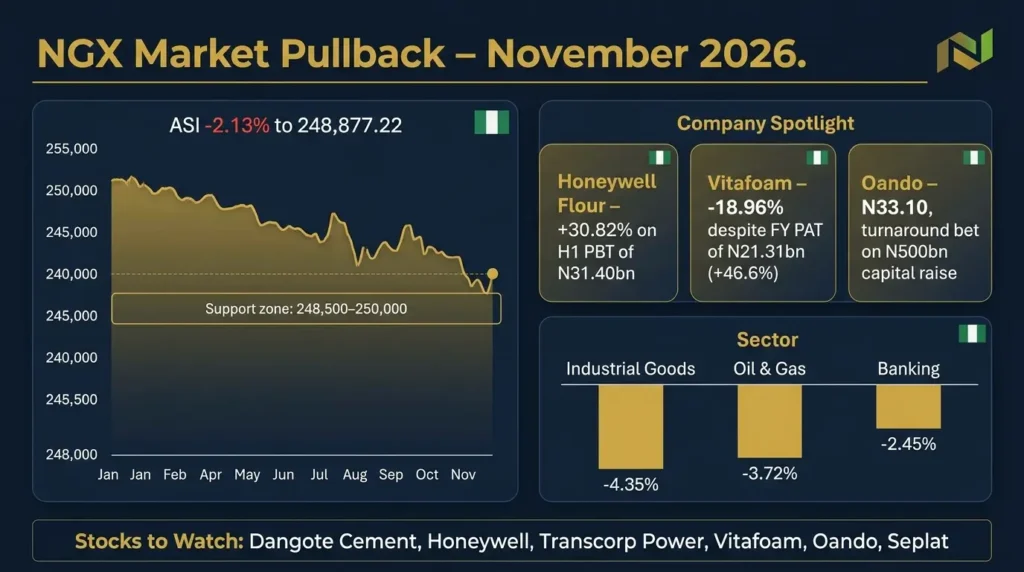
The Nigerian equities market closed the week of November 6, 2026, on a bearish note, with the NGX All-Share Index (ASI) declining 2.13% week-on-week to close at 248,877.22 points . Market capitalisation shed N3.52 trillion to settle at N161.59 trillion, while the year-to-date return moderated to 59.93% from 63.42% the previous week .
This was not a broad panic across every stock—it was a heavyweight-led correction. Market breadth for the week was negative, with 57 decliners against 29 gainers . The decline was driven by sustained profit-taking in large caps, renewed global equity sell-offs, and portfolio rebalancing ahead of year-end.
This NGX market pullback analysis breaks down what drove the decline, the outlook for the new week, the explosive growth in Honeywell Flour, Transcorp Power and E-Tranzact, the Vitafoam paradox, whether Oando is a buy at N33.10, and the stocks to watch.
Let’s examine the NGX market pullback with clarity and strategic discipline.
1. What Drove the 2.13% Pullback?
The ASI dropped from 254,299.49 to 248,877.22 points, wiping N3.52 trillion off market capitalisation . The downturn was driven by five key factors.
Key Drivers of the NGX Market Pullback
| Driver | Impact |
|---|---|
| Profit-Taking in Large Caps | Institutional investors locked in gains after recent rallies, with risk-off sentiment dominating industrial goods and financial counters |
| Global Equity Sell-Off | Renewed sell-offs across global equity markets weighed on domestic sentiment |
| Year-End Portfolio Rebalancing | Investors positioned ahead of the year-end trading period |
| Sector-Wide Weakness | No major sector escaped: Industrial Goods -4.35%, Oil & Gas -3.72%, Banking -2.45%, Consumer Goods -1.41%, Insurance -0.03% |
| Thinning Participation | Turnover collapsed, amplifying moves: 2.829 billion shares worth N208.407 billion vs. 7.619 billion shares worth N637.826 billion the prior week—a fall of 62.87% in volume and 67.33% in value |
The Biggest Weekly Drags
Dangote Cement had rallied 33.12% in October alone before giving back 5.56% last week . The biggest weekly drags were:
- Dangote Cement: -8.50% in one weekly roundup, -5.56% on a Friday-to-Friday comparison
- Aradel Holdings: -9.99%
- HBM Nigeria: -9.70% to -10.00%
- BUA Foods: -8.00%
- First HoldCo: -7.68%
- Access Holdings: -5.94%
On Thursday alone, Dangote Cement and Presco each fell the maximum 10%, dragging the ASI down 1.98% that day .
The Fixed-Income Pull
The CBN held a large OMO auction, offering N1.5 trillion and allotting N2.7 trillion after N5.7 trillion in subscriptions, at stop rates of 17.25%, 16.54% and 15.74% . Treasury bill yields stayed around 17.88%, keeping relatively attractive risk-free returns in competition with equities.
text
       ┌────────────────────────────────────────────────────────┐
       │     NGX MARKET PULLBACK – KEY SIGNALS                  │
       └───────────────────────────┬────────────────────────────┘
                                   │
         ┌─────────────────────────┼─────────────────────────┐
         ▼                         ▼                         ▼
  [ HEAVYWEIGHT SELL-OFF ]  [ WEAK BREADTH ]           [ FIXED-INCOME PULL ]
  Dangote Cement -5.56%     57 decliners vs             OMO at 15.74%–17.25%
  Aradel -9.99%             29 gainers                 T-bills at 17.88%
2. Outlook for the New Week: Cautious and Choppy
The honest picture for the week is cautious and choppy, not a clean rebound or a clean crash.
Base Case: Bargain-Hunting vs. Continued Profit-Taking
After Thursday’s heavy sell-off, persistent sell-side pressure could sustain near-term volatility, although bargain-hunting in oversold heavyweights may provide support. That fits what happened on Friday: the index still fell 0.33%, but breadth actually turned positive at 1.26x (29 gainers versus 23 losers), suggesting some buyers were already picking through the wreckage .
What Will Decide It
Brokers expect trading in the coming week to be shaped by:
- Corporate earnings disclosures and corporate actions — including dividend declarations
- Monetary policy deliberations and signals
- Upcoming debt auctions and fixed-income yields — to see whether high T-bill and bond yields keep pulling liquidity away from equities
Another overhang is a liquidity squeeze from funds committed to the Dangote Petroleum Refinery IPO. The pressure is still being felt despite the close of the offer.
Levels to Watch
Technically, the market is sitting right around a key zone:
| Level | Range | Implication |
|---|---|---|
| Support/Demand Zone | 248,500 – 250,000 | ASI closed Friday at 248,877.22, essentially sitting on support |
| Resistance | 255,000 – 256,950 | A daily close back above 250,000 would argue the correction is stabilising |
| Deeper Pullback Zone | ~245,000 | A break below 248,500 opens room for a deeper pullback |
Earlier analysis before last week’s fall had already warned that chasing breakouts above 255,000 was a near-term risk because daily RSI was in the 68–72 range, lightly overbought. That overbought condition has now been partly worked off by the 2.13% weekly drop.
What Selective Buyers Are Likely to Favour
The pattern from last week was very stock-specific. While heavyweights fell, Honeywell Flour Mills (+30.82%) and Transcorp Power (+23.37%) surged. Expect that selectivity to continue: fundamentally sound names with resilient earnings, strong cash flow and sustainable dividend prospects, rather than a broad market rally.
3. What Is Driving the Growth in Honeywell Flour, Transcorp Power and E-Tranzact?
These stocks were the three clear outliers in a down week, but they were not rising for the same reason. One had a genuine earnings blowout, one was rising on future expectations despite weaker current results, and one was rising despite weaker results.
1. Honeywell Flour — Earnings Turnaround
Week: +30.82% to N29.50, from N22.55
Honeywell filed its half-year results for the six months to September 30, 2026 on October 30, and the market kept repricing it through last week .
| Metric | H1 2026 | H1 2025 | Change |
|---|---|---|---|
| Revenue | N233.79bn | N165.47bn | +41.29% |
| Pre-Tax Profit | N31.40bn | N2.58bn | +1,115.17% |
| Profit After Tax | N22.61bn | N1.62bn | +1,296% |
| Operating Profit | N28.15bn | N3.70bn | +661.81% |
| EPS | N2.85 | N0.20 | — |
Crucially, this was not mainly an FX story. FX gains actually fell to N811 million from N2.22 billion . The improvement came from stronger gross profitability, lower operating expenses, and a swing from net finance expense to net finance income. The biggest swing was at Sagamu, which moved from an operating loss of N6.95 billion to an operating profit of N1.04 billion .
Watch-out: Borrowings rose 60.92% to N52.27 billion, so investors will be watching whether operating cash flow can support capex and reduce reliance on short-term financing.
2. Transcorp Power — Post-Earnings Bets on the Future
Week: +23.37% to N219.60, from N178.00
Transcorp Power’s actual Q3/9-month numbers were mixed-to-down :
- 9M 2026 Revenue: N266.1 billion, down 13.7% from N308.5 billion
- Profit Before Tax: N83.1 billion, down from N91.18 billion
- PBT Margin: Improved to 31.2% from 29.6%
So why did it spike about 10% on Wednesday alone? Investors were staking post-earnings bets on the outlook :
- The company maintained its 2026 guidance despite transmission constraints, gas shortages and equipment delays
- It told investors the outlook improved after the government settled its debt and took measures against vandalism of transmission infrastructure
- It plans a year-end capacity target of 720MW, versus current operating capacity of around 450MW and peak generation of 520MW
- Improved collections, partial settlement of legacy market debts, and reversal of expected credit loss provisions, with cash rising 365% to N10.3 billion
In other words, the market looked past the lower revenue and bought the margin story plus the capacity and collections narrative.
3. E-Tranzact — Momentum/Sentiment, Not Earnings
Week: +14.42% to N18.65, from N16.30; up about 52.87% since end-September
This is the one to be most careful about. The price action and the fundamentals are moving in opposite directions .
| Metric | 9M 2026 | 9M 2025 | Change |
|---|---|---|---|
| Revenue | N20.99bn | N20.11bn | +4.4% |
| Operating Profit | N1.75bn | N3.14bn | -44.4% |
| Profit After Tax | N1.38bn | N2.41bn | -42.7% |
| Q3 PAT | N156.04m | N803.96m | -80.6% |
No single company announcement establishes a direct cause for the rally. Possible sentiment supports, but not proven drivers, include the upcoming 22nd AGM on November 19, 2026, a recent ownership change followed by the appointment of five new directors, and continued investor interest in payments/fintech as a theme.
At N18.65, the stock is trading at a very stretched P/E on trailing earnings of around 119x — any disappointment could reverse the move fast.
4. Why Is Vitafoam Trending Down?
This is the interesting paradox of last week: Vitafoam fell the most precisely when its results looked the strongest.
What Happened to the Price
- Week ended Nov 6: -18.96% to N141.50, from N174.60 — the steepest decline on the NGX that week
- Monday, Nov 2: -9.97% to N157.20
- Tuesday, Nov 3: -9.99% to N141.50
- Past 4 weeks: about -27%
Those two back-to-back ~10% days are important. The NGX has a daily price limit of 10%, so Vitafoam was essentially hitting the maximum allowed down-move two sessions in a row.
But Earnings Were Up, Not Down
Vitafoam reported its full-year results for the year ended September 30, 2026 around Nov 2-3 :
| Metric | FY 2026 | FY 2025 | Change |
|---|---|---|---|
| Profit After Tax | N21.31bn | N14.54bn | +46.6% |
| Revenue | N117.36bn | N111.38bn | +5.4% |
| Gross Profit | N49.40bn | N40.96bn | +20.6% |
| Operating Profit | N33.15bn | N27.28bn | +21.5% |
| Finance Costs | N973.84m | N5.81bn | -83.2% |
| EPS | 1,591 kobo | 1,080 kobo | +47.3% |
Q4 alone was also strong on profit: PAT +55.6% to N7.73 billion, despite Q4 revenue dipping 1% to N28.80 billion .
So Why Is It Falling?
No company-specific negative announcement explains the drop in the trading reports. The most plausible explanation is a combination of four things:
1. Sell-the-news / profit-taking after a huge run. Vitafoam had run from a 52-week low around N65 to a high around N210. When a stock has already priced in a good result, investors who bought early often use the results announcement itself as the exit point to lock in gains.
2. Revenue growth was soft; profit growth was cost-driven. Profit rose 47%, but revenue rose only 5.4%, and Q4 revenue actually fell 1%. The profit jump came mainly from lower cost of sales and a sharp fall in finance costs. Some investors may have been disappointed that top-line growth is not keeping up.
3. It got caught in the broader rotation. Last week was a classic profit-taking week: the ASI fell 2.13%, and selling was concentrated in large- and mid-cap names that had appreciated strongly.
4. Technical/liquidity effect. Once a stock hits -10% two days running, it can trigger further selling: stop-losses, margin pressure, and other holders rushing to exit before the next limit-down day.
Bottom line: Vitafoam is trending down despite strong FY 2026 earnings, not because of weak earnings. The market appears to be repricing it from an overextended level. That does not mean the business has deteriorated — its margins, cash flow and balance sheet actually improved. But the share price had run ahead of the story.
5. Is Oando a Good Buy at N33.10?
At N33.10, Oando is not expensive, but it is not obviously cheap either — because Oando is a turnaround bet on its balance sheet, not a normal value stock.
It closed Friday at N33.10, up 5.08% from N31.50 the prior day . For context, it started the year at N40.20, so it is down about 17.7% year-to-date, and it is trading near its 52-week low of N31.50 versus a high of N56.80.
Whether that is a good buy depends entirely on whether you believe the recapitalisation works.
The Bull Case
1. Operations are genuinely improving. For the 9 months to September 30, 2026 :
| Metric | 9M 2026 | 9M 2025 | Change |
|---|---|---|---|
| Revenue | N2.78 trillion | N2.54 trillion | +9% |
| Gross Profit | N174.5bn | N29.8bn | +483% |
| Operating Profit | N159.7bn | (N109.7bn loss) | Turnaround |
| Production | 42,985 boepd | 37,614 boepd | +14% |
| Facility Uptime | 96.1% | 85% | +11.1pp |
| Production Op. Cost | $15.39/boe | — | -22% |
| Cash from Operations | N285bn | — | — |
The 7-well drilling programme is progressing, with Idu 6ST and Idu 15 already completed and on stream. On completion, it is expected to add 16,000–20,000 boepd gross .
2. The asset base is large. After the 2024 NAOC acquisition, 2P reserves stand at 920 MMboe, about 61% gas, implying a very long reserve life.
3. Deleveraging has started. Total borrowings fell to N2.16 trillion, 22% below the end-2024 peak, while net debt fell to N1.99 trillion.
The Bear Case — and This Is the Real Question
1. Debt costs are wiping out the operating recovery. Despite the operating turnaround, Oando swung to a pre-tax loss of N74.7 billion in 9M 2026, versus a N19.5 billion profit a year earlier . Net finance costs reached N235.2 billion, including N218.6 billion in bank interest alone. Interest alone was close to 3x gross profit.
2. Q3 itself was weaker. Q3 revenue fell 13.2% to N712.6 billion, and Q3 PAT fell 72.5% to N37.9 billion from N138 billion a year earlier.
3. Negative equity and dilution risk. There are forecasts that book value will remain negative until FY29 without the capital raise . Management’s plan is a N500 billion capital raise, including a N200 billion rights issue, plus conversion of $300 million of reserve-based lending into equity, plus a planned up to $1.5 billion bond programme. SEC approval is still pending for the rights issue.
4. Oil price and execution risk. The value is in barrels, not trading revenue. Trading is ~86% of revenue but razor-thin margin. The thesis needs production to keep rising toward 100,000 boepd over 4–5 years, and oil prices to cooperate.
So, Is N33.10 a Good Buy?
| Investor Profile | Verdict | Rationale |
|---|---|---|
| Conservative / Dividend / Low-Risk | No | No dividend capacity until the balance sheet is repaired; negative equity, pre-tax loss, and pending dilution |
| Speculative / High-Risk, Long-Horizon | Possibly, as a small position | At N33.10, you are paying near the year’s low for a company whose operations have turned, whose reserves are large, and whose main problem is financing, not geology |
What to watch before adding aggressively:
- SEC approval and terms of the rights issue — price and dilution
- Progress on the $300 million RBL-to-equity conversion
- Q4 production and whether the drilling programme delivers the extra 16,000–20,000 boepd
- Finance costs in Q4 — are they actually falling?
- Oil price and naira stability
A disciplined way to play it, if you like the story, is to stage in rather than go all-in at N33.10: a starter position now, with room to add only on evidence that the capital raise is approved on acceptable terms and finance costs are falling.
6. Stocks to Watch
1. The Index Deciders — If These Fall, the ASI Falls
If Dangote Cement and Aradel stabilise, the ASI has a chance to hold. If they break lower again, expect another broad down-leg.
2. The Momentum Survivors — Can They Keep Running?
3. The Oversold Bounce Candidates
4. Dividend Calendar — Mechanical Moves This Week
| Stock | Event | Date |
|---|---|---|
| Ikeja Hotel | Ex-dividend | Nov 9, 2026 |
| Seplat Energy | Qualification Nov 12; ex-dividend Nov 11 (LSE) / Nov 13 (NGX); payment ~Nov 27. Combined interim + special dividend of 19 US cents per share | Nov 11–13 |
| Okomu Oil Palm | Ex-dividend Nov 12; dividend N11.50, payment Nov 17 | Nov 12 |
| Guinness Nigeria | Interim dividend N7.00, payment Nov 13 | Nov 13 |
| Berger Paints | 50-kobo interim; qualification Nov 12, payment Nov 20 | Nov 12 |
| Unilever Nigeria | N2 interim dividend, payment Nov 18 | Nov 18 |
Watch Seplat and Okomu especially — they are large enough to move their sectors, and dividend qualification often creates short-term buying, then a post-qualification dip.
7. Action Plan for Investors
Step 1: Watch the support zone.
The ASI closed at 248,877.22, essentially sitting on support. A daily close back above 250,000 would argue the correction is stabilising. A break below 248,500 opens room for a deeper pullback toward 245,000.
Step 2: Separate earnings-backed rallies from sentiment-driven ones.
Honeywell’s surge is supported by a genuine earnings blowout. E-Tranzact’s rally is not — its 9M PAT fell 42.7%. Know which is which.
Step 3: Do not chase Vitafoam’s bounce blindly.
The stock fell despite strong earnings. The question is whether buyers return after the limit-down selling, not whether the results were good.
Step 4: Treat Oando as a speculative position, not a core holding.
The turnaround is real operationally, but the balance sheet remains the swing factor. Stage in, do not go all-in.
Step 5: Monitor fixed-income yields.
T-bill yields at 17.88% continue to compete with equities. Watch whether the CBN’s next OMO auction pulls more liquidity away from stocks.
Step 6: Track dividend qualification dates.
Seplat (Nov 12) and Okomu (Nov 12) are the key dates this week.
8. Final Summary & The Bottom Line
The NGX market pullback was a heavyweight-led correction, not a broad panic. Dangote Cement, Aradel, and HBM Nigeria dragged the index down, while Honeywell Flour and Transcorp Power defied the sell-off.
text
  ┌──────────────────────────────────────────────────────────┐
  │        NGX MARKET PULLBACK – KEY TAKEAWAYS                │
  ├─────────────────────┬────────────────────────────────────┤
  │ Weekly Performance  │ ASI -2.13% to 248,877.22 points   │
  ├─────────────────────┼────────────────────────────────────┤
  │ Market Cap Loss     │ N3.52 trillion to N161.59 trillion│
  ├─────────────────────┼────────────────────────────────────┤
  │ Breadth             │ 57 decliners vs 29 gainers        │
  ├─────────────────────┼────────────────────────────────────┤
  │ Biggest Drags       │ Dangote Cement -5.56%, Aradel     │
  │                     │ -9.99%, HBM -10%                  │
  ├─────────────────────┼────────────────────────────────────┤
  │ Top Gainers         │ Honeywell +30.82%, Transcorp      │
  │                     │ Power +23.37%, E-Tranzact +14.42% │
  ├─────────────────────┼────────────────────────────────────┤
  │ Support Zone        │ 248,500 – 250,000                 │
  ├─────────────────────┼────────────────────────────────────┤
  │ Resistance          │ 255,000 – 256,950                 │
  └─────────────────────┴────────────────────────────────────┘
The Bottom Line:
The week favours selective bargain-hunting in oversold quality names, not aggressive buying. The ASI is sitting on support. If buyers defend 248,500–250,000, expect mixed, sideways-to-mildly-positive trading with rotation into beaten-down quality names. If selling resumes and that zone breaks, expect another leg of profit-taking before bargain hunters step in more aggressively.
For more weekly NGX updates and strategy guides, explore our market trends and analysis archive.
Disclaimer: This article is for informational purposes only and does not constitute investment advice. Always conduct your own research or consult a qualified financial advisor before investing. Past performance does not guarantee future results.