
Building Your NGX Portfolio: Turn Knowledge into Action (Module 6)
By Market Formula Editorial Team / August 2026
Introduction
You have learned about the NGX, opened your brokerage account, mastered fundamental analysis, understood technical timing, and built a stock selection framework. Now comes the moment of truth: turning all that knowledge into an actual portfolio.
This is the module where theory becomes action. Building a portfolio is not about randomly picking a few stocks and hoping for the best. It is about structured decision-making—knowing how much to invest, how many stocks to hold, when to buy, when to sell, and how to track your performance against the market.
The Nigerian stock market has delivered exceptional returns in 2026. The NGX All-Share Index is hovering around 247,000 points, approaching record highs, with market capitalisation at approximately N158.3 trillion after a robust seven-month growth. The market has delivered a 57.7% year-to-date return as of late July 2026, with investors gaining approximately N58.9 trillion in seven months.
Yet beneath this stellar performance lies a critical reality: building a portfolio is different from picking individual stocks. A collection of great stocks does not automatically make a great portfolio. You need structure, discipline, and a system for managing risk.
This module equips you with a complete NGX portfolio building guide—from determining your starting capital to constructing a diversified portfolio, knowing when to buy and sell, and tracking your performance against the market.
If you haven’t already, start with Module 1 – NGX Basics, Module 2 – Investor Toolkit, Module 3 – Fundamental Analysis, Module 4 – Technical Analysis, and Module 5 – How to Pick NGX Stocks before diving into this module.
Let’s build your portfolio from the ground up.
1. How Much Money Do You Actually Need to Start?
One of the most common questions beginners ask is: “How much money do I need to start investing on the NGX?” The honest answer is: less than you think—but more than a token amount if you want to build real wealth.
Minimum Realistic Starting Capital
Some digital brokers let you begin with around ₦10,000, and several apps allow entry points as low as ₦1,000. However, while you can technically start with ₦1,000, the practical reality is different.
Here is why starting with too little can be counterproductive:
Transaction costs eat into small trades. When you buy and sell shares, you pay a combination of fees: brokerage commission, SEC fees, NGX fees, CSCS fees, stamp duty, and VAT. For a typical NGX trade, analysts estimate that you need roughly a 4.5 percent margin just to break even once all fees are added. That means a stock must rise about 4.5% before you make a single naira of profit on a quick buy-and-sell.
Small positions limit diversification. With ₦10,000, buying even two stocks means putting ₦5,000 in each—and after fees, you have even less working capital.
Why ₦50,000–₦100,000 Is a Workable Starting Point
For a serious beginner looking to build real wealth, ₦50,000 to ₦100,000 is a realistic starting point. Here is why:
| Starting Capital | What You Can Do | Considerations |
|---|---|---|
| ₦1,000–₦10,000 | Buy 1–2 stocks | Fees consume a large percentage; limited diversification |
| ₦50,000–₦100,000 | Buy 3–5 stocks | Reasonable diversification; fees are a smaller percentage |
| ₦250,000+ | Build a proper portfolio | Full diversification across sectors |
Practical example: If you invest ₦50,000 across 5 stocks (₦10,000 each), the fees on each trade are a manageable percentage of your capital. If you invest ₦5,000 in a single stock, the fees could represent 2–3% of your investment before you even start.
How to Build Up Gradually vs. Lump-Sum Investing
Lump-sum investing means putting all your capital into the market at once. This works well if you already have the cash saved and you are confident in your stock selections.
Gradual building (Dollar-Cost Averaging) means investing smaller amounts regularly—say, ₦10,000–₦20,000 per month. This approach:
- Reduces the risk of buying at a market peak
- Allows you to average your entry price over time
- Builds the habit of consistent investing
- Is more accessible for investors with regular income
The recommended approach for beginners: Start with a lump sum of ₦50,000–₦100,000 to build your core positions, then add ₦10,000–₦20,000 monthly to gradually increase your exposure.
2. Portfolio Construction Basics
Building a portfolio is not about randomly picking stocks. It is about structured diversification that balances risk and return.
How Many Stocks to Hold
For a starter portfolio, 5 to 10 stocks is the sweet spot.
| Number of Stocks | Pros | Cons |
|---|---|---|
| 1–2 | Easy to track | High concentration risk—one bad stock wrecks your portfolio |
| 3–5 | Manageable; reasonable diversification | Still concentrated; one sector downturn hurts |
| 5–10 | Good diversification; manageable tracking | Requires more research time |
| 10+ | Excellent diversification | Hard to track; may dilute returns |
The NGX portfolio building guide recommends starting with 5–8 stocks and expanding as your capital grows and your research capability improves.
Sector Diversification to Reduce Concentration Risk
The single most important rule of portfolio construction is: do not put all your eggs in one basket.
In 2026, the NGX has seen significant sector concentration. The top 10 most valuable companies account for approximately 70.73% of the NGX’s total equity market capitalisation. This means that if you only buy the largest stocks, you are heavily concentrated in a few companies.
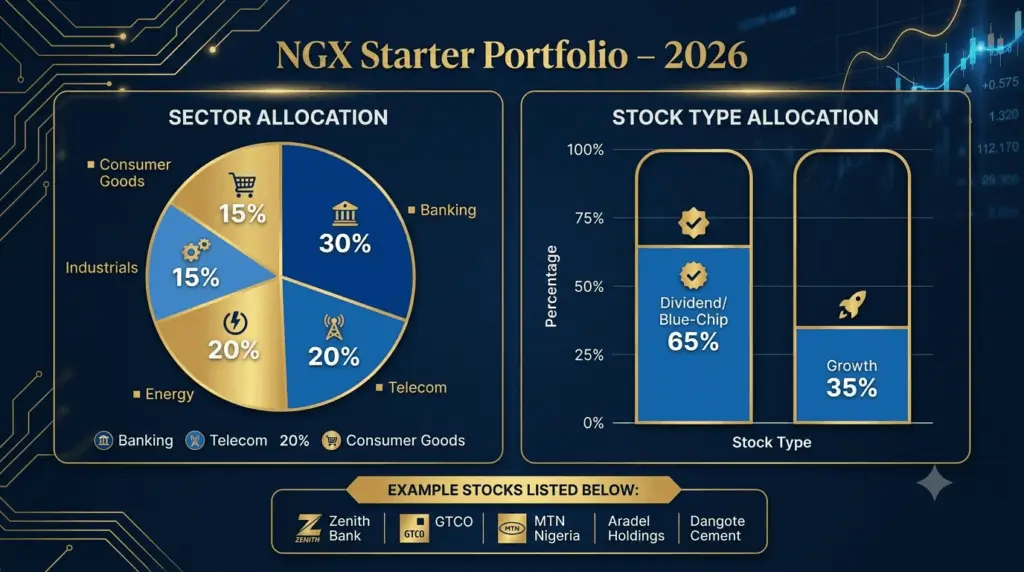
A well-diversified 2026 portfolio should have exposure to:
| Sector | Why Include It | Example Stocks |
|---|---|---|
| Financials | Stability, dividends, high interest rate environment | Zenith Bank, GTCO, Access Holdings |
| Energy | Dollar-denominated revenue, inflation hedge | Seplat Energy, Aradel Holdings |
| Industrials | Infrastructure spending, inflation protection | Dangote Cement |
| Telecom | Digital Nigeria, data revenue growth | MTN Nigeria, Airtel Africa |
| Consumer Goods | Defensive, essential products (but naira-sensitive) | Nestlé Nigeria (cautious) |
Sector performance context (as of mid-2026):
| Sector | Year-to-Date Performance |
|---|---|
| Oil & Gas | Strong performance; 96.80% YTD |
| Industrial Goods | Strong performance; 88.73% YTD |
| Banking | Solid performance; 41.78% YTD |
| Insurance | Weaker performance; -4.74% YTD |
How to Balance Dividend Income Stocks vs. Growth Stocks
Your portfolio should include both dividend income stocks and growth stocks.
| Type | Characteristics | Best For |
|---|---|---|
| Dividend Stocks | Regular cash payments, stable prices, lower growth | Income-focused investors, retirees, beginners |
| Growth Stocks | Reinvest profits, higher potential returns, more volatile | Long-term wealth builders, younger investors |
Recommended allocation for a starter portfolio:
- 60–70% dividend/blue-chip stocks – Stability and income
- 30–40% growth stocks – Higher potential returns
Example starter portfolio (₦100,000):
| Stock | Sector | Allocation | Type |
|---|---|---|---|
| Zenith Bank | Banking | ₦20,000 | Dividend/Blue-chip |
| GTCO | Banking | ₦20,000 | Dividend/Blue-chip |
| MTN Nigeria | Telecom | ₦20,000 | Dividend/Growth |
| Aradel Holdings | Energy | ₦20,000 | Growth |
| Dangote Cement | Industrial | ₦20,000 | Dividend/Blue-chip |
3. When to Buy, When to Hold, When to Sell
Knowing when to enter and exit positions is one of the most challenging aspects of investing. This section provides clear signals for each decision.
Buy Signals: The Perfect Entry
A high-probability buy setup occurs when three conditions align:
1. Fundamentally Strong
The company passes the NAIRA framework test:
- Growing revenue and profit consistently
- Healthy balance sheet with manageable debt
- Consistent dividend payments
- Competitive advantage (moat)
- Trustworthy management
2. Technically Oversold
The stock is trading at a favorable price level:
- Approaching a well-established support level on the weekly chart
- RSI on the daily chart is in the 30–50 range (not overbought)
- Volume has declined during the pullback (weak selling)
- A reversal candlestick pattern (hammer, bullish engulfing) appears with volume
3. Positive Sector Outlook
The sector is not facing severe headwinds:
- The sector is in a favorable position in the current economic cycle
- No major regulatory threats
- Earnings expectations are positive
When all three align, you have a high-probability entry.
Hold Signals: When to Stay Put
Once you are in a position, you should hold as long as:
- The fundamental thesis remains intact – The company is still growing revenue and profit, paying dividends, and maintaining a healthy balance sheet
- The price dip is temporary – A 15–30% pullback in a volatile month like June is often just “market noise”
- The sector outlook remains positive – No major structural changes affecting the industry
The key principle: If the company’s business fundamentals haven’t changed—if they are still profitable and paying dividends—holding your position is often the smartest move.
Sell Signals: When to Exit
There are four clear reasons to sell a position:
1. Fundamentals Deteriorate
- Revenue or profit is consistently declining
- Margins are shrinking significantly
- Debt is rising faster than assets
- The company is losing market share
2. Dividend Cut or Suspension
- The company reduces or eliminates its dividend
- This is often a sign of financial distress
- Exception: If the company is reinvesting for growth and has a clear plan
3. Management Scandal or Governance Issues
- Regulatory fines or sanctions
- Related-party transactions benefiting directors
- Frequent changes in auditors
- Qualified audit opinions
4. Better Opportunity Elsewhere
- You have identified a fundamentally stronger company at a better price
- You are rebalancing to improve diversification
- You need cash for a compelling new opportunity
4. Tracking Your Portfolio Performance
Once your portfolio is built, you need to track its performance. This is not about checking prices daily—it is about measuring whether your strategy is working.
How to Calculate Your Actual Return (Including Dividends)
Many beginners only track price appreciation. This is a mistake. Total return includes both capital gains and dividends.
Total Return Formula:
Total Return = (Ending Value – Starting Value + Dividends Received) ÷ Starting Value × 100
Example:
- Starting Value: ₦100,000
- Ending Value: ₦115,000
- Dividends Received: ₦5,000
- Total Return = (115,000 – 100,000 + 5,000) ÷ 100,000 × 100 = 20%
Note: Dividends in Nigeria are paid net of 10% withholding tax, which is automatically deducted before payment.
Benchmarking Against the NGX All-Share Index
Your performance should always be measured against the market.
| Your Return | ASI Return | Verdict |
|---|---|---|
| 25% | 15% | You outperformed the market |
| 15% | 15% | You matched the market |
| 10% | 15% | You underperformed the market |
The ASI is your benchmark. If your portfolio grew by 8% but the ASI grew by 20%, you actually underperformed the market. If the ASI fell by 10% but your portfolio only fell by 3%, you did an excellent job of protecting your capital.
Using the Excel Screener for Ongoing Monitoring
Your Excel Screener is not just for initial analysis—it is a powerful monitoring tool.
How to use it for ongoing tracking:
- Update quarterly – After each earnings season, input the latest financial data
- Track ratio changes – Is the P/E ratio rising or falling? Is ROE improving or declining?
- Identify warnings – A deteriorating debt-to-equity ratio or shrinking margins is an early warning
- Re-evaluate your thesis – If the numbers no longer support your original thesis, consider selling
The T+1 Settlement Cycle
From June 1, 2026, the NGX moved to a T+1 settlement cycle, meaning trades now settle one business day after the trade date rather than three. This has important implications:
- Faster access to cash – When you sell, you get your money faster
- Quicker portfolio adjustments – You can redeploy capital more quickly
- Higher volatility – Panic selling can happen faster
5. Understanding NGX Trading Rules in 2026
The NGX has introduced significant changes to how stock prices move in 2026. Understanding these rules is essential for any NGX portfolio building guide.
The New Tiered Pricing Framework
Under a new set of NGX rules approved by the SEC on June 16, 2026, shares are now categorised into three groups based on their current share price.
| Group | Price Range | Minimum Shares to Change Price | Tick Size |
|---|---|---|---|
| Group A | N1,000 and above | 10,000 shares | 10 kobo |
| Group B | N500 – N999 | 50,000 shares | 5 kobo |
| Group C | Below N500 | 100,000 shares | 1 kobo |
What This Means for You:
- Group A stocks (Seplat, Airtel Africa, Dangote Cement, Presco, Aradel, Okomu Oil, Geregu, etc.) now require 90% less capital to trigger a price movement than under the old rule
- Group C stocks (GTCO at N128.35, for example) require 100,000 shares to move the price, with 1 kobo increments
Practical implication: This reform is about ensuring that share prices move in response to genuine and meaningful market activity, not isolated transactions of a handful of investors.
The T+1 Settlement Cycle
Effective June 1, 2026, the NGX became the first market in Africa to implement a one-day settlement framework for equities and commodities.
What this means: When you sell a stock, the transaction is finalized within one business day, not three. This increases liquidity and speeds up capital turnover.
Expanded Trading Hours
Effective April 27, 2026, the NGX adjusted its opening bell to 9:00 a.m. and extended the closing gong to 4:00 p.m., nearly doubling its daily activity window to seven hours.
6. Action Plan: Building Your NGX Portfolio
Now that you understand the NGX portfolio building guide, here is your practical action plan.
Step 1: Determine your starting capital.
Aim for ₦50,000–₦100,000 as a realistic starting point. If you have less, start with what you have and build gradually.
Step 2: Choose 5–8 stocks.
Use the NAIRA framework from Module 5 to identify quality companies. Include a mix of sectors: banking, energy, telecom, and industrials.
Step 3: Allocate your capital.
Spread your investment across your chosen stocks. Aim for roughly equal weightings (e.g., ₦10,000–₦20,000 each).
Step 4: Wait for good entry points.
Use the buy signals from Section 3—fundamentally strong + technically oversold + positive sector outlook.
Step 5: Enter your positions.
Use limit orders to control your entry price. Consider dollar-cost averaging if you are unsure about timing.
Step 6: Monitor quarterly.
Update your Excel Screener after each earnings season. Track your total return against the ASI.
Step 7: Re-evaluate annually.
Review each position annually. Sell if the fundamentals have deteriorated or a better opportunity exists.
7. Module 6 — Quick Summary
| Concept | What You Now Know |
|---|---|
| Minimum starting capital | ₦50,000–₦100,000 is workable; ₦1,000–₦10,000 is possible but fees are a bigger drag |
| Number of stocks | 5–8 for a starter portfolio |
| Sector diversification | Include banking, energy, telecom, industrials |
| Balancing dividends vs. growth | 60–70% dividend/blue-chip, 30–40% growth stocks |
| Buy signals | Fundamentally strong + technically oversold + positive sector outlook |
| Sell signals | Fundamentals deteriorate, dividend cut, scandal, better opportunity |
| Total return | Capital gains + dividends received |
| Benchmark | NGX All-Share Index – measure your performance against it |
| T+1 settlement | Trades settle in 1 business day (effective June 1, 2026) |
| New pricing rules | 3-tier system: Group A (10,000 shares), Group B (50,000), Group C (100,000) |
8. Final Summary & The Bottom Line
Building a portfolio on the NGX is a structured process that requires discipline, research, and patience. The NGX portfolio building guide provides a complete framework—from determining your starting capital to constructing a diversified portfolio, knowing when to buy and sell, and tracking your performance against the market.
text
  ┌──────────────────────────────────────────────────────────┐
  │          NGX PORTFOLIO BUILDING – KEY TAKEAWAYS          │
  ├─────────────────────┬────────────────────────────────────┤
  │ Starting Capital    │ ₦50,000–₦100,000 is workable;     │
  │                     │ start smaller and build gradually │
  ├─────────────────────┼────────────────────────────────────┤
  │ Portfolio Size      │ 5–8 stocks for a starter portfolio│
  ├─────────────────────┼────────────────────────────────────┤
  │ Diversification     │ Banking, energy, telecom,         │
  │                     │ industrials, consumer goods       │
  ├─────────────────────┼────────────────────────────────────┤
  │ Buy Signals         │ Fundamentals + Technicals +       │
  │                     │ Sector Outlook aligned            │
  ├─────────────────────┼────────────────────────────────────┤
  │ Sell Signals        │ Deteriorating fundamentals,       │
  │                     │ dividend cuts, scandals           │
  ├─────────────────────┼────────────────────────────────────┤
  │ Performance         │ Track total return (capital       │
  │                     │ gains + dividends) vs. ASI        │
  └─────────────────────┴────────────────────────────────────┘
The Bottom Line:
The NGX is hovering near record highs at approximately 247,000 points, with market capitalisation at N158.3 trillion and year-to-date returns exceeding 57%. The banking recapitalisation has strengthened the sector, and the T+1 settlement cycle has made the market more efficient.
The most successful NGX investors are not those who trade frequently or chase the hottest tips. They are those who build a diversified portfolio of quality companies, buy at favourable prices, collect dividends year after year, and hold patiently while others panic in and out.
The NGX portfolio building guide gives you the structure to do exactly that.
Your Next Steps:
- Determine your starting capital – Aim for ₦50,000–₦100,000 if possible
- Choose 5–8 stocks – Use the NAIRA framework from Module 5
- Wait for good entry points – Use buy signals from Section 3
- Monitor quarterly – Update your Excel Screener and track total return vs. ASI
- Stay disciplined – Hold quality companies through temporary volatility
For more weekly NGX updates and strategy guides, explore our market trends and analysis archive.
Disclaimer: This article is for informational purposes only and does not constitute investment advice. Always conduct your own research or consult a qualified financial advisor before investing. Past performance does not guarantee future results.